Mg9, Mg11 - Circle intersections, chords and tangents
Use the circle properties in Mg11 to connect geometric reasons with coordinate calculations. Then apply Mg9 to find line–circle intersections and recognise tangency through a repeated root, with exact working where a question requires it.
Diameters and right angles
Can a line that meets a circle at one point be identified by algebra alone? For , compare with . They are parallel, but one touches and the other cuts the circle. Circle geometry will explain the difference before we count roots.
Here is a striking starting fact: every triangle whose longest side is a diameter and whose third vertex is on that circle is right-angled. The vertex can wander around the circumference; the angle stays fixed.
You already know
The centre of a diameter is its midpoint. Squared distance between points is . For finite non-zero gradients, perpendicular lines satisfy .
The condition “on that circle” is essential: points inside it do not generally make a right angle.
Angle in a semicircle
If is a diameter and is a different point on the same circumference, then . A chord that misses the centre is not a diameter.
Join the centre to . The two pairs of equal radii form isosceles triangles. With their base angles labelled and , the large triangle's angles are , , . Thus . The other semicircle follows by reflection. The theorem is not in the formula sheet: learn it.
Worked example 1: justify the right angle
Question. and are diameter endpoints. Show that lies on the circle and determine .
Plan. Locate the centre, verify the radius-distance and use the diameter theorem.
Why this step? Membership of the circle is the missing condition that makes the theorem applicable.
Answer. lies on the circle and .
Check. , , , so Pythagoras agrees.
Keep the diameter and change only the position of , from the top to the bottom of the circle.
Worked example 2: the other semicircle
Question. For the same diameter, show that lies on the circle and determine .
Plan. Repeat the membership check; the theorem works on either side of the diameter.
Why this step? The sign of the vertical displacement does not affect its squared length.
Answer. is on the circle and the angle is .
Check. and ; their product is .
The diameter's endpoints themselves are excluded as third vertices because they would not form a triangle.
Watch out
Wrong: “The line is long, so the angle opposite it is right.” Right: identify a diameter and verify that the third point lies on its circle.
Try another circle with a lower-semicircle point.
Chords and perpendicular bisectors
A chord is a straight segment joining two points on a circle. Its midpoint lies on the perpendicular from the centre.
Centre-perpendicular to a chord
The perpendicular from a circle's centre to a chord bisects the chord. Conversely, the perpendicular bisector of a chord passes through the centre.
If is perpendicular to , right triangles and share and have equal hypotenuses, the radii. Their congruence gives . This is why one right triangle is enough.
Length of a chord
For radius and perpendicular centre-distance ,
At the chord collapses to a tangent point; gives no chord. Not in the formula sheet: learn it.
Distance means the shortest, perpendicular distance. A sloping segment to an arbitrary point of the chord will not do.
Worked example 3: from distance to length
Question. A circle has radius . A chord is units from its centre. Find its length.
Plan. Find half the chord using Pythagoras, then double.
Why this step? The perpendicular meets the chord at its midpoint, so the right triangle contains only half of it.
Answer. The chord length is .
Check. .
Change only the centre-distance, from to ; the radius remains .
Worked example 4: moving towards the circumference
Question. Find the chord length when the centre-distance is .
Plan. Use the same right-triangle construction.
Why this step? A chord nearer the circumference is shorter, providing a useful sense-check.
Answer. The chord length is .
Check. , and as expected.
A diameter is the limiting central chord: putting gives .
Watch out
Wrong: a chord with half-length has length . Right: state the full length . The common error is forgetting the second congruent triangle.
Move a chord in a different circle towards its boundary.
A radius determines the tangent
A tangent is perpendicular to the radius at its point of contact. Once the point is known, you can find its equation without calculus.
[DIAGRAM: asset_name: A bisected chord and a perpendicular tangent; caption: A bisected chord and a perpendicular tangent; asset_slug: h640-chord-tangent; description: Equal-scale circles of radius 5 show chord y equals 3 bisected by OM at 0 comma 3, and a tangent 3x plus 4y equals 25 at P 3 comma 4 perpendicular to radius OP]
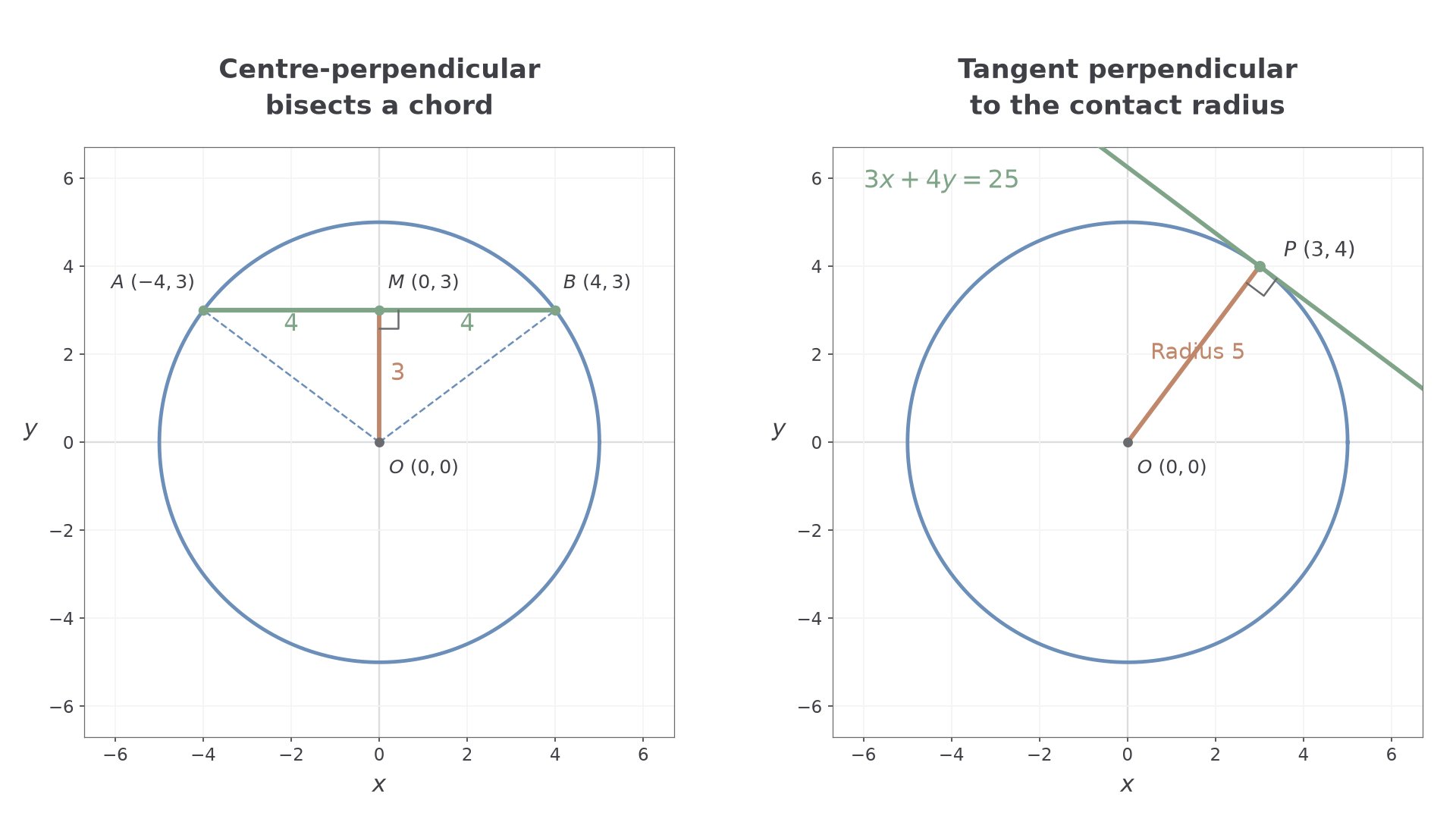
On the right, every other point of the perpendicular line is farther from than is: the radius is one leg of a right triangle. That explains why the line meets the circle only at .
Radius and tangent gradients
For a finite non-zero radius gradient ,
A horizontal radius gives a vertical tangent; a vertical radius gives a horizontal tangent. Not in the formula sheet: learn it.
Begin with the useful translated circle from coordinate geometry; its centre is not the origin.
Worked example 5: a sloping tangent
Question. Determine the tangent at to .
Plan. Check the point, find the radius gradient, then form the perpendicular through it.
Why this step? The slope measured from the origin would be the slope of the wrong radius.
Answer. .
Check. The line contains , and .
Change only the point of contact to the rightmost point of the same circle. The gradient calculation now needs a geometric boundary case.
Worked example 6: a vertical tangent
Question. Determine the tangent at to the same circle.
Plan. Recognise the horizontal radius and use its perpendicular direction.
Why this step? An undefined tangent gradient is not a failure of the geometry; it tells you to use a vertical line equation.
Answer. .
Check. Substitution into the circle gives , so is its only intersection.
At the top point , the same reasoning gives : a vertical radius has a horizontal tangent.
Watch out
Wrong: a vertical tangent must be . Right: a vertical line fixes , so the tangent at is .
The next point is on the opposite side of the same circle.
Line–circle intersections and tangency
Substitution gives a second, algebraic explanation of tangency. It also finds intersection coordinates when the line cuts across the circle.
The intersection quadratic
After valid line substitution into a non-degenerate circle, the quadratic discriminant decides the number of distinct real intersections:
The one-point case is a tangent. Not in the formula sheet: learn it.
Use exact algebra to establish a result when MEI asks for detailed reasoning. A plot suggests a count; it does not prove a repeated root.
Worked example 7: the cutting line
Question. Find the intersections of with .
Plan. Express in terms of , substitute and solve the quadratic.
Why this step? Multiplying by clears the squared denominator; multiplying by would not.
Answer. gives , and gives . The points are , .
Check. The latter point gives and .
Now change only the line's constant from to . This is the second line in the opening question.
Worked example 8: the tangent line
Question. Show that is tangent to , and find the contact point.
Plan. Show that substitution produces one repeated root.
Why this step? The squared factor establishes a single distinct real intersection, which is the condition for tangency.
Answer. The line is tangent at .
Check. The radius gradient is ; the line gradient is , so geometry confirms the algebra.
More generally, substituting gives . Its discriminant is . Hence gives two intersections, gives tangency and gives none. The negative tangent is real too: the circle has two parallel supporting lines, one on each side. A vertical line can instead be substituted directly for .
Exam tip
For “Show that” and the detailed-reasoning instruction, display the equation that establishes the given result. Writing only “one calculator root” does not explain why the line is tangent.
Keep the same family but move beyond the tangent.
Quick Recap
- The right angle in a semicircle requires a diameter and a third point on the circumference.
- The centre-perpendicular bisects a chord, so Pythagoras gives half its length.
- A tangent is perpendicular to its radius; treat vertical and horizontal cases geometrically.
- Line substitution produces a quadratic: two distinct roots, a repeated root or no real roots match the three intersection cases.
The opening lines behave differently because gives , touching at , whereas gives two distinct intersection points.