Mn4, Mn5 - Connected particles, strings and pulleys
Choosing a system is part of the mathematics. You will model connected particles, form equations for individual bodies, and use the connection to link their motions. Comparing whole-system and separate-body answers gives a useful check on tension, acceleration and changes of stage.
What a string and pulley model imposes
Can two connected particles have the same acceleration magnitude while accelerating in opposite directions? Hang two equal particles over a pulley: each can balance with tension . Replace just one mass by a heavier one, and that equilibrium no longer works. One particle accelerates down while the other accelerates up, yet the taut string still links their journeys.
You already know
A force diagram shows the forces acting on one chosen body. For fixed mass, the resultant is ; zero resultant means equilibrium or uniform straight-line motion.
Before writing equations, separate assumptions about the forces from assumptions about the motion.
Ideal connection
A light string has negligible mass. An inextensible string has fixed length. For a taut light string over a fixed smooth ideal pulley, use one tension magnitude. In a simple arrangement with one straight segment per particle, one segment lengthens by as much as the other shortens, giving equal speed and acceleration magnitudes along the strings. A slack string has zero tension.
Smoothness removes pulley friction; the ideal string and pulley assumptions permit common tension. Inextensibility gives the length constraint. Neither assumption makes tension equal to a particle's weight. Tension pulls each body towards its adjacent string segment, even if that body's acceleration points the other way.
You can choose one positive direction downwards and the other upwards, then use the same signed acceleration scalar in both equations. A negative answer means the acceleration opposes your chosen directions. For vehicles translating together along one straight track, the acceleration vectors themselves are equal.
Decide which forces cross your chosen system boundary. Coupling forces are internal to an engine-plus-carriage system but external to either vehicle alone. For hanging particles, adding equations along the respective string directions cancels tension algebraically; the two particles are not one body translating with a common vector. A vector system including the bent string also has an external support force from the pulley.
Key idea
Write the connection constraint as well as the force equations: equal acceleration magnitudes do not require equal acceleration vectors.
These ideal-connection rules are not in the formula sheet. Here is a quick test of which assumption supplies which information.
A whole train and its individual vehicles
A required acceleration lets you work backwards to the drive and the coupling force.
A taut light inextensible coupling pulls the carriage forwards and the engine backwards, maintaining fixed separation and common acceleration. Add the individual equations to eliminate that internal force. Then isolate the carriage to recover it. Resistances on both vehicles stay in the whole-train equation.
Translating train
On a horizontal track, with forwards positive,
The third equation is the sum of the first two, for vehicles with the same acceleration and fixed masses.
Not in the formula sheet: learn it.
A numerical answer should make sense in both individual equations, not just their sum.
Worked example 1: prescribing the acceleration
Question. A engine pulls a carriage on a horizontal track through a taut light inextensible coupling. Resistances are and , respectively. Find the drive and tension needed for acceleration forwards.
Plan. Use the whole train for drive, then the carriage for tension.
Why choose these systems? The whole train removes the unknown tension; the carriage then contains only one unknown force.
Answer. Drive is ; tension is .
Check. For the engine, .
Change only the required signed acceleration. The train is still travelling forwards, so its resistance directions do not reverse when it slows.
Worked example 2: slowing while travelling forwards
Question. The same train now needs acceleration , with forwards positive. Find the required drive and tension.
Plan. Keep the force directions but insert the negative acceleration.
Why this step? Acceleration describes a change of velocity, so forward motion can coexist with a backward resultant.
Answer. Drive is ; tension is .
Check. . The positive tension is compatible with a taut flexible coupling.
A rigid link can push as well as pull. A flexible coupling cannot: if the calculation requires negative tension, the assumed taut flexible model fails.
Watch out
Wrong: reverse resistance because . Correct: resistance opposes the actual motion; determine that direction from velocity, then use signed acceleration in the equation.
Try a different engine and carriage, still moving forwards while slowing.
Two hanging particles and compatible signs
Separate equations show precisely when common tension is greater or smaller than a particle's weight.
For masses and , take the first mass downwards and the second upwards as positive. You need not know the final acceleration sign before starting.
Compatible hanging-particle equations
For a taut light inextensible string over a fixed smooth ideal pulley,
The last equation follows by addition; tension must be found from an individual particle equation.
Not in the formula sheet: learn it.
Equal masses make the driving difference zero. This includes rest, but also uniform motion if the particles already have compatible non-zero velocities.
Worked example 3: a balanced pair
Question. Two masses are released from rest on opposite sides of a fixed smooth ideal pulley, connected by a taut light inextensible string. Use . Find signed acceleration with the left mass down positive, tension, and the initial motion. Give non-exact final values to significant figures.
Plan. Write both equations and add them before finding tension.
Why add? Common tension cancels, exposing the zero driving difference.
Answer. Acceleration is zero, tension is , and both remain at rest.
Check. Each particle has zero resultant. Initial rest, not zero acceleration alone, establishes that they stay at rest.
Change only the left mass to . The equilibrium case becomes a moving system with the same connection assumptions.
Worked example 4: unbalancing the pair
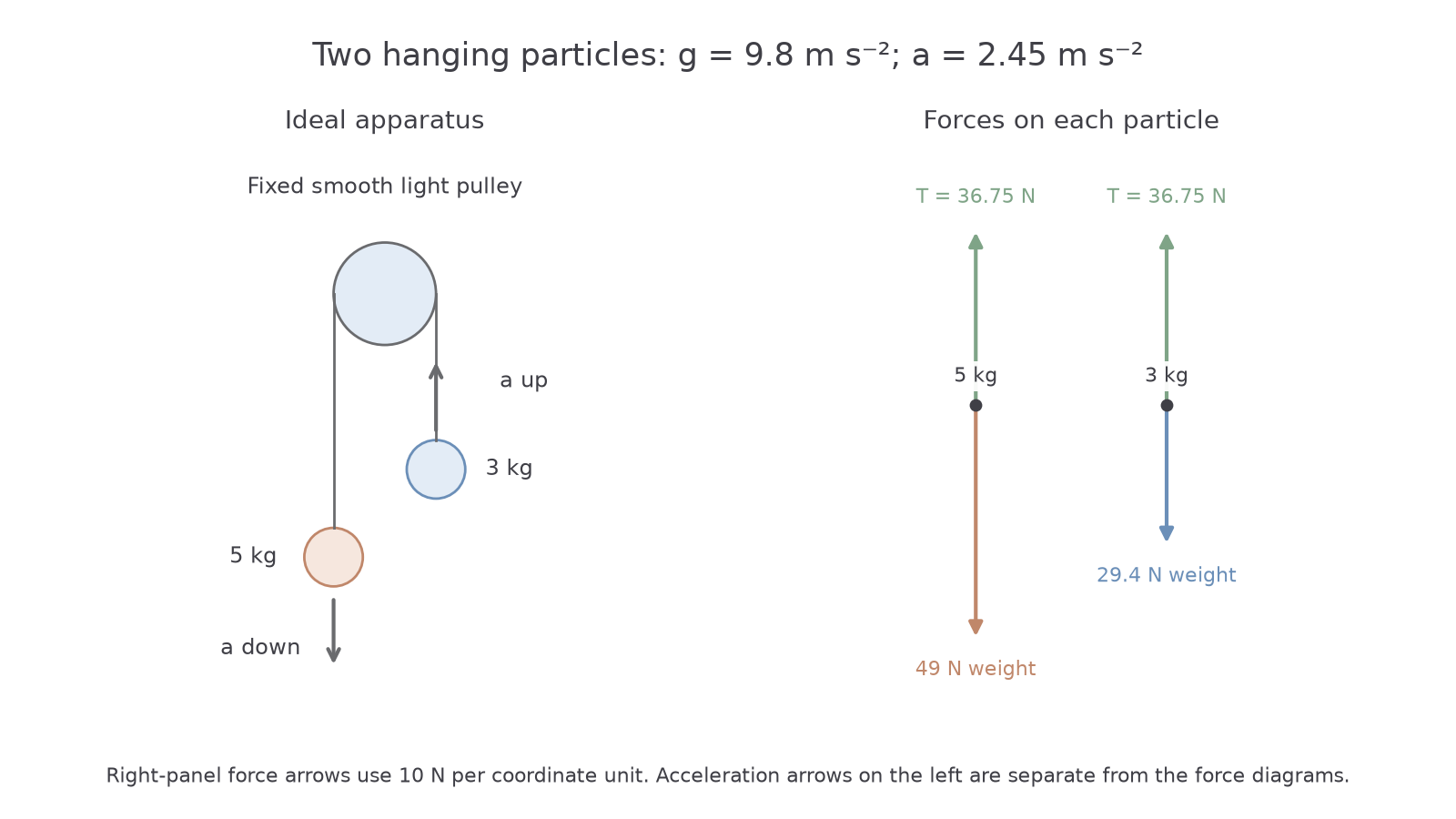
Question. With left mass and right mass , find signed acceleration with the left mass down positive, tension and the initial motion. The pair is released from rest as before. Give non-exact final values to significant figures.
Plan. Use the new left weight and mass while retaining compatible directions.
Why this step? The right particle accelerates upwards, so its tension must exceed its own weight.
Answer. Acceleration is , tension is , and the left particle initially descends.
Check. Using guard digits, . Rounding before finding tension would weaken this check.
The diagram shows the unrounded force values from this second example, with acceleration arrows drawn separately from forces.
[DIAGRAM: asset_name: Separate equations for two hanging particles; asset_slug: hanging_particle_forces; description: Five-kg and three-kg particles on opposite sides of an ideal pulley, separate upward tension and downward weight arrows, acceleration 5 kg down and 3 kg up distinguished from force arrows; caption: The particles have opposite acceleration vectors and one common tension]
Continue this lesson.
You’re previewing NovaLearn without an account. Create a free account to read the rest.
Create free account