My1–My5 - Projectile motion and trajectories
Form a projectile's vector equations from its launch and gravity, then use them to find its flight, launch velocity and Cartesian trajectory. Keep the landing surface explicit, including a specified slope, and decide when the idealised model remains useful.
Assumptions and component equations
Can a projectile hit rising ground while it is still rising? A ball launched with velocity , using , has height . If the ground is and , it meets the ground after one second, while its vertical velocity is still upwards. The landing surface can end a flight before its usual highest point.
First build the free-flight model; the final part will explain why that intersection is a genuine first impact.
You already know
Resolve launch speed at angle above horizontal into horizontally and vertically. Both components share one elapsed time.
Model the projectile as a particle with no air resistance or propulsion after release. Horizontal travel is small enough to regard gravity as parallel everywhere; vertical travel is small enough to take its magnitude as constant. These assumptions ignore size, rotation and deformation, and can be poor for light objects with a large surface area.
Projectile under gravity
During idealised free flight, a projectile's only force is gravity. With horizontal and vertically upwards, its acceleration is . In particular, zero upward velocity does not mean zero acceleration.
Use the specified value of . If none is specified, use ; another planet or an explicitly simplified model requires its own stated value.
Vector equations for a projectile
With starting position and initial velocity ,
These follow by inserting into the supplied vector constant-acceleration equations. These particular projectile forms are not printed. Not in the formula sheet: learn it.
The horizontal velocity is constant because horizontal acceleration is zero. The vertical component can be positive, zero or negative during the same flight.
Worked example 1: form the model from speed and angle
Question. A ball is launched from at , at above horizontal. Neglect air resistance and use . Determine its initial velocity, velocity at time , and position at time , before impact.
Plan. Resolve the launch velocity, then use the fixed upward axis for both vector equations.
Why this step? The starting height belongs in position, while the launch angle determines velocity components.
Answer. , with and as displayed, in SI units during free flight.
Check. At , the equations recover and the resolved launch velocity; differentiating position gives velocity.
Change only the angle to thirty degrees below horizontal. The vertical launch component changes sign; gravity does not.
Worked example 2: a downward launch
Question. A ball is launched from at , at below horizontal. Neglect air resistance and use . Determine its initial velocity, velocity at time , and position at time , before impact.
Plan. Resolve with a negative vertical launch component, keeping upwards positive.
Why this step? Changing launch direction cannot reverse the direction of gravity.
Answer. ; the displayed and describe the downward launch before impact, in SI units.
Check. The derivative of is , which is negative for all , as a downward launch requires.
For a horizontal launch . From height , using , its ground equation is , giving a one-second fall independently of horizontal speed. That independence follows from the assumptions, rather than from a cancellation between the horizontal and vertical motions.
Watch out
Wrong: use automatically when a question gives another value. Right: use the stated acceleration and the sign dictated by your axes.
Change only the angle again and form the full model.
Position, speed and direction during flight
At a specified horizontal position, find the time first, then use that same time in both position and velocity components.
Consider flight under a stated , with initial velocity from level ground. The model gives , and . Its return to ground is at .
Speed and flight direction
For velocity ,
For , an angle to horizontal satisfies ; use “above” or “below” according to the sign of . Not in the formula sheet: learn it.
A vertical velocity component of zero means horizontal motion if . Position gives a different direction: is the slope from the launch point, not the flight direction.
Worked example 3: reaching a horizontal coordinate
Question. A projectile starts at the origin with velocity . Neglect air resistance and use . At horizontal coordinate , determine its position, velocity, exact speed and direction. Give the direction angle to one decimal place.
Plan. Recover time from horizontal motion and evaluate the vector equations.
Why this step? A horizontal coordinate determines time here because horizontal velocity is constant and non-zero.
Answer. Position is , velocity is , speed is , and direction is above horizontal.
Check. The time lies inside , before the highest point at .
Change only the specified horizontal coordinate to twenty-four metres. The projectile reaches the same height on its descent.
Worked example 4: the descending branch
Question. For the same launch , no air resistance and , determine position, velocity, exact speed and direction at . Give the direction angle to one decimal place.
Plan. Use the changed horizontal coordinate to obtain a new common time.
Why this step? Equal heights can occur at two different times, with opposite vertical velocities.
Answer. Position is , velocity is , speed is , and direction is below horizontal.
Check. Times two and four are equally spaced about the apex time three; their equal heights and opposite vertical components agree.
A specified height can give two permissible roots. Evaluate the velocity at each unless a rising or falling branch is specified, and reject times after first impact. A ball can have positive height and negative vertical velocity.
Watch out
Wrong: use the angle as the direction of flight. Right: use the velocity components, with the correct reference direction and vertical sense.
Move the specified horizontal coordinate once more, to the apex.
Flight time, horizontal range and greatest height
Choose the landing level before using a flight-time formula, and distinguish height above ground from rise above launch.
For launch height , ground impact on a horizontal level satisfies . Select the first positive impact root. With , horizontal range is ; it is not distance along the curved flight.
Same-level range and greatest rise
For , , no earlier obstruction and landing at the launch level,
At an attained apex,
Here is rise above launch. These are derived from the component equations. Not in the formula sheet: learn it.
For the first result, factor , rejecting the release root. For the second pair, solve and substitute into height: . If launch is above ground, greatest height is , provided impact has not interrupted the ascent.
For fixed launch speed , same-level range is . Thus gives greatest range on that horizontal level, since for . This derived result is not printed on the sheet and is not a shortcut for sloping ground.
[DIAGRAM: asset_name: A projectile with horizontal velocity at its apex; asset_slug: projectile_flight; description: Equal-scale trajectory x=12t, y=16t-5t squared from launch to same-level landing at x=38.4 metres, with apex (19.2,12.8), upward-right launch tangent and horizontal apex velocity; caption: A projectile with horizontal velocity at its apex]
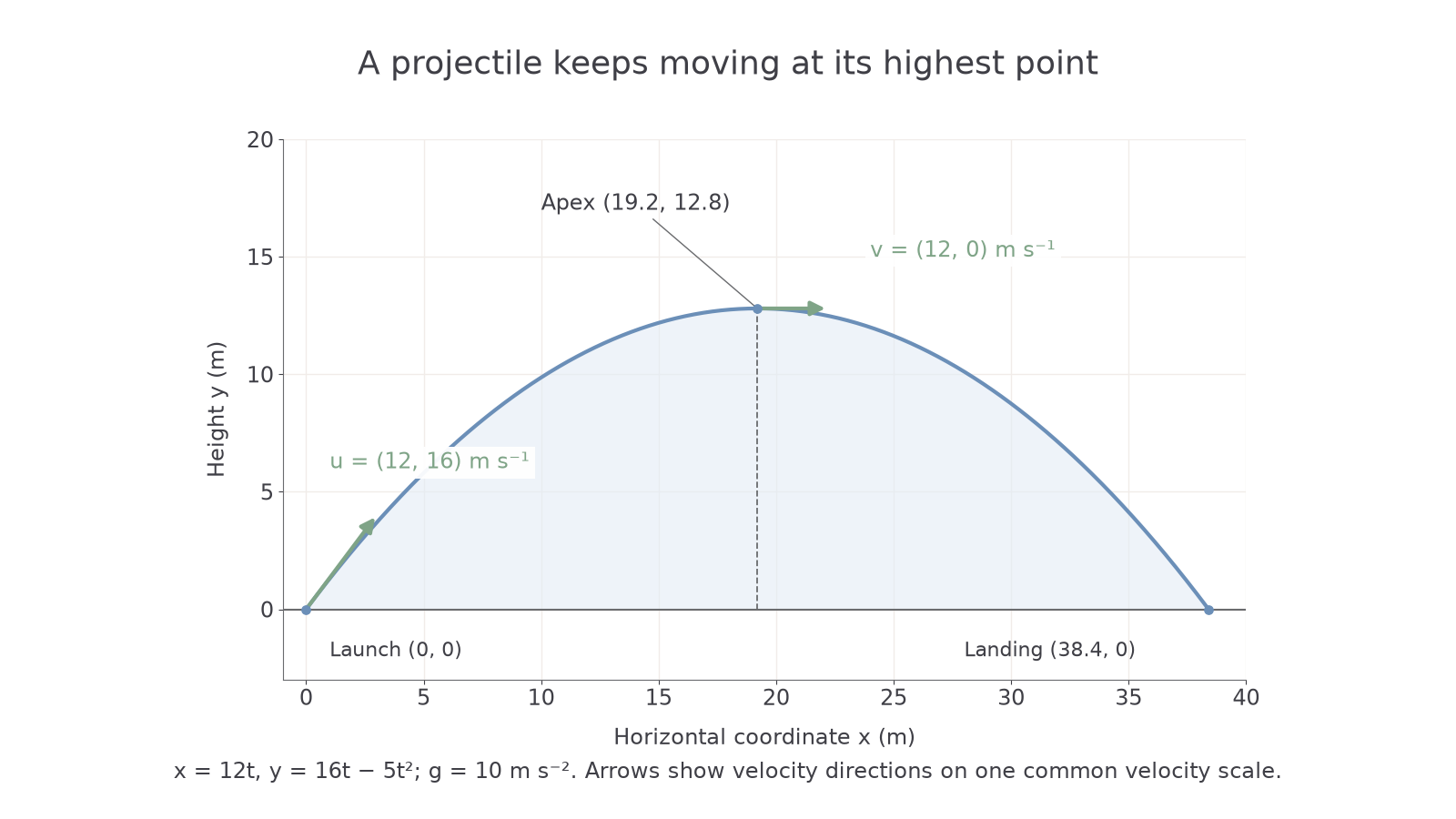
For this figure alone, and , giving flight time , range , apex time and greatest rise , in SI units. The horizontal velocity survives at the top.
Worked example 5: level-ground flight
Question. A projectile starts from horizontal ground with velocity . Neglect air resistance and use . Determine its flight time, horizontal range and greatest height above ground.
Plan. Solve the actual ground equation, then find the apex from vertical velocity.
Why this step? The two roots represent release and return; only the second is the flight duration.
Answer. Flight time is , horizontal range is , and greatest height is .
Check. The apex lies halfway through this same-level flight.
Change only the launch height to fourteen metres above ground. The same three requests now need an unequal-level calculation.
Worked example 6: a lower landing level
Question. A projectile starts above horizontal ground with velocity . Neglect air resistance and use . Determine its flight time, horizontal range and greatest height above ground.
Plan. Include fourteen metres in the height equation, and keep the unchanged apex time.
Why this step? The rise above launch is unchanged, but the height above ground and the total fall time have increased.
Answer. Flight time is , horizontal range is , and greatest height above ground is .
Check. The other root is before launch, and the apex time three occurs before impact.
The free-flight apex need not be attained if an elevated surface intercepts the projectile first. The final part uses that observation to resolve the opening question.
Watch out
Wrong: add launch height to the range or use for a lower landing level. Right: launch height enters the vertical equation; range then follows from the resulting time.
Continue this lesson.
You’re previewing NovaLearn without an account. Create a free account to read the rest.
Create free account