Ma2 - Solving quadratic equations and disguised quadratics
Learn to solve quadratics by factorising, completing the square, using the formula and reading graphs. Then recognise the same structure inside another expression, and use its domain to decide which answers survive.
Reversible rearrangement
Can the quadratic method produce four answers to , but only one to ? Try in the first equation and in the second: both work. Finding every answer means understanding what each solving step preserves.
You already know
Collect like terms, clear constant denominators across the whole equation and keep brackets around substituted expressions. A real square is non-negative; a denominator cannot be zero.
You want to replace an equation with one that asks exactly the same question. Adding the same expression or multiplying by a non-zero constant can be undone; squaring is different because it loses signs.
Equivalent equations
Equations are equivalent on a domain when they have the same solutions there. For real , and are equivalent, but also allows .
Rearrangement is your starting tool. For instance, gives , hence ; both given sides equal . The examples now recall changing a subject before the quadratic work.
Worked example 1: a constant denominator
Question. Make the subject of .
Plan. Clear the constant denominator and isolate .
Why this step? Multiplication by is reversible for every real , so the relation is preserved.
Answer. , with no restriction on real .
Check. At , the formula gives , and .
Now put the unknown in the denominator instead. The algebra must carry a restriction as well as an equality.
Worked example 2: changing the subject with a restriction
Question. Make the subject of .
Plan. Exclude the zero denominator, clear the fraction and factor the terms containing .
Why this step? At , the preceding equation says . Division excludes a value that could not have worked anyway.
Answer. , where .
Check. gives , and . Also .
For squares, with , gives and requires . Without the sign restriction on , keep both signs. For reciprocals, gives , with both non-zero. These prerequisite rearrangements are not in the formula sheet: learn them.
Watch out
Wrong: , so . Dividing by has silently discarded . Write to retain both possibilities.
Keep the same denominator care when you rearrange this formula.
Solving by factorisation
To use factors, first make one side zero. Then a product can vanish because either factor vanishes.
Zero-product rule
For real expressions and ,
This rule concerns a product equal to zero, not a product equal to another number.
Not in the formula sheet: learn it.
Check a proposed factorisation by expanding. A correct constant term alone does not guarantee the correct middle term.
Worked example 3: a fractional root
Question. Solve .
Plan. Factorise, then solve the two linear equations.
Why this step? One factor equal to zero makes the whole product zero, even if the other is non-zero.
Answer. or .
Check. Substitution gives and .
Change the constant term to zero. You can now take out a common factor, which protects the zero root.
Worked example 4: a common factor
Question. Solve .
Plan. Factor out rather than dividing by it.
Why this step? Dividing by would be valid only after treating separately.
Answer. or .
Check. Zero works immediately; .
If the equation is , expand and rearrange to before choosing a solving method. Setting each factor equal to does not solve it.
Watch out
The equation does not require and . Use or, since either factor may supply the zero.
Apply the common-factor approach with a negative non-zero root.
Completing the square and the formula
A completed square makes the two-root structure visible. The quadratic formula packages that rearrangement for general coefficients.
Dividing by , then adding the square of half the coefficient of , gives
Taking both square roots yields the formula. Since the principal root of is , writing merely exchanges the plus and minus roots when .
Quadratic formula
For and , the roots of are
There are two distinct real roots for a positive discriminant, one repeated root for zero, and no real roots for a negative discriminant.
Not in the formula sheet: learn it.
Here is a neat pair: and have product , so they are reciprocals, even though both are negative. They arise naturally in the first example.
Worked example 5: seeing both signs
Question. Solve exactly.
Plan. Complete the square and take both square roots.
Why this step? names the positive square root, but both signs solve a square equal to .
Answer. or .
Check. Each gives ; their product is .
Change only the leading coefficient to . Fractions enter the completed square, so the formula offers a compact alternative.
Worked example 6: using signed coefficients
Question. Solve exactly.
Plan. Apply the quadratic formula and simplify both terms of the numerator.
Why this step? The fraction line covers the full numerator; it divides the surd as well as .
Answer. or .
Check. , and each root makes .
In MEI questions, “Solve” can allow calculator roots unless another instruction specifies the evidence. “Determine” asks for justification; an exact answer needs exact working. Show your chosen method so a slip need not erase its credit.
Watch out
Wrong: . Since , dividing the surd by gives .
Try another leading coefficient, keeping the two exact answers together.
Graphical solutions
The equation's right side tells you which height to look for on a graph. Solving means reading the horizontal coordinates where meets .
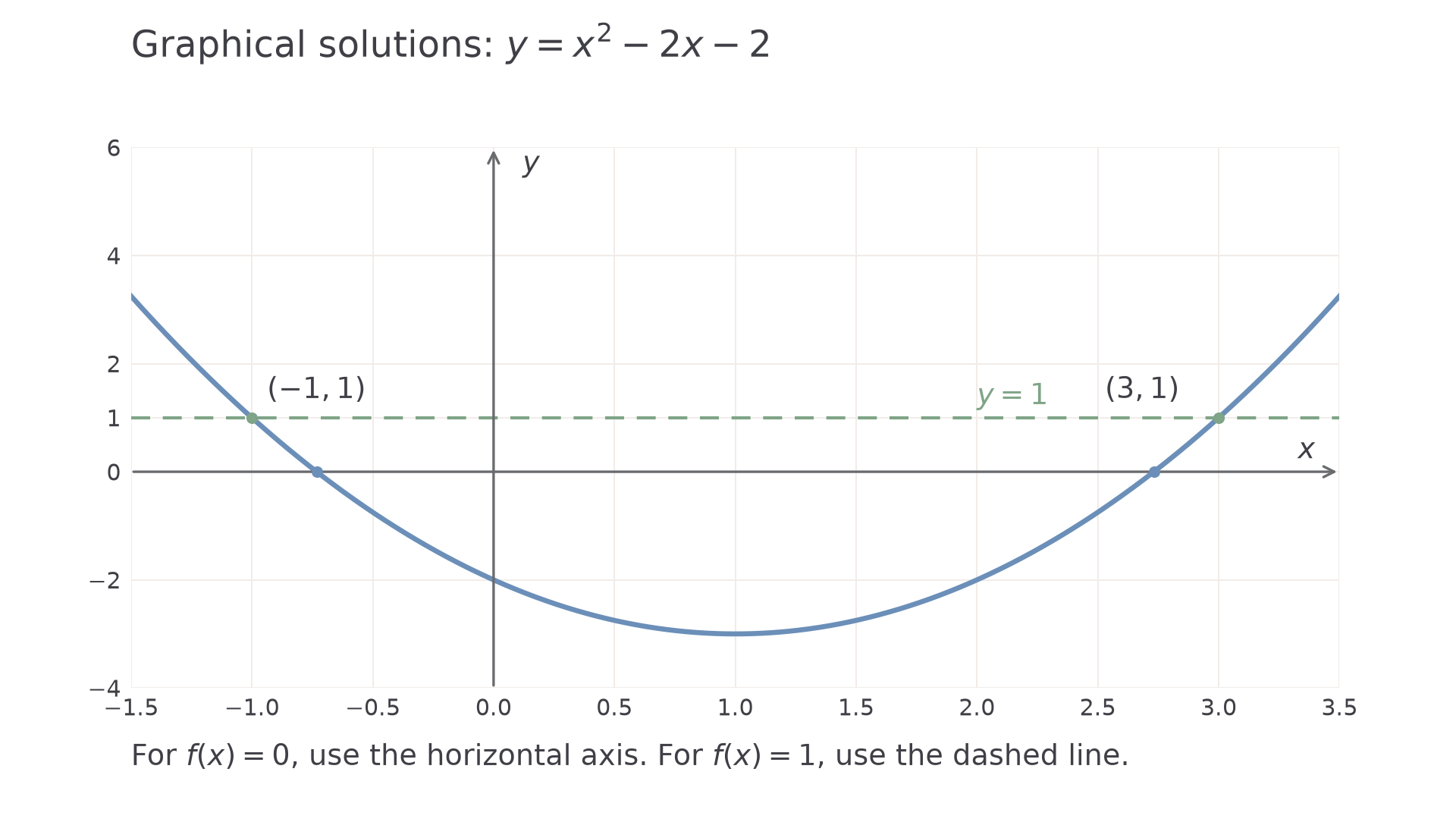
Here the same curve answers several different equations. Changing the required output moves the horizontal line, not the curve.
Worked example 7: reading zero-output solutions
Question. Estimate the solutions of from the displayed graph.
Plan. Use the horizontal-axis crossings and check their approximate values with a completed square.
Why this step? A horizontal-axis crossing has output zero, exactly the condition asked for.
Answer. Approximately and , to one decimal place.
Check. The exact values are approximately , agreeing with the estimates.
Change the required output from zero to . The second pair of intersections is already marked.
Worked example 8: reading a different output
Question. Estimate the solutions of and check them exactly.
Plan. Read the intersections with , then factorise the corresponding equation.
Why this step? The height is fixed by the equation; the unknown is the horizontal coordinate.
Answer. or , confirmed exactly by algebra.
Check. At each value the given quadratic has output .
A graph supports estimation, not an exact surd claim. Choose a window with both branches and the relevant heights; a crossing outside the screen is still a solution. Use algebra to establish a complete count or a true tangency. Graphical solution is not a supplied formula-sheet result.
Exam tip
“In this question you must show detailed reasoning” requires the analytical steps. A graphing calculator may help you check them, but an unsupported root list does not provide that reasoning.
Move the line down for this check; all data needed are stated in the question.
Quadratic substitutions
An equation may be quadratic in a repeated expression rather than in the letter printed in the question. Give that expression a temporary name, then remember to undo it.
Quadratic in a function of the unknown
An equation , with , becomes a quadratic in when . The allowed values of still come from its definition.
For instance, must be non-negative. If , then ; is inadmissible, while gives . A real cube root, by contrast, can have either sign.
Worked example 9: four answers from a quadratic
Question. Solve for real .
Plan. Solve in , then recover both signs of each square root.
Why this step? Squaring maps two opposite non-zero numbers to the same value; reversing it recovers both.
Answer. .
Check. The squared values give and .
Change only the repeated expression to , the real cube root. The temporary quadratic stays the same, but its inverse changes.
Worked example 10: reversing a cube-root substitution
Question. Solve , using real cube roots.
Plan. Put , solve, then cube each temporary root.
Why this step? Cubing has just one output for each real input. There is no new plus-or-minus choice.
Answer. or .
Check. Their real cube roots are , which satisfy the temporary quadratic.
This substitution reasoning is not in the formula sheet: learn it. It also helps when an unfamiliar passage defines a new variable; read the definition before deciding its range.
Watch out
Wrong: reject every negative temporary root. Reject a negative , but allow a negative . The definition decides, not the letter .
Use a new temporary quadratic with the same cube-root definition.
Restrictions and extraneous candidates
Turning an equation into a quadratic gives candidates. The definition of the substitution and the given equation decide which are solutions.
For , first exclude . Set . Then , so and . Substitution checks give and . A temporary reciprocal value of zero would have no finite and must be rejected.
Extraneous candidate
An extraneous candidate solves a transformed equation but not the given one. Squaring may introduce one because a positive number and its negative have equal squares.
A square-root equation has two necessary conditions: its radicand is non-negative, and its right side is non-negative. Check both before interpreting the quadratic's roots.
Worked example 11: squaring with a positive right side
Question. Solve .
Plan. Require , square, and test the candidates in the given equation.
Why this step? The squaring implication goes forwards without preserving the sign information backwards.
Answer. only.
Check. At , both sides are . At , the sides are and , so that candidate fails.
Change only the sign of the right side. The squared equation cannot notice the change; you must.
Worked example 12: changing the permitted sign
Question. Solve .
Plan. Combine the radicand and right-side conditions, square, then retain the admissible root.
Why this step? The required non-positive now keeps and rejects .
Answer. only.
Check. At , both sides are . At , they are .
This answers the opening question. Reversing legitimately gives four roots of the fourth-power equation, while the root equation's sign condition keeps only . Candidate and domain checks are not supplied on the formula sheet.
Watch out
Wrong: check a candidate only in the squared equation. That cannot recover the lost sign. Substitute into the equation that still contains the square root or denominator.
Now vary the number inside the root and keep the negative right side.
Quick Recap
- Factorisation needs zero on one side; completing the square and the formula handle less convenient factors.
- A graphical solution reads a horizontal coordinate at the required output height.
- A substitution has a definition and a range; reverse it before giving the final answer.
- Retain denominator exclusions and test candidates after squaring.
The opening fourth-power equation has roots ; the square-root equation has just . The difference comes from reversing the substitution and enforcing its conditions.