Ma4, Ma5 - Simultaneous equations and intersections
Use elimination and substitution for two linear equations in Ma4, then extend those tools to a linear and a quadratic equation in Ma5. Learn to recover the correct pairs of values and justify how many common points the equations describe.
Eliminating a variable
Could changing just one number turn a system with no solutions into one with infinitely many? Take and . The first equation requires , so the pair is impossible. Change to , though, and every point with works. The answer really can jump from none to infinitely many.
You already know
An equation can be multiplied by a non-zero constant without changing its solutions. Checking a pair means substituting both coordinates into each equation.
Usually two linear equations give just one common pair. The same values must work at the same time.
Simultaneous solution
A simultaneous solution satisfies every equation in a system. Write a two-variable solution as an ordered pair . An equation is linear when unknowns occur only to the first power and are not multiplied together: is linear; is not.
Elimination makes coefficients match so that adding or subtracting removes one unknown. Keep another equation as well: a single eliminated equation does not determine both coordinates.
Worked example 1: opposite signs
Question. Solve and .
Plan. Make the coefficients of opposite, add and back-substitute.
Why this step? Opposite -terms cancel, leaving one unknown with a non-zero coefficient.
Answer. .
Check. and .
Now make the matched coefficients the same sign. The cancellation requires subtraction.
Worked example 2: the same signs
Question. Solve and .
Plan. Match the coefficients of , subtract the equations and recover .
Why this step? Adding would leave ; subtraction is what removes equal terms.
Answer. .
Check. and .
The opening systems show what happens if elimination cancels both unknowns. A contradiction means no solution; an identity means the equations have repeated the same condition. Geometrically, those are distinct parallel lines and the very same line, respectively. Neither elimination nor these classifications are supplied in the formula sheet.
Watch out
Wrong: becomes after multiplying by . Multiply the right side too: it must be .
Use coefficients that cancel immediately in this check.
Substitution and fractional equations
Substitution uses an expression from one equation in place of an equal variable in the other. A coefficient of often makes this efficient.
Substitution into a linear equation
If , the simultaneous system with reduces to
then . Retain the domains of both equations.
Not in the formula sheet: learn it.
Write brackets around the inserted expression. They show which terms a coefficient or minus sign acts on.
Worked example 3: substituting after a minus sign
Question. Solve and .
Plan. Replace by its complete expression and solve for .
Why this step? The minus sign belongs to all of , so its constant term becomes positive.
Answer. .
Check. and .
Now change the presentation to fractions and brackets. Clearing them exposes a simple substitution again.
Worked example 4: a fractional equation
Question. Solve and .
Plan. Simplify both equations, make the subject and substitute.
Why this step? Constant denominators can be cleared everywhere, without introducing excluded values.
Answer. .
Check. and .
For linear equations, either elimination or substitution is valid. Choose the route that keeps signs and fractions manageable. If a variable occurs in a denominator, preserve its non-zero restriction after clearing it.
Watch out
Wrong: . Distribute the minus sign to both terms: .
Use a fractional equation with a new coefficient in the numerator.
Linear and quadratic systems
With one linear and one quadratic equation, reduce to one unknown just as before. This time the reduced equation may have two roots, so carry both branches through.
You already know
For a quadratic equal to zero, factorisation or the quadratic formula finds the real roots. Each root must then be put into the linear equation to recover its partner.
A two-variable quadratic can contain squares or a mixed term. Replacing one variable by a linear expression makes these manageable.
Worked example 5: retaining both pairs
Question. Solve and .
Plan. Substitute for , solve the resulting quadratic and pair each root correctly.
Why this step? A root belongs with the height obtained from that same root, not the other branch's height.
Answer. and .
Check. and ; both pairs also satisfy .
The next quadratic has a mixed term instead of a sum of squares. Only its form changes the substitution decision.
Worked example 6: choosing the shorter substitution
Question. Solve and .
Plan. Use , leaving the existing square in .
Why this step? Solving for first avoids introducing an extra square of a bracket into the mixed-term expression.
Answer. and .
Check. and ; both pairs sum to .
Do not reject a negative coordinate just because it looks less familiar. A context may forbid negative lengths, but this unrestricted system does not. These methods and domain checks are not supplied in the formula sheet.
Watch out
Wrong: combine with from different branches in Worked example 5. The pair fails . Write the two ordered pairs explicitly.
Try another line through the origin with a different sum of squares.
Intersections and solution counts
The graph is a useful check on a simultaneous system: common solutions are exactly common points. A repeated root supplies one distinct point, not two different intersections.
For and , equating outputs gives . The diagram compares : two points, touching at one point, and no points.
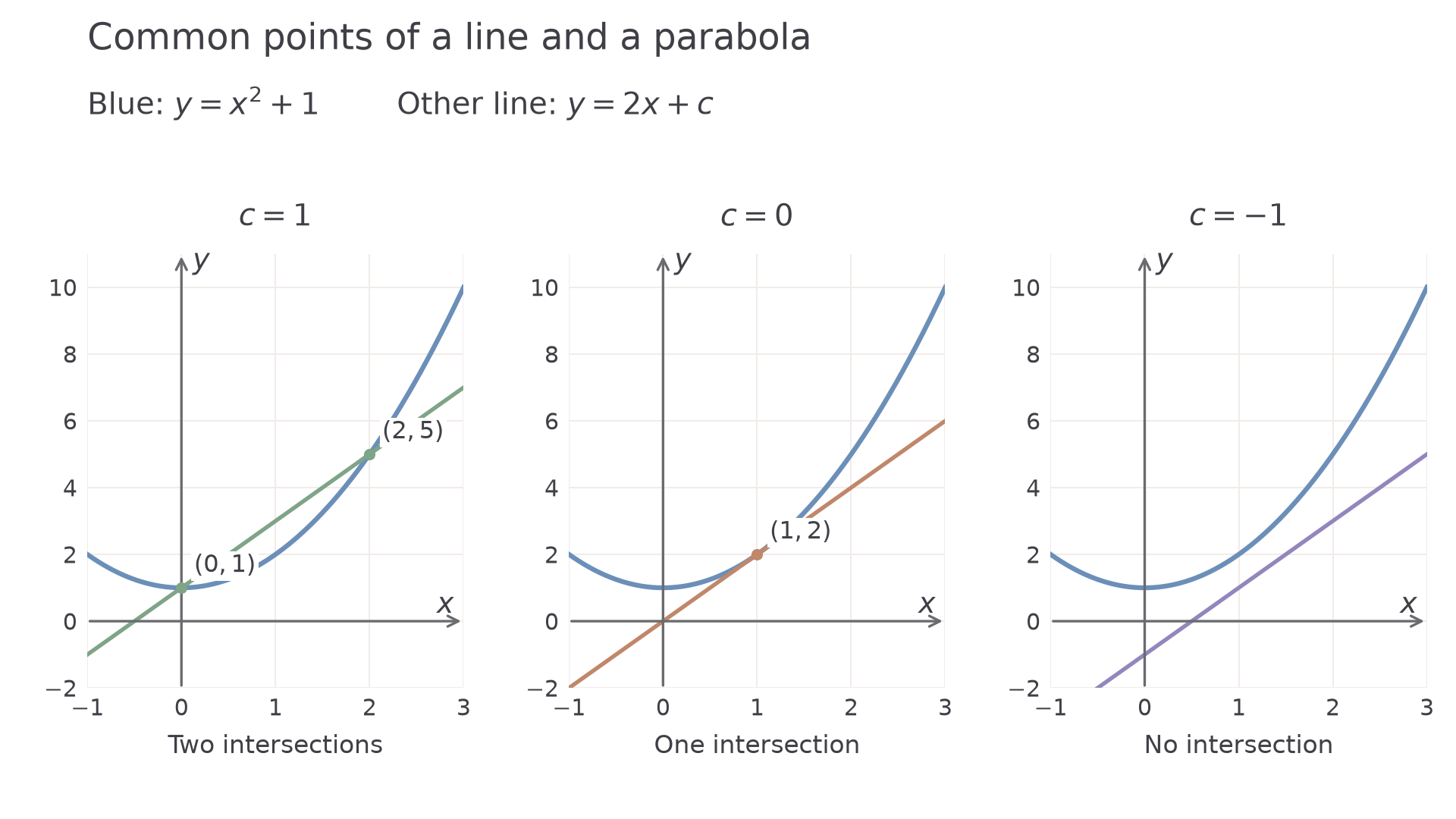
At , the points are . At , the square would have to be negative, so no real common point exists. Algebra establishes those conclusions beyond the visible plotting window.
Worked example 7: two intersections farther apart
Question. Find the intersections of and .
Plan. Equate the outputs, complete the square and recover both heights.
Why this step? A positive right side gives two different offsets from .
Answer. and .
Check. The parabola gives , as does , at those respective coordinates.
Change only the line's constant to zero. Both offsets collapse to zero.
Worked example 8: a repeated root
Question. Determine the intersection of and .
Plan. Equate outputs and identify the repeated root.
Why this step? The square is zero at just one value. The line touches the curve at that common point.
Answer. One intersection, .
Check. Both outputs are at ; the quadratic difference is positive elsewhere.
Thus the family has two intersections for , one for and none for . This classification is not a supplied formula: it follows from the non-negativity of a real square. Keep any stated domain restriction when counting roots.
Exam tip
“Determine” needs justification. Show the reduced quadratic and its repeated-root or discriminant condition; an apparently touching calculator graph alone is insufficient.
Use the same count argument after changing the gradient and curve height.
Quick Recap
- Eliminate by adding opposite coefficients or subtracting matching ones.
- Substitute a complete expression, using brackets to control signs.
- A linear/quadratic system may have two real branches; recover both ordered pairs.
- A repeated root gives one common point, and a negative required square gives none.
Changing the opening system's to really does turn no solutions into infinitely many: two distinct parallel lines become the same line. A line and a quadratic can instead have zero, one or two intersections.