Mv1–Mv3 - Vectors, components, magnitude and direction
Use the language and geometry of vectors to describe movements, combine arrows and calculate lengths and directions. You will move between column vectors, unit-vector notation and magnitude-direction form, with signs that agree with your sketch.
Vectors and their components
Two map instructions say “move west, then north”. Could one straight instruction replace them? It would need a length and a direction; “” alone would send you too far and tell you nothing about where to go.
You already know
Cartesian coordinates use perpendicular axes. Pythagoras gives a right triangle's hypotenuse, and trigonometric ratios connect its lengths and angles. A negative coordinate means the opposite direction along that axis.
Choose east as positive horizontal and north as positive vertical. The two instructions combine into the arrow . Their route has length , but the straight displacement has length , since . Surprisingly, the final arrow is unchanged if you swap the order of the instructions, even though you visit a different intermediate point.
Scalar, vector and components
A scalar has magnitude only; a vector has magnitude and direction. Distance and speed are scalars; displacement and velocity are vectors. Cartesian components are signed amounts along perpendicular axes. With standard unit vectors and , our displacement is
The component vectors are and ; their coefficients are scalars. Bold letters distinguish vectors in print. Underline a vector letter in handwriting, or use an arrow such as . Reversing that arrow gives .
Vector language
Equal vectors have the same magnitude and direction, hence equal corresponding components. Non-zero parallel vectors are scalar multiples; the multiplier can be negative. Points are collinear when they lie on one straight line. A position vector starts at a chosen origin; a unit vector has magnitude . The zero vector has magnitude zero and no direction.
For example, and are parallel but not equal. An arrow can slide to another starting point without changing its vector. A position vector cannot do that while still describing the same point from the same origin. We will use parallel vectors to prove collinearity in the next lesson.
Key idea
A signed component can be negative; a modulus or magnitude is a non-negative scalar. Equal lengths alone do not make two vectors equal.
The distinction is small in notation and large in meaning.
Adding, subtracting and scaling vectors
Vector addition joins arrows head to tail. Its resultant runs from the first start to the final finish, so it records the combined movement without remembering the route.
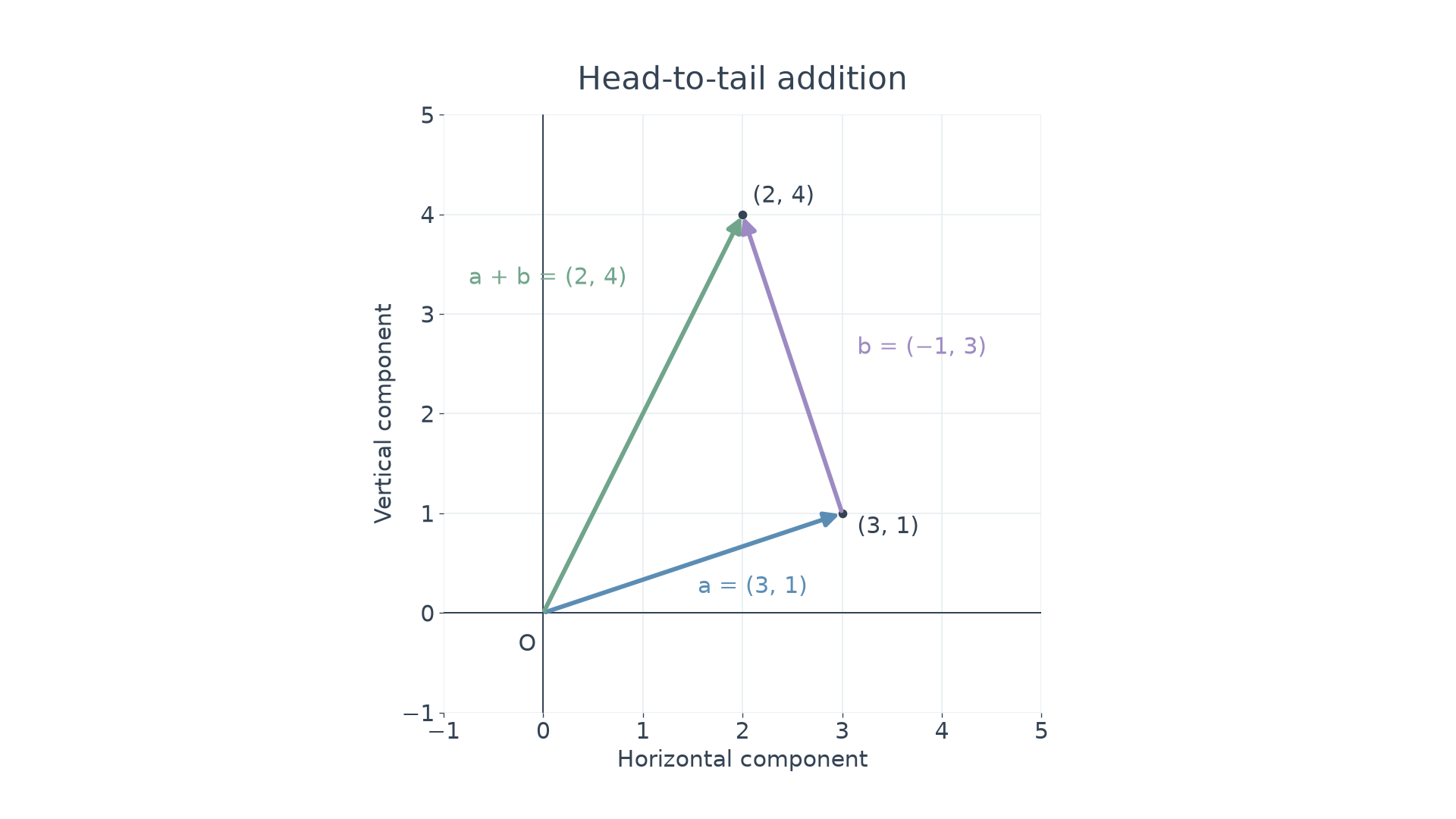
The blue arrow , followed by the purple arrow , gives the green resultant . Translating the purple arrow preserves its vector.
The diagram also explains why addition is component by component. Subtracting a vector means adding its reverse. If two arrows share a tail, goes from the head of to the head of .
Combining and scaling vectors
For , and real :
Scaling changes magnitude by . For non-zero vectors, positive keeps direction and negative reverses it; gives .
Not in the formula sheet: learn it.
MEI also uses general vectors whose components are unknown. The route round a triangle remains valid without coordinates: if and , then .
Worked example 1: a combination of general vectors
Question. In triangle , and . Find . Then evaluate it for , .
Plan. Express each route using and , simplify, then insert components.
Why this step? Expressing the route first prevents the arrow being confused with the position of .
Answer. , or for the given vectors.
Check. , and .
Change only the final plus sign to a minus sign. Keep the route and both vectors unchanged.
Worked example 2: reversing one contribution
Question. For the same triangle and components, find .
Plan. Subtract the entire vector after doubling .
Why this step? Changing the sign of reverses the whole vector, including its negative vertical component.
Answer. .
Check. .
For a second numerical check on the diagram's arrows, , and . Each operation treats the two components separately.
Watch out
Wrong: . Right: the vertical component is , so the result is .
Use the same route with fresh component values.
Continue this lesson.
You’re previewing NovaLearn without an account. Create a free account to read the rest.
Create free account