Mu6, Mu7 - Conditional probability and two-way data
Calculate conditional probabilities from the tables, trees, Venn regions and sample-space information in Mu6. Then use Mu7 to decide whether a probability stays unchanged after conditioning, giving a numerical argument for independence.
A condition selects the relevant group
Can six people represent both and of a group? In a library survey, six people have online membership and borrow fiction. There are sixteen fiction borrowers and eighteen online members. The six are the same people, but the group used as the denominator changes.
You already know
means both events and means not . With equally likely outcomes, a probability is a favourable count divided by the count of the relevant sample space. A probability need not remain the same when that space is restricted.
“Given fiction” removes the non-fiction borrowers from consideration before any division takes place.
Conditional probability
means the probability of given . It measures within the outcomes satisfying . The event after the bar is the condition, so its probability supplies the denominator.
A person is selected uniformly from this complete survey of 40. Let mean online membership and mean borrowing fiction.
| Total | |||
|---|---|---|---|
| 6 | 12 | 18 | |
| 10 | 12 | 22 | |
| Total | 16 | 24 | 40 |
The joint event has probability . A conditional probability is a different fraction.
Conditional probability from a joint event
For ,
A zero denominator does not define a conditional probability by this rule; an empty conditioned group supplies no usable proportion.
In the formula sheet.
The table lets you choose the required group directly, without treating a conditional as a joint probability.
Worked example 1: membership within fiction borrowers
Question. Use the complete library table to find and .
Plan. Keep only the fiction column, then divide each relevant count by its total.
Why this step? The information given has already restricted the selection to sixteen people.
Answer. The probabilities are and .
Check. They sum to 1. The formula gives the same result: .
Change only the condition to not borrowing fiction. Keep the membership event and the complete table unchanged.
Worked example 2: membership within non-fiction borrowers
Question. From the same table find and .
Plan. Use the non-fiction column and its total of 24.
Why this step? The condition selects the sample space before the event count is divided by its size.
Answer. Both probabilities are .
Check. The two counts fill all 24 non-fiction borrowers. A denominator of 40 would instead give the corresponding joint probabilities.
The complete table also contains six fiction borrowers among eighteen online members, giving . That is the opening puzzle: changing the conditioned group changes the denominator. It does not justify exchanging the order of event symbols in an answer.
Watch out
Wrong: . Right: . The numerator concerns both events, while the denominator concerns the given event alone.
Use the same restricted-group reasoning on a fresh survey.
Later branches contain conditional probabilities
A later branch describes the situation after the earlier branch has occurred; it is not the probability of the whole path.
Write for first green or yellow, and for the corresponding second-draw events. After , the branch to green is .
A complete conditional path
For ,
This works for dependent events too. The conditional second factor becomes only when independence applies.
In the formula sheet.
Outgoing branches from each node are disjoint and exhaustive, so their probabilities sum to 1. Distinct final paths are disjoint and can be added.
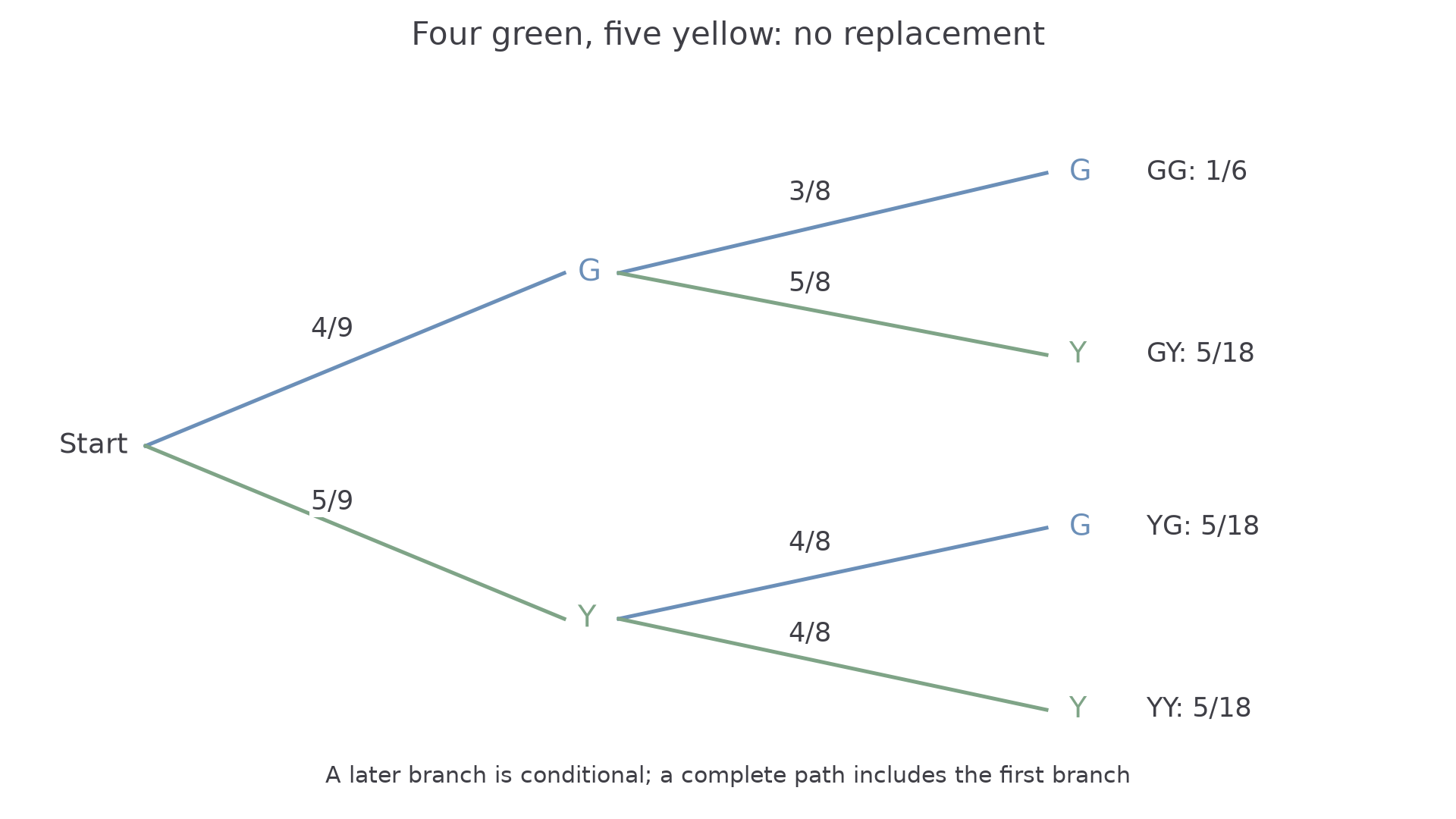
Worked example 3: a branch and its joint path
Question. A bag contains four green and five yellow counters. Two are drawn without replacement. Find , , and the probability of different colours.
Plan. Use the remaining bag after yellow, then add the two mixed-colour paths.
Why this step? The branch already assumes first yellow; the joint event must include the chance of reaching that branch.
Answer. The three probabilities are , and .
Check. GG has probability , YY has probability , and all four path probabilities sum to 1.
Change only replacement. Restore and thoroughly mix the counter between independent draws; keep the bag and requested events fixed.
Continue this lesson.
You’re previewing NovaLearn without an account. Create a free account to read the rest.
Create free account