Mt1, Mt2, Mt8 - The unit circle, exact values and trigonometric graphs
Use a rotating radius to define trigonometric functions for any angle, obtain exact values with the correct signs, and connect these values to the shape and transformations of their graphs.
Coordinates on the unit circle
Can two points on opposite sides of a circle have the same height? At and , a unit-radius point is unit above the centre in both cases, although its horizontal coordinate changes sign. That small observation explains a whole symmetry of the sine graph.
You already know
For a right-angled triangle, is opposite over hypotenuse, adjacent over hypotenuse and opposite over adjacent. Coordinates can be negative even though lengths cannot.
Think of the radius as a moving pointer. Measure its angle from the positive horizontal axis, anticlockwise for positive angles and clockwise for negative angles.
Unit circle
A circle with centre and radius . If the pointer ends at , define , and for . These agree with right-triangle ratios in the first quadrant and define the functions for other angles.
The endpoint is the essential information; you do not need a triangle entirely in the first quadrant.
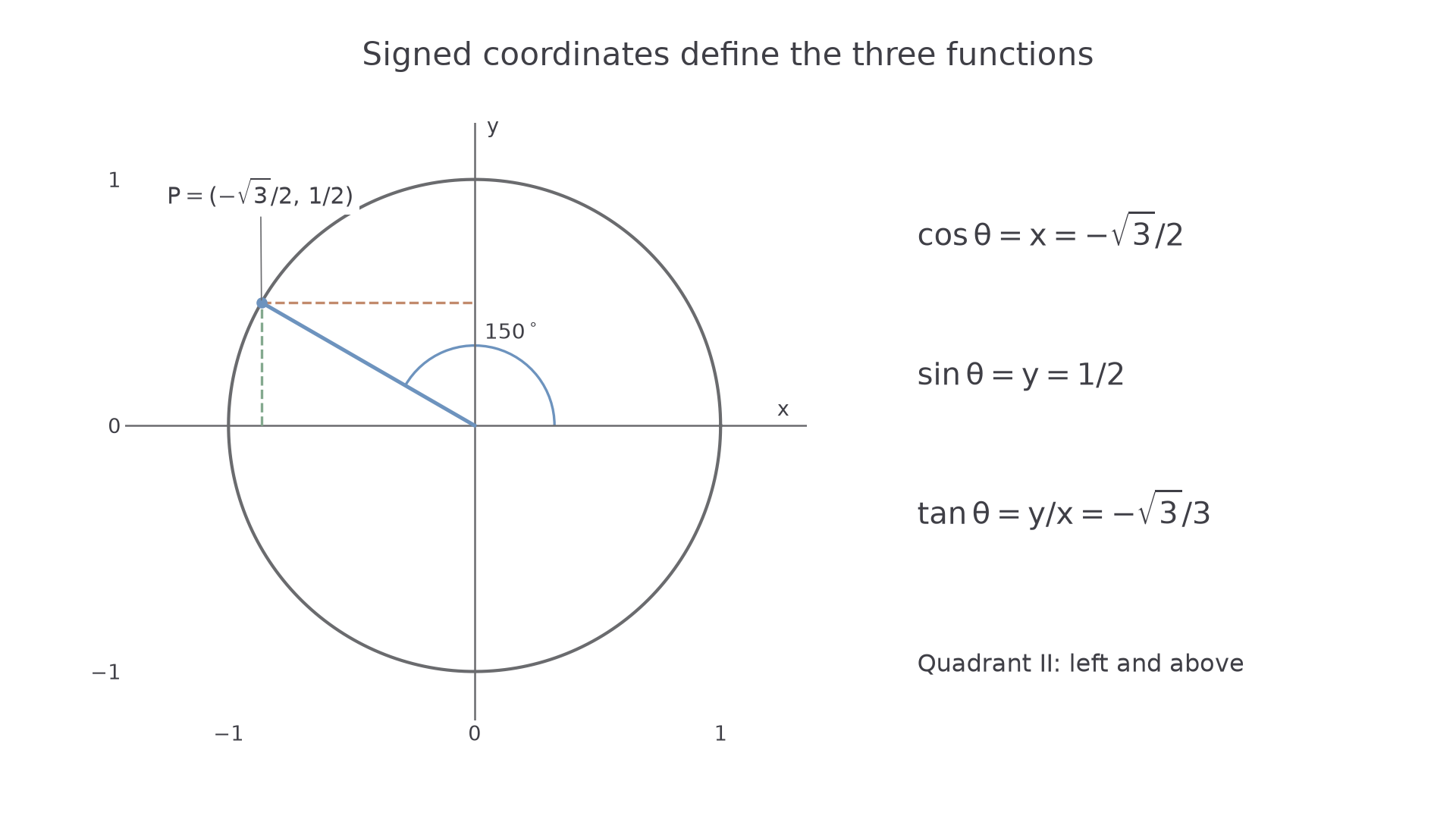
Sine and cosine exist for every angle. Tangent is undefined at , integer , where . Zero horizontal coordinate is not zero tangent: division by zero has no value. These definitions are not in the formula sheet: learn them.
| Quadrant | Sign of | Sign of | Sign of |
|---|---|---|---|
| I | positive | positive | positive |
| II | negative | positive | negative |
| III | negative | negative | positive |
| IV | positive | negative | negative |
Here is a useful surprise: a pointer and the pointer facing exactly the opposite way have the same tangent. Reversing both coordinates leaves their ratio unchanged.
Worked example 1: values without finding the angle
Question. The endpoint of a unit radius is . Find its sine, cosine and tangent.
Plan. Read the two coordinates and use vertical over horizontal for tangent.
Why avoid finding ? The definitions give exact ratios immediately; an approximate angle would only add rounding.
Answer. , , .
Check. , as required for a unit-circle point.
Change only the sign of the horizontal coordinate. The reflected point has the same height, which is the phenomenon in the opening question.
Worked example 2: the same height on the other side
Question. Find the three values when the endpoint is .
Plan. Retain the vertical coordinate and use the new horizontal sign in the ratio.
Why does tangent change sign? Only its denominator changed sign.
Answer. Sine is , cosine , tangent .
Check. The point lies in quadrant II, where sine is positive and the other two values are negative.
A sketch with the two signs marked is often enough to prevent an avoidable error.
Watch out
Wrong: at this second point. Right: sine reads the second coordinate, . Keep horizontal and vertical roles separate.
For the matched question the point moves below the horizontal axis too.
Exact values and reference angles
Exact values come from two familiar triangles, then extend to every required multiple by the circle's signs and repeated turns.
Recall the isosceles right triangle with sides , and half an equilateral triangle with sides . Dividing by the hypotenuse gives the sine and cosine values below; their ratio gives tangent. Radians describe the same angles using radians. Their geometric definition comes in the radians lesson.
Exact degree and radian values
At , sine is , cosine and tangent .
Not in the formula sheet: learn it.
Use the axes directly at quarter turns: at the endpoint is , while at it is . Tangent is undefined whenever cosine is zero. At other positions the acute angle to the horizontal axis is the reference angle: for example, uses reference angle , with both coordinates negative.
Worked example 3: an exact quadrant-III value
Question. Determine the exact values of sine, cosine and tangent at .
Plan. Find the reference angle and retain the signs of quadrant III.
Why attach signs after finding magnitudes? The special triangle has positive lengths; the circle tells you their directions.
Answer. Sine and cosine are ; tangent is .
Check. Squaring and adding the two coordinates gives .
Change only the number of complete turns: subtract . The negative argument now ends at exactly the same point.
Worked example 4: a clockwise route to the same point
Question. Determine the exact sine, cosine and tangent of .
Plan. Add a full turn, then use the values already established.
Why add , rather than ? A half turn reverses sine and cosine; only a full turn preserves both.
Answer. Sine and cosine are , and tangent is .
Check. : the clockwise endpoint is left and below the origin.
Other exact values follow in the same way. For example, ends at , with sine , cosine and tangent . Keep the surds exact when an exact value is requested. “Determine” calls for justified working; it does not by itself specify exact form.
Watch out
Wrong: a negative angle always has negative tangent. Right: tangent is positive when the two coordinates have the same sign, including quadrant III.
Continue this lesson.
You’re previewing NovaLearn without an account. Create a free account to read the rest.
Create free account