Mc11 - Differentiating trigonometric functions
A wave can pass through zero while changing as quickly as it ever does. Use first principles to explain the derivatives of sine and cosine, then differentiate linear combinations of sine, cosine and tangent as Mc11 requires. Keep the input in radians and track each function's domain.
Deriving the sine derivative from a limit
At which point of is the curve rising fastest? At its peak the gradient is zero; at the origin a chord to input has gradient about . The zero crossing is a better candidate than the highest point.
You already know
First principles means taking the limit of . The sine addition identity separates a fixed input from a small increment . Angles here are in radians.
Why radians? Unit-circle areas give for : compare the triangle inside a sector with the tangent triangle outside it. Hence , so the ratio tends to one. Its value is the same at , covering the other side. Also,
These are limit statements, not substitutions of zero into a denominator.
Radian sine and cosine limits
Not in the formula sheet: learn it.
A proof must show where those limits enter.
Worked example 1: establishing the sine derivative
Question. Show from first principles that .
Plan. Expand the changed function and collect two standard ratios.
Why this step? stays fixed, so only the two ratios depend on the shrinking increment.
Answer. for every real radian input.
Check. At , the gradient is minus one: the wave crosses the axis downwards.
Change only the vertical scale to the opening wave.
Worked example 2: doubling the wave
Question. Differentiate from first principles.
Plan. Pull the constant outside the quotient and repeat the limit argument.
Why this step? A vertical stretch multiplies chord gradients, whereas the input unit stays unchanged.
Answer. , with largest upward gradient two at , .
Check. The origin gives two, matching the nearby chord estimate.
The sine derivative is not in the formula sheet: learn it. The sheet supplies the first-principles definition, but quoting the final derivative does not establish it.
Watch out
Wrong: replace numerator and denominator by zero and conclude that the gradient is zero. Simplify the difference quotient first; its limit describes the gradient.
A new scale keeps the proof structure intact.
Deriving cosine and locating its minus sign
The derivative of cosine is negative sine. Rather than memorising a mysterious extra sign, look for it in .
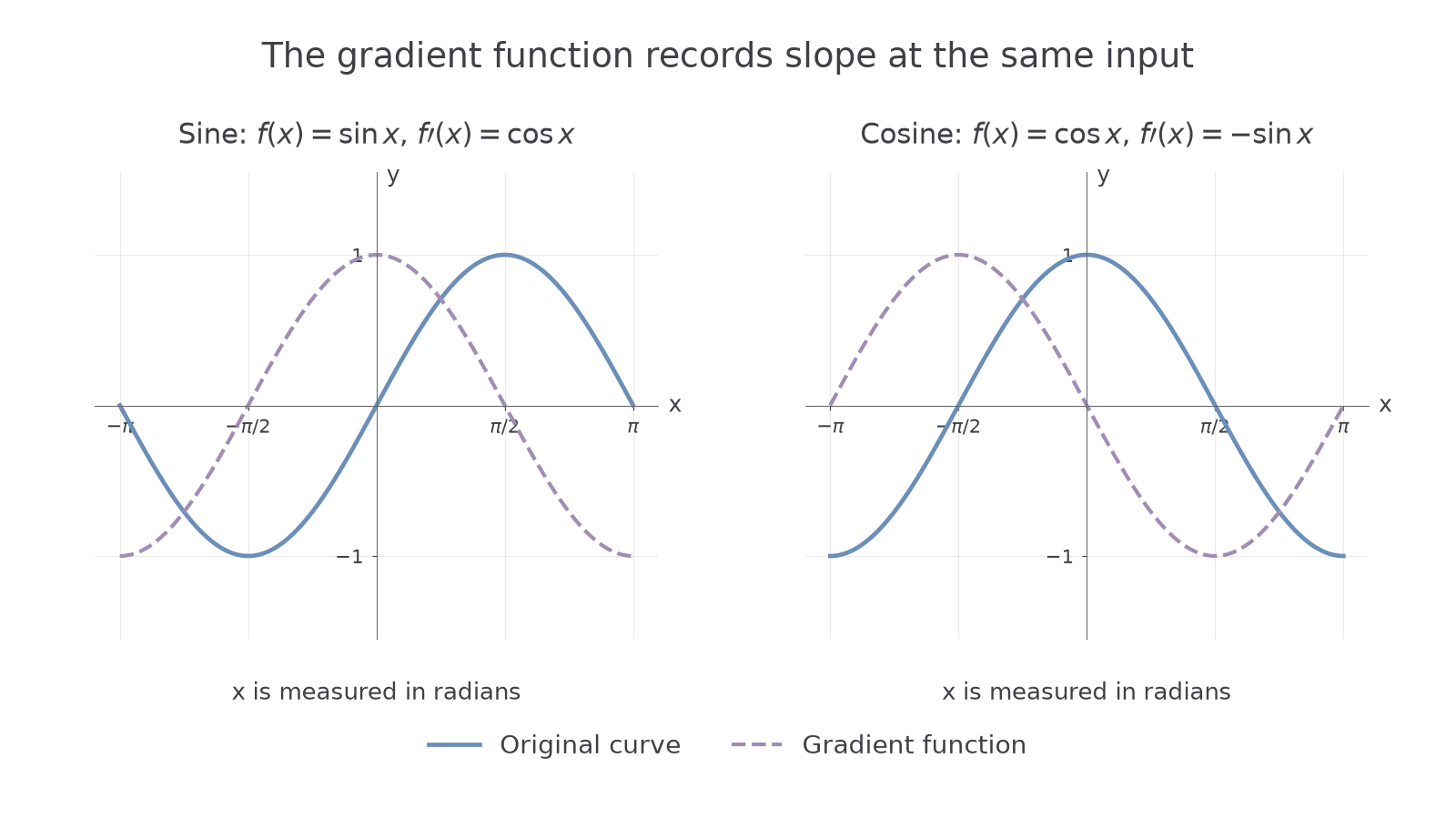
Follow the four curves through successive differentiations: sine becomes cosine, then minus sine, then minus cosine, then sine again. Four differentiations return you to the starting wave.
Worked example 3: proving the cosine rule
Question. Show from first principles that .
Plan. Subtract after expanding the addition identity.
Why this step? The negative sine product occurs before the limit; no new sign rule is being invented.
Answer. The derivative is for all real radian inputs.
Check. At the slope is minus one, matching the downward zero crossing.
Change only the vertical multiplier from one to two.
Worked example 4: a stretched cosine
Question. Differentiate from first principles.
Plan. Scale the entire cosine difference quotient.
Why this step? The scale multiplies both terms, including the negative one.
Answer. .
Check. At the slope is minus one; the graph is falling.
This derivative is not in the formula sheet: learn it. The alternative identity connects the sign to an input rate of minus one, but a first-principles demand needs the limit working.
Watch out
Wrong: use a plus between the two terms in the cosine difference quotient. Correct the addition identity first; the derivative then has the correct sign automatically.
Now let reflection and stretching act together.
Continue this lesson.
You’re previewing NovaLearn without an account. Create a free account to read the rest.
Create free account