MC1, MC2, MC4, Ma6 - Polynomial graphs, roots and intercepts
Read the shape of a polynomial from its factors and leading term. You will distinguish a sketch from a plot, explain crossings and touches, and connect graph intersections with equation and simultaneous-equation solutions.
Plotting and sketching a graph
Does a degree-four graph have to cross the horizontal axis four times? Consider : both squared factors are non-negative, so the whole graph stays on or below the axis. It reaches zero twice and never crosses. We will build the clues that make that sketch inevitable.
Begin with . Inputs give outputs ; these points lie on a smooth parabola. One point, or one small window on a calculator, would tell you much less.
Plot and sketch
A plot uses accurately calculated points on scaled axes. A sketch shows the important features and their relationships without needing an exact scale: labelled axes, intercepts, crossings or touches, overall shape and end behaviour. A graph consists of every permitted point , not just the points you happened to calculate.
A clear sketch is selective, rather than careless. Find exact coordinates algebraically whenever the equation makes them available.
You already know
For , the squared term is zero at , giving a minimum for and a maximum for . Set to find horizontal intercepts and to find the vertical intercept. These results are not in the formula sheet: learn them.
The completed square lets you identify several features before drawing anything.
Worked example 1: a sketch from exact features
Question. State the features needed to sketch .
Plan. Read the minimum from the square, then calculate the axis intersections.
Why this step? The square already identifies the bottom of the curve; expanding would discard the most useful form.
Answer. Draw an upward parabola through , and , with minimum and symmetry line .
Check. The roots are each 2 units from the symmetry line. Substitution gives zero at both.
Change only the overall sign of the function. Every height reverses while zero heights stay fixed.
Worked example 2: the same roots, opposite opening
Question. State the features needed to sketch .
Plan. Use the negative square to locate the maximum and recalculate the vertical intercept.
Why this step? Multiplying the function by sends positive heights to negative heights and negative heights to positive heights; a root remains a root.
Answer. A downward parabola has maximum , horizontal intercepts , , and vertical intercept .
Check. Inputs 0 and 2 both give height 3, confirming symmetry about 1.
Drawing smooth curves matters: a corner or an extra crossing is a mathematical assertion, even on a sketch.
Watch out
Wrong: join the five points of a quadratic table with straight segments.
Right: draw the smooth parabola consistent with its equation. A sparse table does not turn the curve into a polygon.
Try a new centre and minimum, retaining the same feature-first approach.
Factors reveal roots and crossings
A zero factor gives an axis intersection, and its repeated power explains whether the curve passes through the axis or turns back.
Root and multiplicity
A root satisfies , so its graph point is . The multiplicity of that root counts the factor : one copy is a simple root, two copies a double root, three a triple root. A root is an input, not an ordered pair.
Near , the other nonzero factors retain their signs. Only the factor that becomes zero decides whether the product changes sign there.
Multiplicity and the graph
If with positive integer and , an odd gives a crossing at ; an even gives a touch without crossing.
Not in the formula sheet: learn it.
Watch the sign of the product rather than memorising a picture for every degree.
Worked example 3: a cubic with one touch
Question. Find the intercepts of and describe each meeting with the horizontal axis.
Plan. Find the roots from the factors, use their powers and substitute zero for the vertical intercept.
Why this step? A squared factor is positive on either side of its root, so the product keeps the same sign around 1.
Answer. It crosses at , touches at , and passes through .
Check. Near , the first factor changes sign while the square stays positive. Near 1, the first factor stays positive and the square does not change sign.
Change just the multiplicity at 1 from two to three. This changes a touch to a flattened crossing.
Worked example 4: an odd repeated power
Question. Find the intercepts and crossing behaviour of .
Plan. Retain the same roots but test the new odd power's sign.
Why this step? An odd power has the same sign as its input, so the cubed factor reverses the product's sign at 1.
Answer. The curve crosses at both and , flattening at 1, with vertical intercept .
Check. At the output is ; at it is . These have opposite signs.
The left panel shows the first cubic. In the right panel, the opening quartic has a squared factor at each root.
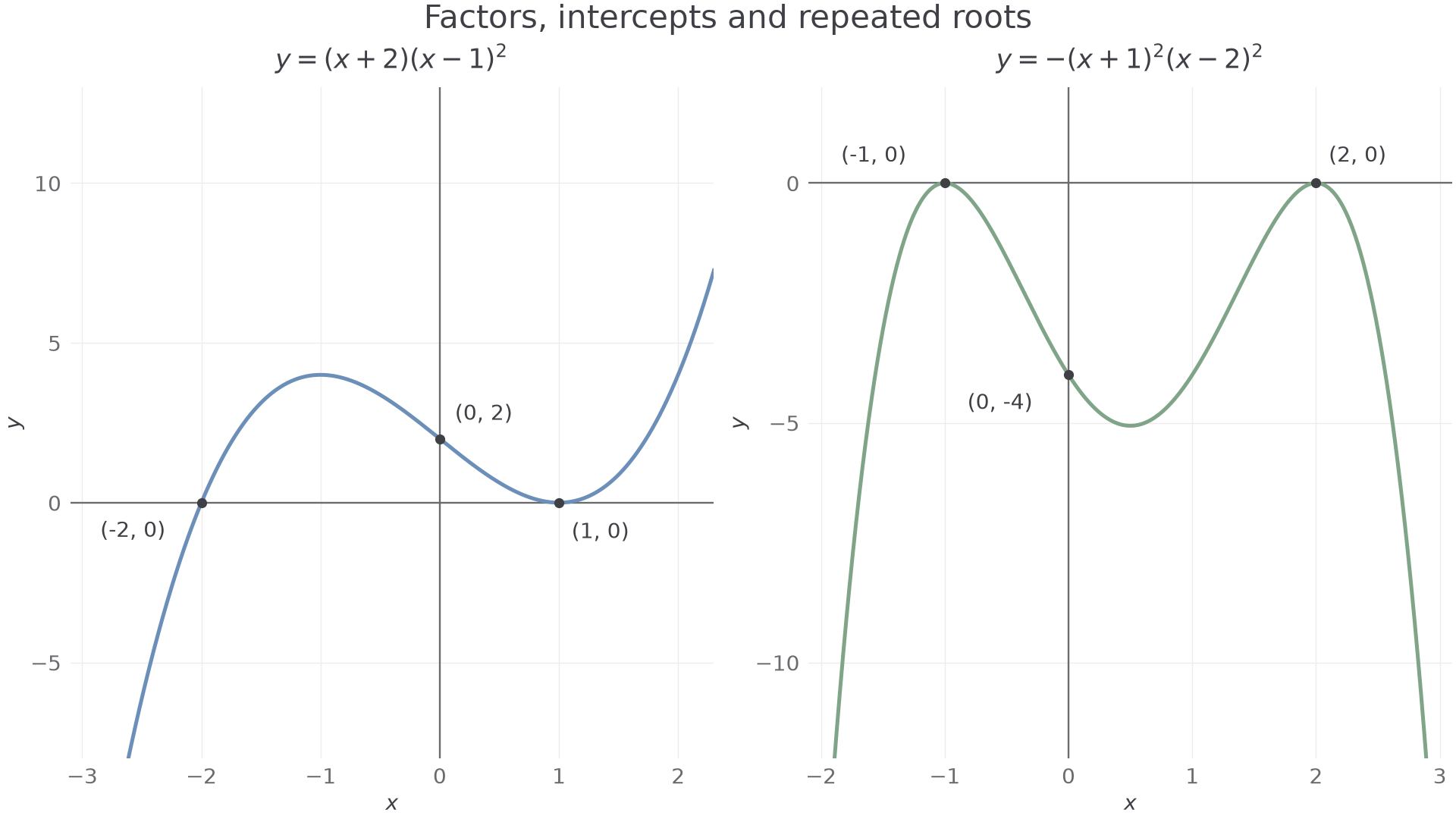
Both right-panel touches are explained by even multiplicities, rather than by the degree alone.
Watch out
Wrong: a repeated root always gives a touch.
Right: count its multiplicity. A double root touches; a triple root crosses with a flattened shape.
Move the root positions and keep the same multiplicity argument.
Degree and sign determine the ends
A sketch joins local root information to the distant behaviour controlled by the leading term.
For large magnitudes of , the highest power dominates the lower powers. For instance, has the same end directions as .
Leading term and end directions
For a polynomial with leading term , , the distant ends behave like .
| Degree | Positive leading coefficient | Negative leading coefficient |
|---|---|---|
| Even | Both up | Both down |
| Odd | Left down, right up | Left up, right down |
Not in the formula sheet: learn it.
Now complete the opening quartic's sketch. Its factors supply a particularly strong sign check.
Worked example 5: a quartic that stays below the axis
Question. Describe a sketch of .
Plan. Combine degree and leading sign with the roots, vertical intercept and sign of the squared product.
Why this step? The non-positive product forces the entire curve below the axis between its touches; it cannot make an extra crossing.
Answer. Both ends go down. The curve touches at and , stays below the axis elsewhere and passes through .
Check. At , the output is , which agrees with the dip shown between the roots.
Reverse only the overall sign. The touch points stay fixed, but the dip and the ends turn upwards.
Worked example 6: reversing a quartic's sign
Question. Describe a sketch of .
Plan. Keep the same squared factors and reverse every nonzero height from the previous curve.
Why this step? Multiplying by a nonzero constant does not change which factors vanish or how often they occur.
Answer. Both ends go up; the graph touches at and and passes through , staying above the axis elsewhere.
Check. At , the height is , exactly the negative of the earlier height.
Degree is not a count of distinct real crossings. In fact, has none. A cubic such as has opposite end directions but only two distinct real roots. Exact non-root turning coordinates require further information; do not invent them from a sketch.
Watch out
Wrong: “Degree four means four different real intercepts.”
Right: use the actual real factors and their multiplicities. Degree alone does not guarantee real roots or distinct crossings.
The next graph has odd degree and a negative coefficient, so its ends differ from both worked quartics.
Equation solutions are intersections
Two graphs intersect exactly where their outputs agree at the same input.
This connects the graph to algebra: roots of meet the horizontal axis, roots of meet a horizontal line, and roots of meet another curve or line.
From an equation to coordinates
For an admissible solution of , the simultaneous equations and have solution
The equation root is a horizontal coordinate; the intersection is an ordered pair.
Not in the formula sheet: learn it.
A labelled graph offers a useful check on how many pairs to expect.
Worked example 7: two shared heights
Question. Find the intersections of and .
Plan. Equate the heights, factor the quadratic and recover each matching height.
Why this step? Giving only the roots would omit the vertical coordinates required for the intersections.
Answer. and .
Check. , and , so both points satisfy both equations.
The picture links each algebraic factor to one intersection input.
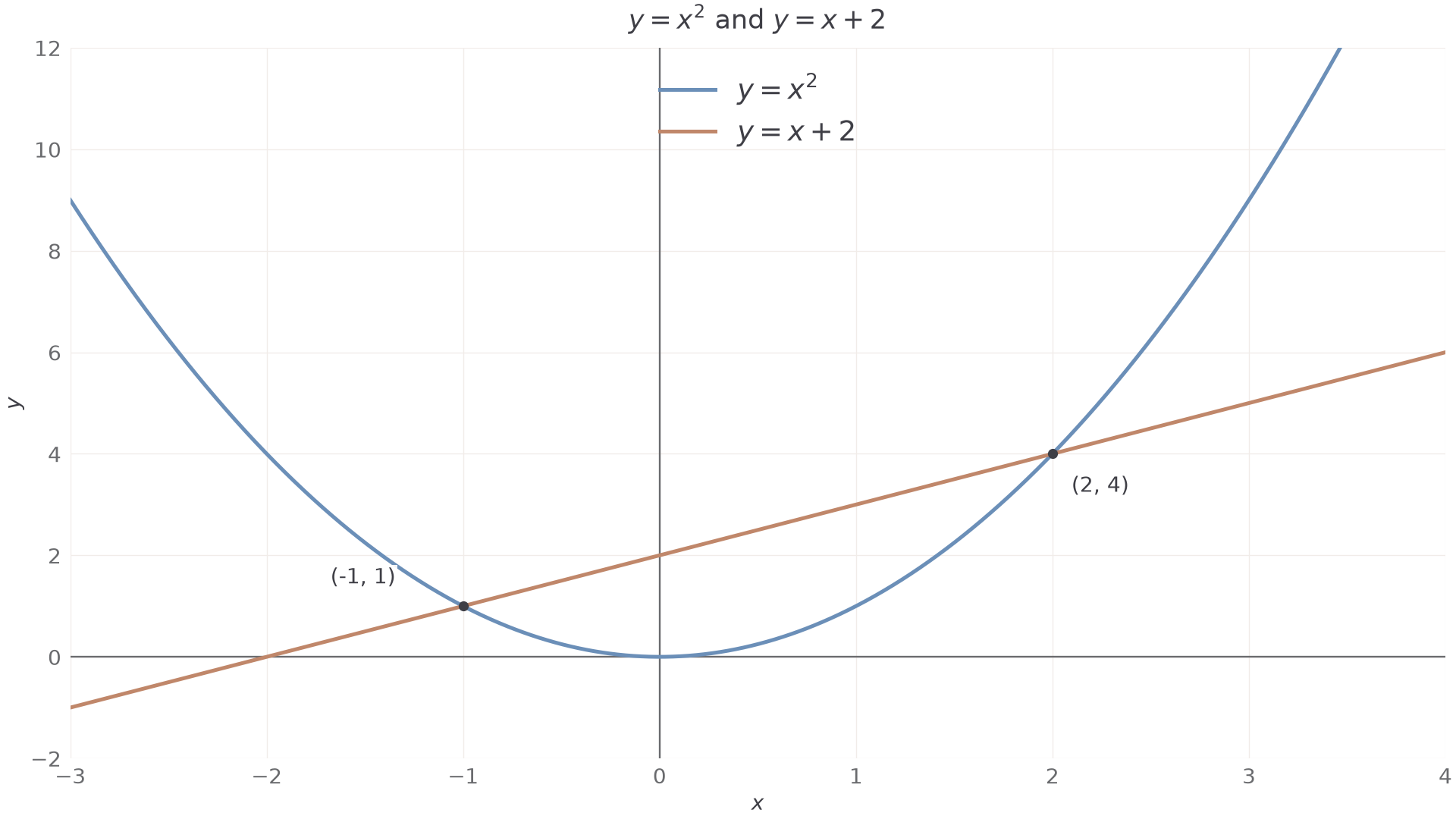
Change just the line's intercept, from 2 to 0. One intersection now lies at the origin.
Worked example 8: keeping a zero root
Question. Find all intersections of and .
Plan. Factor the difference without dividing by an expression that might be zero.
Why this step? Dividing by would assume and lose the origin, which is a valid intersection.
Answer. and .
Check. Both satisfy . No other roots remain after the complete factorisation.
An intersection equation can have a repeated root when a line touches a curve, or no real roots when the graphs miss. A restricted viewing window cannot by itself establish that no intersection exists elsewhere.
Exam tip
Give coordinates when asked for points of intersection. Keep exact fractions or surds when the question requests exact values; decimals read from a sketch do not establish exact coordinates.
Finish with a different line and name both the equation solutions and the points they produce.
Quick Recap
- Sketch principal features; plot accurately on scaled axes.
- Set for horizontal intercepts and for the vertical intercept.
- Odd root multiplicity gives a crossing; even multiplicity gives a touch.
- Leading term gives end directions; intersection inputs solve equations and their heights complete simultaneous solutions.
The opening degree-four curve has two touches and no crossings: its squared factors keep non-positive, with zero only at and 2.