Mv4–Mv6 - Position vectors, distances and vector problems
Connect Cartesian coordinates with position vectors, calculate distances and locate points in a given ratio. Build geometric arguments from general vectors and use the same addition rule to find and balance force resultants.
From positions to displacements
A survey team marks a collection point on a straight path from to , with . Where is ? A different map origin must not change its physical location, so our method needs to separate positions from movements.
You already know
Vector addition combines component changes; multiplication by a scalar changes each component. The modulus is a scalar length. Parallel non-zero vectors are scalar multiples.
Choose an origin . A position vector locates ; its Cartesian components are the coordinates of . The displacement starts at , so it is a different arrow from the position vector of .
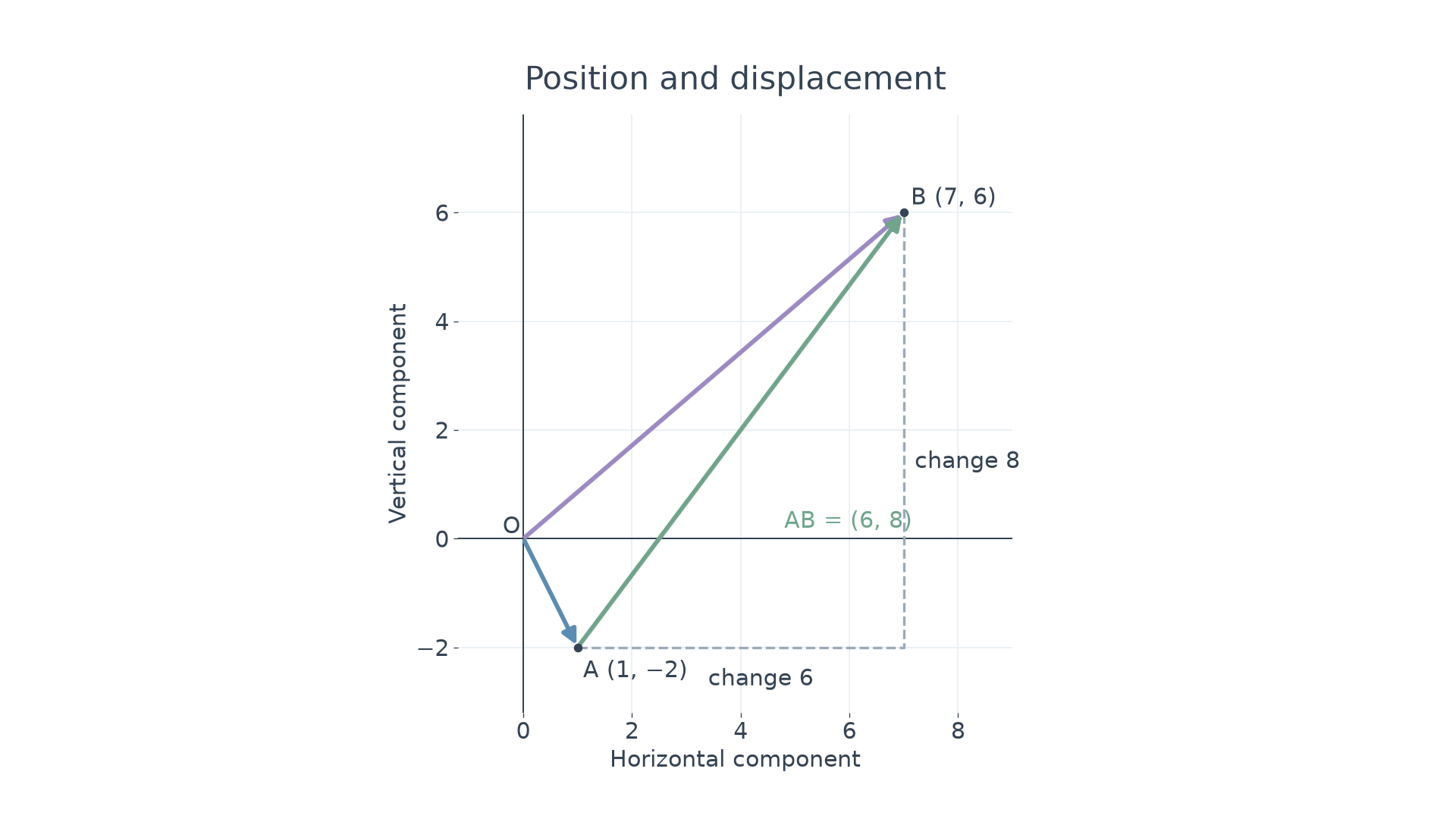
For the separate example , , the position arrows begin at , while has components and length .
Travelling means reversing , then adding . That route supplies the subtraction rule.
From positions to a displacement
If and , then
For Cartesian points, . The first expression is a vector; the second is its scalar length.
Not in the formula sheet: learn it.
There is a neat cancellation hidden here. If a new origin has old position , the new positions are and , but their difference is still . You can change every coordinate on the map without changing any journey between fixed points.
Worked example 1: the survey displacement
Question. Find and for , .
Plan. Subtract the coordinates of from those of , then find the modulus.
Why this step? A distance between points depends on their coordinate differences, not their separate distances from .
Answer. , .
Check. , the required finish.
Change only the origin. Put the new origin at the point whose old coordinates are .
Worked example 2: the same journey on a different map
Question. Find the new positions of and , then find their displacement and distance in the new coordinates.
Plan. Subtract the new origin's old position from both points, then subtract the new endpoint positions.
Why this step? Moving the origin changes positions, not the vector between the two fixed points.
Answer. New positions , ; displacement , distance .
Check. Adding back to each new position recovers the old coordinates.
The displacement reverses sign for the return trip, but its modulus remains . Neither changing the origin nor reversing a route makes a distance negative.
Watch out
Wrong: find by subtracting from . Right: subtract the vectors first, then take the modulus. The two endpoint lengths refer to , not to the connecting segment.
Try another common change of origin, keeping the physical points fixed.
Locating points along a segment
A ratio divides the whole displacement into equal shares. Once you know the movement from , include 's position to locate the endpoint of that movement.
Internal division of a segment
If , with and between and , then
More generally, a fraction from gives . The midpoint uses . Values or go beyond the segment.
Not in the formula sheet: learn it.
The coefficient of the movement is , not . In the diagram's example , , ratio gives ; the two displacement pieces are in the required ratio.
Worked example 3: the collection point
Question. For , , find with internally.
Plan. Move three of the five equal shares of from .
Why this step? The first ratio number measures the part from , so the fraction must also be measured from .
Answer. .
Check. and , so the first is times the second.
Change only the ratio from to . The point moves to the other side of the midpoint.
Worked example 4: exchanging the two shares
Question. For the same endpoints, find with internally.
Plan. Add two-fifths of the displacement to .
Why this step? The whole still has five shares; only the number travelled from changes.
Answer. .
Check. , , giving ratio .
This calculation uses a specified fraction to locate a point. There is no need to introduce vector equations of lines. When the endpoints are letters, exactly the same weighted combination works.
Watch out
Wrong: report only as the position of . That is . Right: add so the position vector starts at the origin.
Apply the same fraction to a new segment.
Continue this lesson.
You’re previewing NovaLearn without an account. Create a free account to read the rest.
Create free account