MF12 - Static and limiting equilibrium on rough surfaces
Use Newton's laws to decide whether rough contact can keep a particle at rest. Resolve applied forces, distinguish actual friction from its limiting value, and find both boundaries of an equilibrium force range.
Testing a proposed static equilibrium
Can lifting a box slightly make it easier to slide, even before it leaves the floor? Yes: an upward force reduces the normal reaction, so it also reduces the available friction. We need both components of an applied force to decide whether the box can stay still.
Take a box with . Its weight is . An upward applied component of leaves a normal reaction of . With , the friction capacity is , rather than .
You already know
Forces on a particle in equilibrium sum to . Here points horizontally right and vertically up. Resolve the whole applied force, including any vertical component.
The normal contact force cannot be negative. Rough contact also places a bound on the tangential force it can supply.
Static and limiting equilibrium
In static equilibrium a particle remains at rest. Friction supplies the value needed for balance, provided its magnitude does not exceed . At limiting equilibrium its magnitude equals : sliding is impending.
Use the friction magnitude when comparing demand and capacity; use a signed component when recording direction.
Checking rough contact
For a particle in static equilibrium,
The bound must hold for the friction demanded by the equilibrium equations. At the limit, .
Not in the formula sheet: learn it.
Start with a force whose vertical component partly supports the box.
Worked example 1: an applied force in components
Question. A particle rests on rough horizontal ground, with and . An applied force is . Determine , the required friction, and whether equilibrium is possible and limiting.
Plan. Balance the vertical and horizontal components separately, then test the friction bound.
Why include ? Although it does not drive sliding directly, it changes normal contact and hence the friction limit.
Answer. , with friction left. Equilibrium is possible and non-limiting.
Check. The reaction is positive. The complete force sum is , in newtons.
Only the horizontal applied component changes next, from to . Find the same quantities.
Worked example 2: the vertical component stays fixed
Question. The same particle has applied force , with and . Determine , the required friction, and whether equilibrium is possible and limiting.
Plan. Keep the normal reaction, but test the new horizontal demand.
Why not report actual static friction as ? That force is unavailable; it is what equilibrium would require.
Answer. , but equilibrium would require friction left. Static equilibrium is impossible, so there is no limiting equilibrium to classify.
Check. Maximum opposing friction leaves unbalanced rightwards.
The friction limit is a capacity, rather like a load limit: having spare capacity does not mean it is all being used.
Watch out
Wrong: put simply because the ground is rough. Right: first calculate the required friction. Use equality only when the particle is on the point of sliding.
Try an applied force pointing left as well as up.
An angled pull changes the limiting force
When the applied force has an unknown magnitude, its vertical and horizontal effects change together. Write two equations before solving for either unknown.
[DIAGRAM: asset_name: Pulling and pushing at an angle; asset_slug: angled_contact_forces; caption: The vertical component changes the reaction and therefore limiting friction; description: Paired force diagrams show a rightward upward pull and a rightward downward push at angle alpha to horizontal. Weight acts down, normal reaction up and limiting friction left in both panels.]
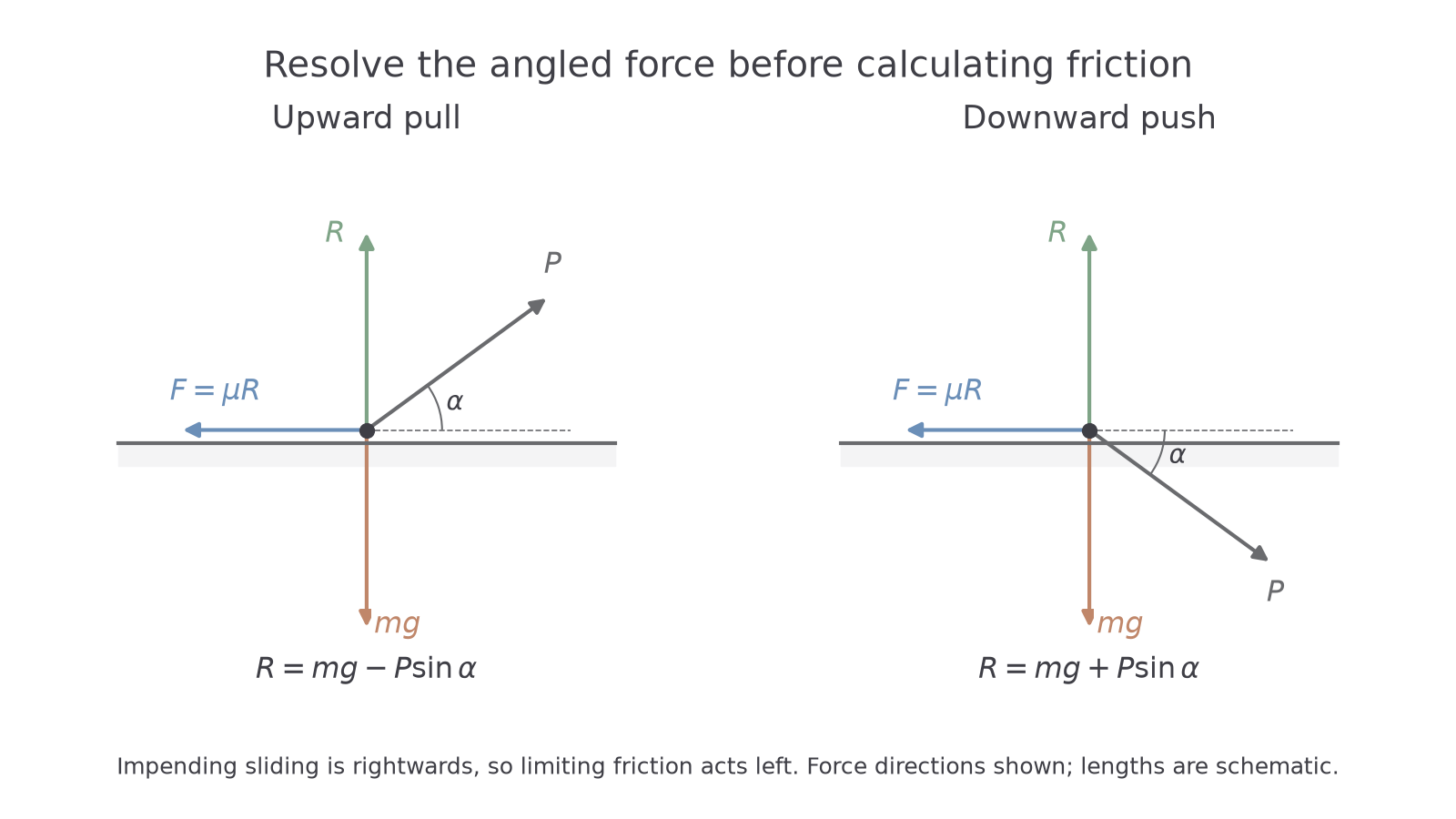
For an acute angle above or below the horizontal, the horizontal component is . The perpendicular component either supports the weight or adds to it.
Angled forces at the sliding threshold
For impending rightward sliding on horizontal ground,
Use the appropriate normal equation. Any solution must have and .
Not in the formula sheet: learn it.
Begin with an upward pull that reduces contact.
Worked example 3: simultaneous limiting equations
Question. A particle on rough horizontal ground has . A force acts right and up at an acute angle with and . The particle is on the point of sliding right. Take . Determine and exactly.
Plan. Eliminate the reaction between normal balance and the limiting-friction equation.
Why retain the force in normal balance? The lifting effect grows as grows; the reaction is not a fixed .
Answer. and .
Check. Both are positive, and , so the horizontal forces balance.
Change only the vertical sense of : it now acts below the horizontal. The requested exact quantities stay the same.
Worked example 4: the same angle directed downwards
Question. The same particle has and . A force acts right and down, with and . It is on the point of sliding right. Determine and exactly.
Plan. Reverse the sign of the applied normal component, then solve the two balances.
Why is the threshold so much larger? This push adds a large downward component, which increases the friction it has to overcome.
Answer. and .
Check. Both the horizontal component and limiting friction are , and contact is maintained.
A negative reaction would invalidate the assumed contact. For an upward force, is the boundary where the normal reaction becomes zero.
Exam tip
For a “Determine” question, display the two component equations and how they give the result. A correct final number alone does not show which contact model you used.
Try a new mass, coefficient and angle, keeping the downward-push structure.
Continue this lesson.
You’re previewing NovaLearn without an account. Create a free account to read the rest.
Create free account