Mc17, Mc18, MC9 - Concavity and points of inflection
Use increasing and decreasing gradients to describe concavity (Mc17), and establish stationary or non-stationary points of inflection (Mc18). You will show how a stationary inflection differs from a maximum or minimum when sketching a curve (MC9).
The sign of the second derivative describes bending
Can two curves have exactly the same bending, but only one have a horizontal tangent? Compare and . Their second derivatives agree everywhere; their first derivatives tell quite different stories at zero.
Before comparing them, take . Its slopes at are . The curve falls before 2, while the gradient increases towards zero.
You already know
describes the tangent gradient and its rate of change. Increasing height and increasing gradient are separate statements.
MEI uses the words “concave upwards” and “concave downwards” in examination questions. Read them as statements about the gradient's change.
Concavity
A smooth curve is concave upwards where its gradient increases, so . It is concave downwards where its gradient decreases, so . For example, is concave upwards even on its decreasing left branch. A straight line has constant gradient, not a change of concavity.
The specification also gives the alternative terms convex downwards and convex upwards respectively; use the stated concave upwards/downwards wording consistently. These sign interpretations are not in the formula sheet: learn them.
Worked example 1: separate bending from direction
Question. Find the concavity intervals of , and describe its direction on .
Plan. Use the second derivative for concavity and the first derivative for direction.
Why this step? Positive second derivative says the slope increases, not that the slope is already positive.
Answer. Concave downwards for , concave upwards for . On , the curve decreases while its gradient increases.
Check. At , and : opposite signs are entirely consistent.
Change only the overall sign. Reflection reverses the direction and concavity at every point where the derivatives are nonzero.
Worked example 2: reflection reverses the bending
Question. Find the concavity intervals of , and its direction on .
Plan. Differentiate twice and interpret the signs.
Why this step? The minus sign affects both derivatives; reversing just the rising/falling labels would leave half the picture wrong.
Answer. Concave upwards for , concave downwards for ; increasing on .
Check. At , the gradient is and its rate of change is .
Concavity describes how successive gradients compare, rather than their current sign.
Watch out
Concave upwards does not mean rising. In the first example, the curve decreases on while its gradient increases towards zero. Use the first derivative for direction and the second for concavity.
Changing the coefficient of the linear term alters the direction intervals but leaves concavity unchanged.
A zero second derivative is only a candidate
An inflection belongs to the curve's shape, rather than to an equation solved in isolation.
Point of inflection
A point of inflection is a point on a curve where it changes from concave upwards to concave downwards, or vice versa. For the smooth curves in this lesson, gives candidates; a change of sign of establishes which are inflections.
The sign-change criterion is not in the formula sheet: learn it.
The comparison below includes a horizontal inflection, a sloping inflection and a flat minimum. A zero second derivative appears in all three cases.
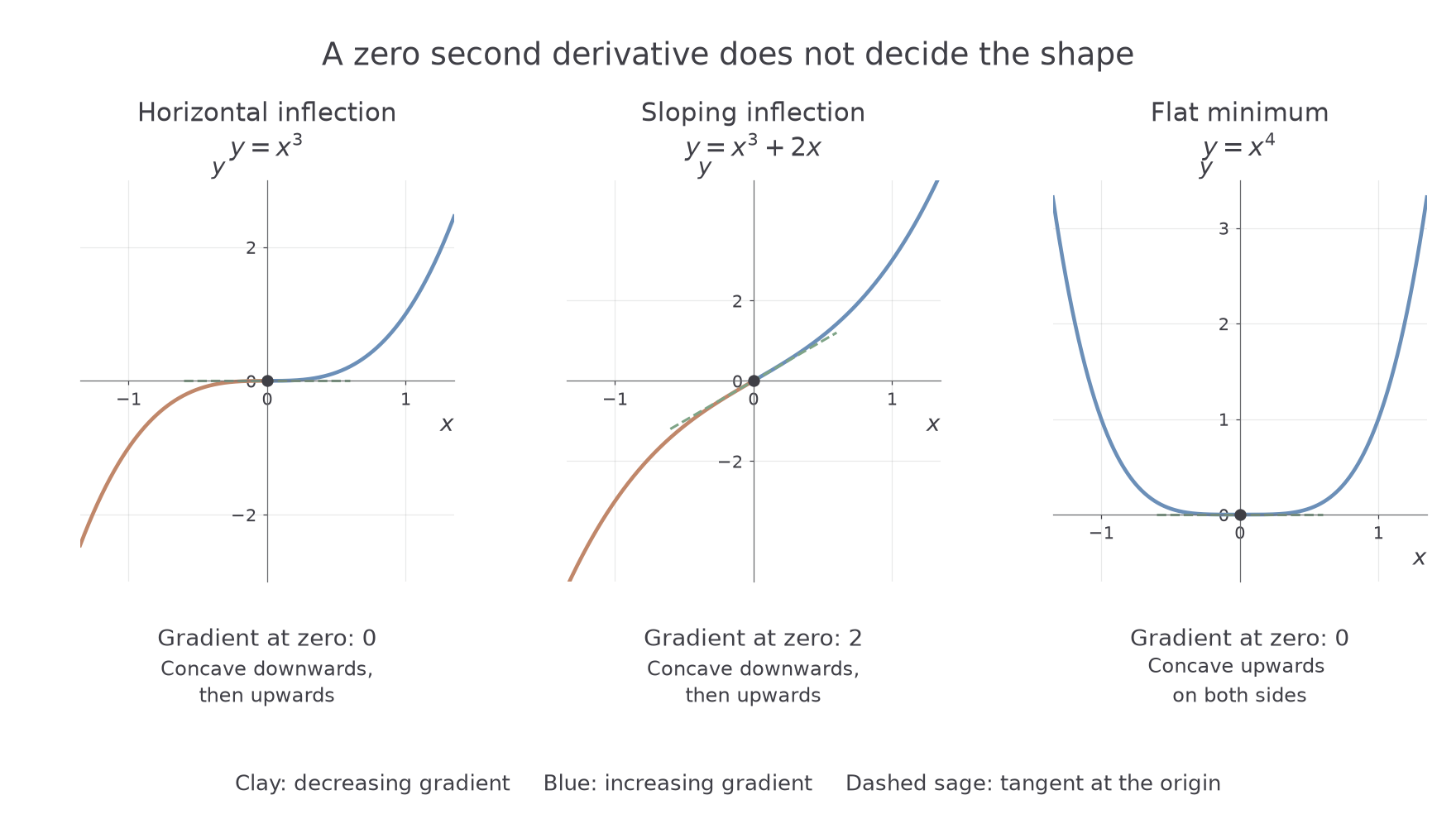
The sign change, rather than the apparent flatness of a small screen plot, makes the decision secure.
Worked example 3: an odd-power sign change
Question. Determine the point of inflection of .
Plan. Differentiate twice, establish the change of concavity and find the point's height.
Why this step? A candidate becomes an inflection only after the change of concavity has been justified.
Answer. Point of inflection .
Check. The gradient decreases towards 2 on the left, then increases away from 2 on the right.
Change only the leading power to 4. The second derivative then has an even-power zero.
Worked example 4: an even-power zero
Question. Determine whether has an inflection at the origin.
Plan. Test the signs of the second derivative on both sides.
Why this step? A zero value is compatible with concavity staying the same across the point.
Answer. No inflection at zero: the curve is concave upwards on both sides.
Check. At and 1, in each case.
The quartic shows why a candidate cannot be accepted from one equality.
Watch out
A zero second derivative is not enough to establish an inflection. The curve must change from concave upwards to downwards, or vice versa; an even-power zero can leave the sign unchanged.
Also check that the candidate belongs to the curve. For , the second derivative is negative for and positive for , but zero is not in the domain. Separate branches do not meet at an inflection. The smooth-curve method here should not be extended blindly to points where the relevant derivative does not exist.
Stationary and non-stationary inflections
After establishing the change of concavity, inspect the first derivative to name the type of inflection.
Stationary and non-stationary inflections
At a point of inflection , a zero first derivative gives a stationary inflection; a nonzero first derivative gives a non-stationary inflection. For example, has a stationary inflection at zero, while has a non-stationary inflection there.
Continue this lesson.
You’re previewing NovaLearn without an account. Create a free account to read the rest.
Create free account