Mn1–Mn3, Mn6 - Newton's laws and equations of motion
Connect Newton's three laws with equations of motion for a particle. You will distinguish a force from a resultant, model motion under gravity, and use one equation for a train whose components have no relative motion.
The first law and zero resultant force
Does a moving trolley need a forward resultant force to keep moving? Imagine an ideal trolley already rolling at a steady velocity: a forward pull of exactly balances a backward resistance of . Its velocity stays steady, although forces act on it.
You already know
Velocity has magnitude and direction. Zero acceleration means constant velocity, including the possible velocity zero. Add force vectors by adding corresponding components.
The distinction is between a force and the resultant of all forces on your chosen body. We use an inertial reference frame, such as the usual stationary-ground model: a frame in which Newton's laws apply.
Newton's first law
A particle remains at rest or moves with constant velocity unless acted on by a non-zero resultant external force. Equilibrium means zero resultant force; it permits uniform straight-line motion as well as rest.
Not in the formula sheet: learn it.
The first law distinguishes rest from uniform motion in a straight line, and gives both the same zero-resultant condition. Turning at constant speed is different: direction changes, so velocity is not constant. A force diagram shows actual external forces on the named body. To complete its equilibrium diagram, add the force that cancels the known arrows; do not add a ‘force of motion’.
[DIAGRAM: asset_name: Completing an equilibrium force diagram; asset_slug: equilibrium_missing_force; description: On a particle, forces (6,0) and (-2,3) newtons have sum (4,3), so the added force (-4,-3) newtons balances them; equal force-component scale and labelled directions; caption: Completing an equilibrium force diagram]
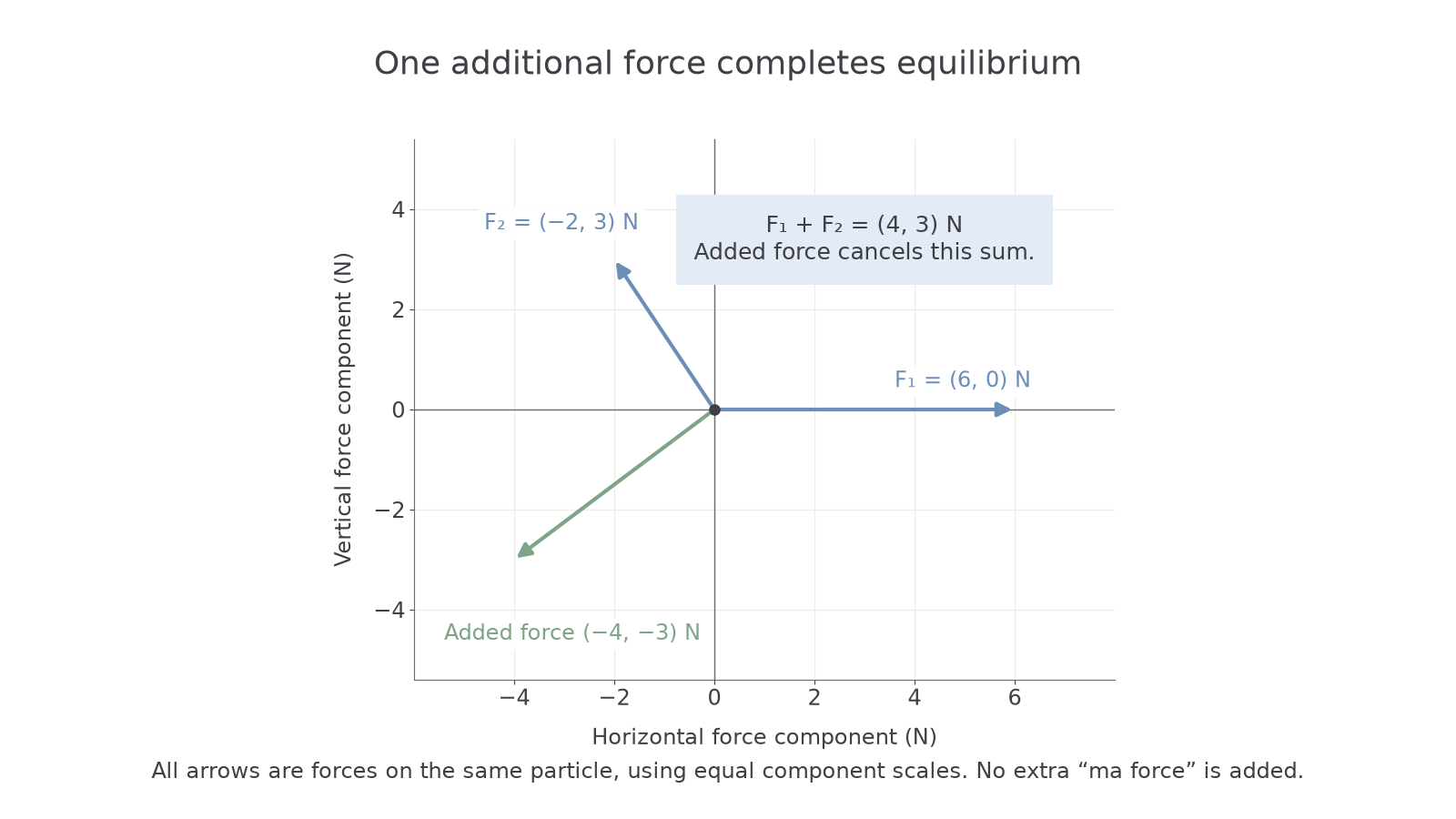
Worked example 1: completing a moving particle's diagram
Question. A particle moves with constant velocity. Its only forces are , and . Find and its magnitude.
Plan. Add the known forces, then reverse their resultant.
Why reverse the sum? Constant velocity requires both component resultants to vanish.
Answer. , magnitude .
Check. and ; both directions balance.
Change only the motion statement from uniform motion to rest. The force calculation should stay the same: equilibrium describes forces, not a unique velocity.
Worked example 2: completing a stationary particle's diagram
Question. A particle remains at rest. Its only forces are , and . Find and its magnitude.
Plan. Use zero acceleration to cancel the known resultant.
Why no new force for being at rest? Rest is one of the motions allowed by zero resultant.
Answer. , magnitude .
Check. The three vectors sum to , exactly as in example 1.
If the velocity is non-zero, its direction still comes from the velocity vector, not from a vanished resultant.
Watch out
“Moving right, therefore resultant right” is wrong. Moving right at constant velocity gives zero resultant; a rightward resultant gives a rightward change in velocity.
Now complete a diagram with a different known resultant.
The second law and directed equations
When the forces stop balancing, use their signed resultant to find how velocity changes.
Equation of motion
An equation of motion is a directed relation between the resultant force on a particle and its acceleration. State the particle, the positive direction, and the individual forces before forming it. For instance, ‘vehicle, right positive: drive minus resistance equals mass times acceleration’ specifies a physical model, rather than just an algebraic equation.
For constant mass, force and acceleration are parallel. One newton is the force that gives a mass of acceleration .
Newton's second law
For constant mass ,
Use kg, N and . Not in the formula sheet: learn it.
Forces constant in time give constant acceleration. Then the constant-acceleration equations, which are in the formula sheet, connect the force model with subsequent motion.
Worked example 3: drive greater than resistance
Question. A vehicle moves right at . A constant drive of acts right and constant resistance of acts left. Find its signed acceleration and velocity after , taking right as positive.
Plan. Subtract resistance from drive, then use .
Why subtract ? It opposes the chosen positive direction, even though its magnitude is positive.
Answer. , .
Check. The positive resultant increases the positive velocity.
Change only the drive to . Keep the same initial motion, interval, resistance and requested outputs.
Worked example 4: resistance greater than drive
Question. A vehicle moves right at . Its drive is zero and constant resistance is left. Find its signed acceleration and velocity after , taking right as positive.
Plan. Use the leftward resultant, then update the velocity.
Why is negative acceleration compatible with rightward motion? It reduces the rightward velocity; it does not instantly reverse it.
Answer. , .
Check. Stopping would take , so the leftward resistance remains appropriate throughout these three seconds.
A resistance that opposes motion must change its description if the motion reverses. A constant-resistance model should not silently continue through a stop into an unphysical reversal. Here the law uses a fixed mass throughout the motion. A model in which fuel is ejected and the moving system loses mass is outside this treatment; substituting a changing mass into the same equation is not a justified extension.
Watch out
The line omits resistance. Write every contributing force before simplifying; is not another arrow on the force diagram.
Try a smaller drive, keeping the same style of directed equation.
Weight and support in vertical motion
A lift passenger can move upwards while feeling lighter. The support force responds to acceleration, while weight stays the same in a fixed gravitational field.
Weight and a vertical equation of motion
Weight is downwards. For a particle supported by an upward floor reaction , taking upwards as positive,
Replace by tension for a cable-supported load with the same force directions. These are applications of Newton's law. Not in the formula sheet: learn it.
Use unless told otherwise. Mass measures inertia and stays in kg; weight is a force measured in N.
Worked example 5: accelerating upwards
Question. A passenger moves upwards with acceleration . Find the upward reaction and state whether it exceeds the passenger's weight. Take upwards positive and .
Plan. Subtract weight from reaction in the upward equation.
Why include even inside a lift? Gravity continues to act; the floor supplies a separate force.
Answer. , exceeding weight by .
Check. , the specified acceleration.
Change only the acceleration's direction. The passenger still moves upwards, but now slows down.
Worked example 6: moving upwards and slowing
Question. A passenger moves upwards with acceleration . Find the upward reaction and state whether it exceeds the passenger's weight. Take upwards positive and .
Plan. Keep the force directions and change the sign of acceleration.
Why does support decrease? A downward resultant is needed to reduce the upward velocity.
Answer. , which is below weight.
Check. ; reaction remains positive, so the floor can supply it.
Continue this lesson.
You’re previewing NovaLearn without an account. Create a free account to read the rest.
Create free account