Mt5, Mt6 - Fundamental trigonometric identities
Use the tangent ratio in Mt5 and the Pythagorean identity in Mt6 to connect exact values, prove equalities and solve equations. The emphasis is on choosing a useful identity while keeping signs, denominators and all permitted solutions under control.
Two identities from coordinates
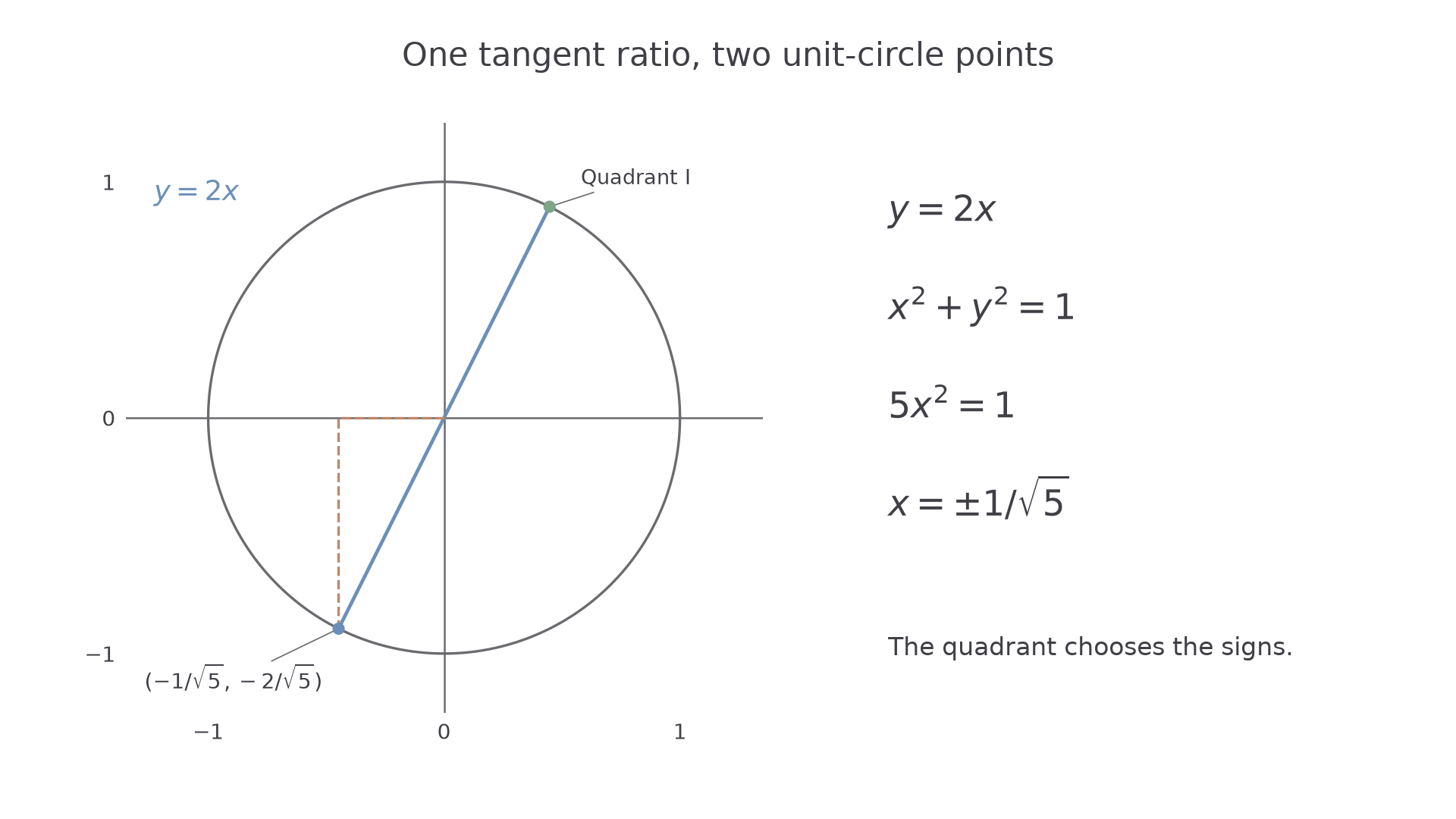
Can you find sine and cosine exactly from , without finding the angle? A unit-circle point with that ratio lies on . Substituting into gives . There are two possible points, one in quadrant I and one in quadrant III. By the end you will choose the right one from an interval.
You already know
The point on the unit circle at angle is . Pythagoras gives its squared distance from the origin; quadrant signs tell you which coordinates are positive or negative.
This coordinate picture produces two identities. One is a sum of squares; the other is a ratio of signed coordinates.
Fundamental trigonometric identities
Not in the formula sheet: learn it.
The first follows from . The second follows from the slope , so it excludes , with integer . At , the first identity remains true while the tangent ratio is undefined. Here , rather than .
Identity
An identity is an equality true for every input in its stated domain. An equation selects the inputs where an equality holds. A few successful numerical checks are evidence, but cannot establish an identity for every input.
A small change can destroy an identity: at , , not . Yet at that sum does equal . The squares in the real identity carry the geometry.
Key idea
Use the sum of squares to find magnitudes and the ratio to relate signed values. Neither removes the need to check the domain.
A domain error can hide in a calculation that uses an otherwise correct identity.
Recovering values without losing signs
A tangent value gives a ratio; combine it with the sum of squares and the quadrant to recover the two coordinates.
The opening problem has an unexpected feature: the tangent is an integer, but both sine and cosine are irrational. A simple ratio need not have simple rational components.
Worked example 1: a ratio in quadrant III
Question. Given and , find and exactly.
Plan. Write sine in terms of cosine, substitute into the identity, then choose the negative signs.
Why this step? Tangent is positive in two quadrants; the supplied interval selects the point with two negative coordinates.
Answer. and .
Check. Their ratio is , and their squares sum to .
Change only the interval to quadrant I, keeping the tangent value fixed.
Worked example 2: the other point with the same ratio
Question. Given and , find and exactly.
Plan. Reuse the magnitude calculation, then choose the positive coordinate signs.
Why this step? The squared equation cannot distinguish the two points; the interval does.
Answer. , .
Check. Both values are positive, have magnitudes below and give tangent .
Starting from sine or cosine is equally useful. If in quadrant II, then , giving , . If in quadrant III, then and . An interval is the missing sign information in both calculations.
Watch out
Wrong: choose a positive square root simply because the square is positive. Right: the square root gives a magnitude; the quadrant supplies the sign of sine or cosine.
Change the tangent value, retaining the quadrant-III choice from the first example.
Simplifying and proving with domains
Choose a form of the identity that removes an awkward square or produces a factor you can cancel, while keeping the starting expression's restrictions.
For example,
The simpler result may exist where the quotient does not. That does not fill a missing input in the quotient. A useful related proof is
Here the conjugate turns the numerator into a difference of squares. The stated condition ensures all denominators and cancelled factors are nonzero.
Continue this lesson.
You’re previewing NovaLearn without an account. Create a free account to read the rest.
Create free account