Mp31, Mp32, MF1–MF3 - Particles, forces and mechanical assumptions
Translate modelling words into consequences: Mp31 and Mp32 explain simplifying assumptions and the particle model. MF1–MF3 develop force vocabulary, local gravity and force diagrams, so you can choose a system and explain which interactions your model includes.
What a mechanical model retains
A package rests on a shelf. If you press down on it with a force, does the shelf's support force still equal the package's weight? The answer depends on what the model includes, not just on spotting the word “horizontal”.
Start with the package itself. To locate it on a large shelf, its centre may be enough. To decide whether it tips over an edge, we need its shape and size too.
You already know
Mass is measured in kilograms, while force and weight use newtons. Vectors have magnitude and direction, so force diagrams need arrows with clear labels.
A simplification is useful when the omitted detail has little effect on the question being asked.
Particle model
A particle has mass but negligible size for the purpose of the model. Its position and translational motion are retained; its shape, orientation and rotation are not modelled.
A train can be a particle when tracking a journey along a long straight route. It needs a length when deciding when its rear clears a platform. “Particle” does not mean massless or stationary.
Other modelling words each have a specific job:
| Word | Mathematical consequence | What it does not imply |
|---|---|---|
| Light | Neglect mass and weight of the named object. | A light string can still transmit tension. |
| Smooth | Neglect friction at that contact. | A normal contact force can still act. |
| Uniform | Mass is distributed evenly through the modelled body. | The body need not be rigid. |
| Inextensible | A string's length does not change. | It need not stay taut. |
| Thin | Neglect thickness where it is irrelevant, as for a lamina. | Its mass need not be negligible. |
| Rigid | Shape and dimensions do not change. | Mass need not be uniformly distributed. |
| Long term | Consider behaviour after initial changes, often a limiting or settled state. | The physical situation need not continue for ever. |
For example, a falling-body model may predict an approach to a limiting speed in the long term. A real fall still ends on landing. You should use the prediction only while the model's conditions remain relevant; “long term” is about the model's behaviour, not permission to ignore the ground.
To refine a model, identify a specific mismatch with observations and restore the feature causing it. A thin flexible sheet blowing about needs more than a rigid-lamina model; a slowly drifting feather may need resistance from the air. Retest the refined prediction rather than assuming that a longer description guarantees a better model.
Key idea
An assumption has a consequence. Explain the consequence in the situation, and say when the omitted effect could matter.
The words in a mechanics question are deliberately different: do not swap one for another.
Forces belong to a chosen body
A force diagram is an account of interactions with one selected body or system. It does not contain an arrow simply because the body is moving.
Force diagram
A force is a vector interaction that can change velocity. A force diagram shows each force acting on the selected body as a labelled arrow in its direction. Forces the body exerts on other objects belong on those objects' diagrams.
Tension and compression act along a connector, but one pulls and the other pushes. Contact forces are related to the contact surface, while resistance is related to motion through a medium.
| Force | Direction on the selected body |
|---|---|
| Weight | Towards the attracting body; locally downwards |
| Tension | Along a taut string, pulling away from the body |
| Thrust or compression | Along a compressed rod, pushing on the body |
| Normal reaction, or normal contact force | Perpendicular to the surface, away from it |
| Frictional force | Along the contact, opposing relative sliding or its tendency |
| Resistance | Opposes motion relative to the resisting medium |
| Driving force | In the direction in which the drive acts |
A rough surface may exert friction; a smooth contact neglects it. Normal reaction is perpendicular to a slope, not necessarily vertical. “Resistance” needs a direction and a physical context: for a ball falling through still air it acts upwards.
[DIAGRAM: asset_name: Contact and falling-body force diagrams; asset_slug: mechanics_forces; description: Forces on a crate on a rough horizontal floor, a bead on a smooth incline and a falling ball with resistance; caption: Contact and falling-body force diagrams]
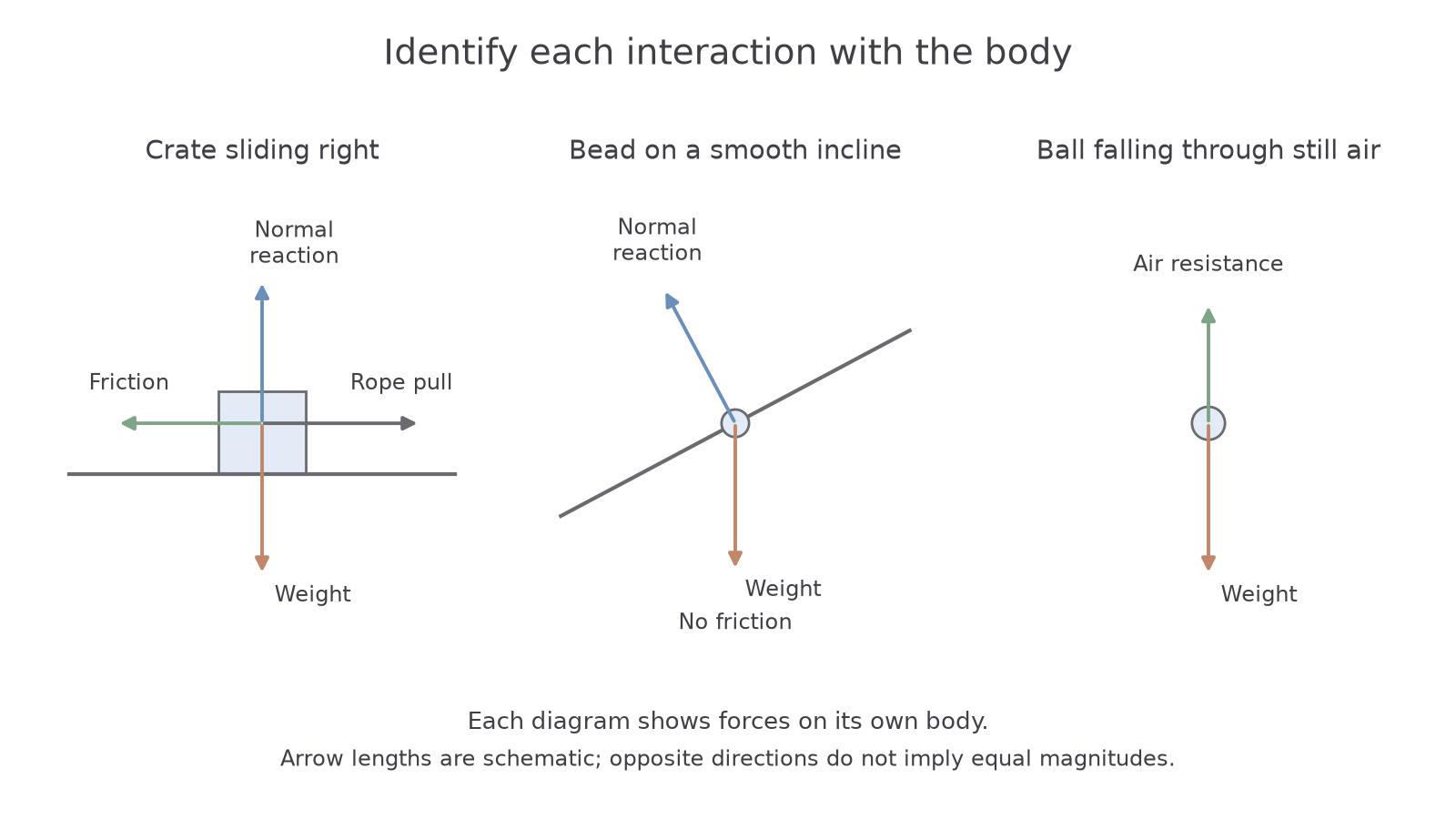
These are separate force diagrams, with schematic arrow lengths. In particular, the falling ball's two arrows do not claim that resistance equals weight.
Worked example 1: a gravity-only model
Question. A ball has been released and is falling through still air. Model it as a particle and neglect air resistance. State its forces and their directions, explain why the hand's force is absent, and state the effect of the air-resistance assumption on the model.
Plan. List current interactions with the ball, then apply the stated omission.
- Earth attracts the ball, so include weight vertically downwards.
- Air resistance is neglected, so omit an air-force arrow.
- The hand is no longer in contact, so omit the hand's force.
Why this step? A past push or support is not a present interaction after release.
Answer. The diagram has one force: weight downwards. The hand no longer touches the ball. Neglecting air resistance removes the air's interaction, leaving a gravity-only model.
Check. Downward velocity is not an additional downward force.
Change only the resistance assumption. The ball is still falling through still air after release.
Worked example 2: restore a resistance force
Question. Include air resistance for the same falling ball. State its forces and their directions, explain why the hand's force is absent, and state the effect of the air-resistance assumption on the model.
Plan. Retain gravity and add the previously neglected interaction with the air.
- Keep weight downwards.
- Add air resistance upwards, opposing the downward motion relative to the still air.
- Keep the hand's force absent: release has not been reversed.
Why this step? Refinement restores the relevant omitted interaction; it does not replace weight with resistance.
Answer. Weight acts downwards and air resistance upwards. The hand no longer touches the ball. Including air resistance restores the air's interaction, refining the gravity-only model.
Check. No equality of magnitudes is implied. A force law for would need further information.
At the highest point of an upward throw, velocity can be zero while weight still acts downwards. Zero velocity at one instant does not mean zero force: stopping and staying stopped are different claims.
Watch out
“Add air resistance” may be too vague when improving a model that already includes it. Identify the omitted direction or effect, such as horizontal resistance for a body moving through the air in two dimensions.
Use the same resistance rule for a stone travelling in the other direction.
Mass, weight and local gravity
The value of gravitational acceleration belongs to the model's location and accuracy. A calculator's stored constant is not a replacement for a question's stated value.
Local gravitational acceleration
The magnitude of acceleration due to gravity is not universal. Near Earth's surface it is often modelled as constant, normally in these examinations unless otherwise specified.
The internationally agreed standard acceleration is , which some calculators store. It is a reference value, not an assertion that every place has exactly that acceleration. On Earth, varies with latitude and height; no inverse-square law for gravitation is required here.
Weight magnitude
Use mass in kilograms and local gravitational acceleration magnitude in , giving weight magnitude in newtons. Weight acts locally downwards. The mass remains unchanged when the location changes.
Not in the formula sheet: learn it.
A calculation makes the distinction between the conventional and stated values clear.
Worked example 3: the examination convention
Question. Calculate the weight of a instrument near Earth's surface when no value of is specified. Give the answer to significant figures.
Plan. Use the examination convention , and round only the final result.
Why this step? The conventional is part of the specified examination model; extra calculator digits do not improve that model.
Answer. , downwards.
Check. The estimate is close to the unrounded result.
Continue this lesson.
You’re previewing NovaLearn without an account. Create a free account to read the rest.
Create free account