MF13–MF15 - Moments and rigid-body equilibrium
Calculate moments about a point or axis and combine the turning effects of several forces. You will distinguish force balance from turning balance, then choose a useful point to find unknown forces in rods and rectangular laminas.
Moment and perpendicular distance
Could two opposite pushes with zero resultant still turn a book? Push its top edge to the right and its bottom edge equally to the left: both pushes favour clockwise turning. Keeping the positions of the forces changes the story completely.
First consider upwards on a horizontal rod, right of . Its turning effect is anticlockwise. If its line passes through , that turning effect is zero even though the force remains .
You already know
A resultant force is the directed sum of forces. Horizontal and vertical components can balance separately; a rigid-body diagram must also show where the forces act.
A force's line of action is the straight line through its point of application in its direction. Measure to that line, at right angles.
Moment of a force
A force's moment about a point measures its turning effect: force magnitude multiplied by the perpendicular distance from the point to the force's line of action, with clockwise or anticlockwise sense.
Moments act about an axis. Here the forces lie in a plane, and the axis through the chosen point is perpendicular to that plane; describing the moment as “about ” identifies this implied axis.
[DIAGRAM: asset_name: Perpendicular moment distances; asset_slug: perpendicular_moment_distances; description: A horizontal rod with a vertical 10 N force 3 m from O and a rectangular lamina with a horizontal 8 N force 0.5 m above O; perpendicular distances and line-of-action extensions labelled; caption: Use perpendicular distance to the force's line of action]
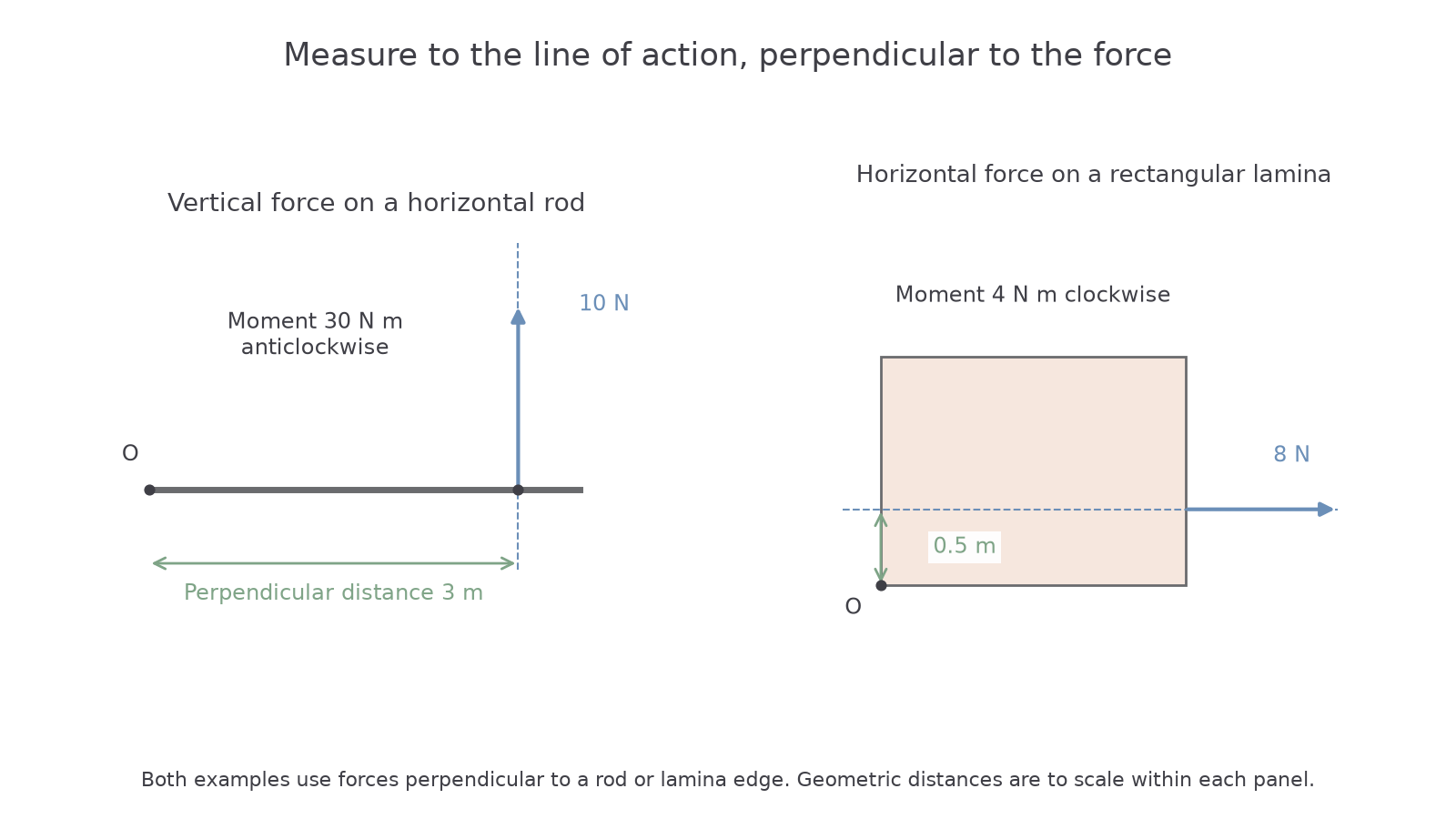
In the second panel, the horizontal force has vertical arm , so its moment is clockwise. Moving its application point along that same horizontal line leaves the moment unchanged. That useful fact is about the line of action, not the length of the arrow.
Moment magnitude
For a coplanar force of magnitude whose line of action is perpendicular distance from the point,
Use newtons and metres for . A force through the point has zero moment.
Not in the formula sheet: learn it.
The models here use rods and rectangular laminas, with forces perpendicular to the rod or to an edge of the lamina. The following rod is vertical, so its horizontal force is perpendicular to it.
Worked example 1: a horizontal force on a vertical rod
Question. A horizontal force acts rightwards on a vertical rod, above . Calculate its moment about , giving its sense and the answer in .
Plan. Convert the vertical perpendicular arm to metres, then multiply.
Why use the vertical distance? The line of action is horizontal, so its perpendicular distance is vertical.
Answer. clockwise.
Check. A rightward push above turns the top rightwards; .
Change only the force's height, placing it below . Its magnitude and rightward direction stay the same.
Worked example 2: crossing the reference point
Question. A horizontal force acts rightwards on a vertical rod, below . Calculate its moment about , giving its sense and the answer in .
Plan. Use the same perpendicular arm and identify the new turning sense.
Why does the sense reverse? A rightward push below the point turns the bottom rightwards, which is anticlockwise.
Answer. anticlockwise.
Check. Reflecting the application point across preserves the arm's length and reverses the rotation.
A vector treatment of moments is unnecessary: record a magnitude and sense, or a signed scalar with a declared convention.
Watch out
The line mixes centimetres with metres. It is , which equals .
Try a fresh force and distance, keeping the below-point geometry.
Adding clockwise and anticlockwise moments
A force system can have several turning effects on one rectangular lamina. A single sign convention keeps horizontal and vertical forces in the same calculation.
Take anticlockwise as positive. A rightward force above is clockwise, whereas an upward force right of is anticlockwise. Use the rotation, not the sign of the force component.
Adding moments
For coplanar forces,
Calculate every term about the same point, using the distance perpendicular to that particular force.
Not in the formula sheet: learn it.
For a rectangle, different edges can provide different perpendicular arms. This is why multiplying every force by one convenient side length fails.
Worked example 3: moments on a rectangular lamina
Question. A rectangular lamina is wide and high, with horizontal and vertical edges and lower-left corner . An force acts rightwards at the upper-left corner and a force upwards at the lower-right corner. Find the total moment about , including its sense.
Plan. Use vertical arm for the horizontal force and horizontal arm for the vertical force.
Why are the arms different? Each must be perpendicular to its own force's line of action.
Answer. clockwise.
Check. The clockwise contribution just exceeds anticlockwise.
Change only the direction of the upper force. Both moments will now have the same sense.
Worked example 4: reinforcing moments
Question. The same by rectangular lamina has an force leftwards at the upper-left corner and a force upwards at the lower-right corner. Find the total moment about its lower-left corner , including its sense.
Plan. Keep the perpendicular arms and reassess each turning sense.
Why add? Pulling the top leftwards and pushing the right-hand edge upwards reinforce the same rotation.
Answer. anticlockwise.
Check. Reversing the force changes the signed total by ; .
Continue this lesson.
You’re previewing NovaLearn without an account. Create a free account to read the rest.
Create free account