Mk9–Mk12 - Motion in two dimensions with vectors
Describe motion in a plane by connecting position, velocity and acceleration component by component. Distinguish distance travelled from displacement, find a Cartesian path with its physical domain, and compare particles' positions at a common instant.
Position, travel and direction in a plane
Can a moving particle have zero average velocity but a positive average speed? Picture a robot travelling from to , then back to , in four seconds. Its final position tells you nothing about the ten metres it has travelled. A position log and a distance counter answer different questions.
You already know
For fixed perpendicular unit vectors and , . Subtract endpoints in destination-minus-start order to find a displacement.
Position locates the particle relative to an origin. The same vector may be written . The coordinates have units of length; the unit vectors do not.
Displacement and the two distances
Displacement over an interval is . Its magnitude is separation of the endpoints. Distance from the origin is , whereas distance travelled is the length of the actual route. For instance, a complete circuit has positive distance travelled but zero displacement.
Velocity includes direction; speed is its non-negative magnitude. Acceleration measures change in velocity, so it can change the direction of motion even when speed is momentarily unchanged. The magnitude of acceleration is a scalar, not a substitute for its vector. The signs of individual velocity and acceleration components alone do not determine speed change in a plane; the one-dimensional same-sign rule cannot simply be applied to one component of a turning motion.
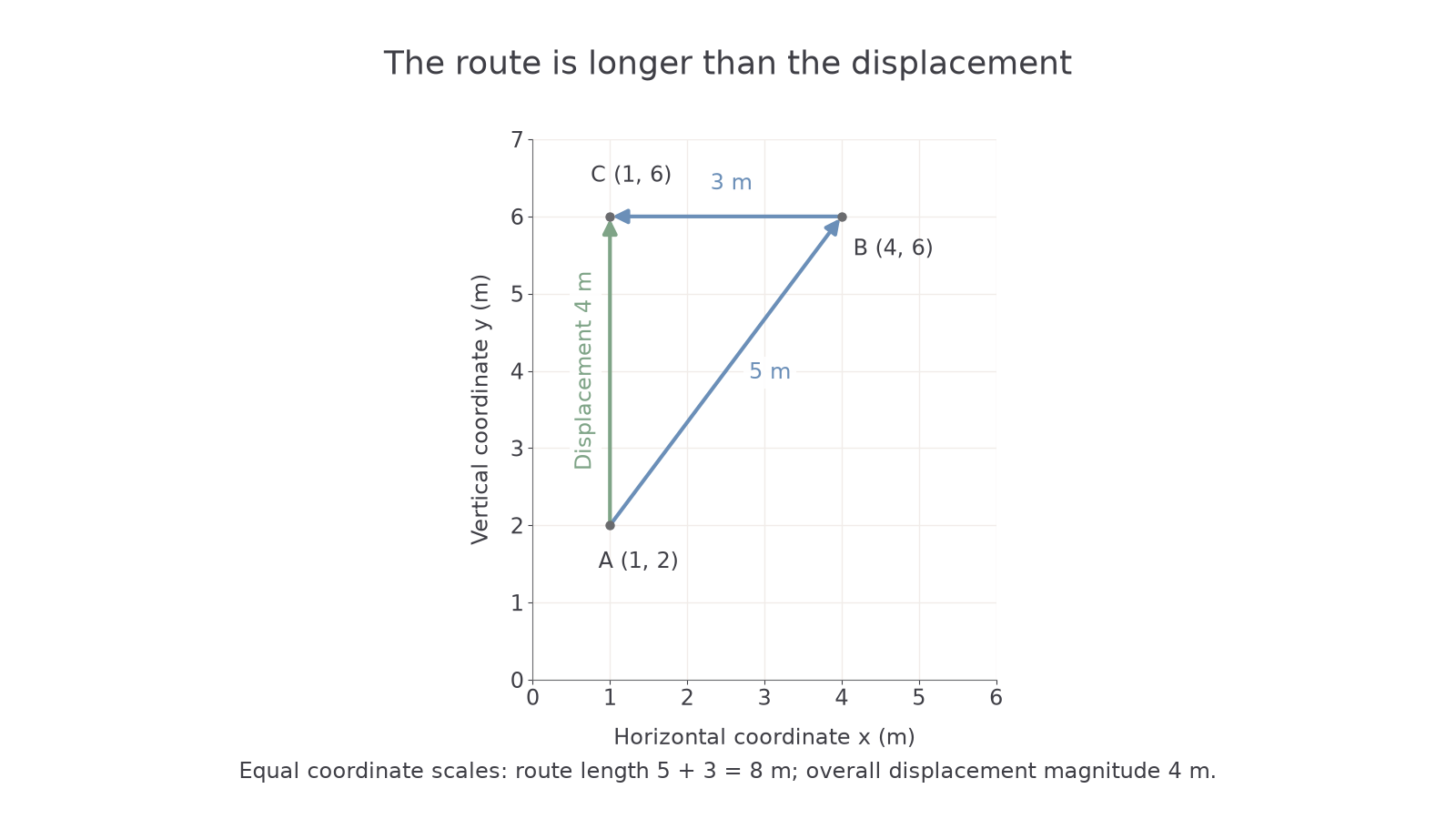
[DIAGRAM: asset_name: A route and its overall displacement; asset_slug: vector_route; description: Equal-scale coordinate diagram showing A(1,2), B(4,6), C(1,6), the 5 and 3 metre legs and the 4 metre displacement from A to C; caption: A route and its overall displacement]
Average velocity and average speed
For an elapsed time ,
The magnitude of average velocity is at most average speed. Not in the formula sheet: learn it.
The picture's bent route gives a useful comparison before we return to the robot's closed trip.
Worked example 1: following the route
Question. A particle travels from to to , with coordinates in metres, in . Find its displacement, distance travelled, average velocity and average speed.
Plan. Use the endpoints for displacement and both leg lengths for total travel.
Why this step? A magnitude is taken separately for each leg before the lengths are added.
Answer. Displacement is , distance travelled is , average velocity is , and average speed is .
Check. Final distance from the origin is ; it is neither the route length nor the displacement magnitude.
Change only the final destination to . Keep the same four requests and elapsed time.
Worked example 2: returning to the start
Question. A particle travels from to and back to , with coordinates in metres, in . Find its displacement, distance travelled, average velocity and average speed.
Plan. Cancel the displacement vectors, but add the outward and return distances.
Why this step? The speed calculation measures the journey, not the net change of location.
Answer. Displacement and average velocity are zero vectors; distance travelled is , and average speed is .
Check. There is no contradiction: velocity vectors can cancel, but non-negative route lengths cannot.
MEI includes relative position in two dimensions, developed in the last part. Two-dimensional relative velocity is excluded; do not extend the earlier one-dimensional relative-velocity method here.
Watch out
Wrong: average speed is . That uses distance from the origin. Right: first add the lengths of the route travelled, then divide by elapsed time.
Try a fresh closed route with the same elapsed time.
Constant acceleration with vector equations
Constant acceleration in a plane means that both acceleration components remain constant throughout the interval.
You already know
The one-dimensional equations relate signed displacement, velocity, acceleration and one elapsed time. A displacement vector must be added to the starting position to give the new position.
Apply and , then collect the two component equations into a vector. The displacement forms follow in the same way, or by integrating the velocity components.
The four vector equations
When is constant,
Here . In the formula sheet.
There is no vector version of in this course. A scalar equation along a chosen axis is legitimate, but squaring a column vector component by component does not create a valid extra vector equation.
Worked example 3: one time for both directions
Question. A particle starts at , with velocity and constant acceleration . Determine its velocity and position after .
Plan. Substitute the shared time into the velocity and displacement equations, then add the initial position.
Why this step? Horizontal velocity has reversed, but displacement records the whole interval, including the earlier rightward motion.
Answer. and .
Check. , confirming displacement.
Change only the elapsed time to four seconds; the requested vectors remain the same.
Worked example 4: later in the same motion
Question. A particle starts at , with velocity and constant acceleration . Determine its velocity and position after .
Plan. Use consistently in both vector equations.
Why this step? A zero horizontal displacement does not imply zero horizontal velocity at the end.
Answer. and .
Check. Horizontal average velocity is , giving zero horizontal displacement over four seconds.
To recover an unknown constant acceleration, rearrange in both components. For example, a velocity change from to in three seconds gives .
Watch out
Wrong: use as if it were a constant in a constant-acceleration equation. Right: if either component varies with time, use calculus instead.
The same particle is observed at a third time below.
Differentiate vector components
A vector model can combine a steady horizontal drift with a changing vertical motion; differentiate the components separately.
You already know
The chain rule gives . Differentiate a position before taking a magnitude to find speed.
The fixed unit vectors remain unchanged while their scalar components are differentiated.
Time derivatives of a vector
For ,
Speed is . Not in the formula sheet: learn it.
Differentiate position first and take its derivative's magnitude afterwards. The derivative of distance from the origin generally measures something different. Keep the complete vector when the question asks for velocity or acceleration.
Worked example 5: a changing vertical rate
Question. For , a particle has . Determine its velocity, acceleration and speed at seconds.
Plan. Differentiate both components and use .
Why this step? Differentiating gives ; the chain-rule sign matters.
Answer. Velocity is , acceleration is , and speed is .
Check. The particle is still moving upwards, while the negative vertical acceleration reduces its upward velocity.
Continue this lesson.
You’re previewing NovaLearn without an account. Create a free account to read the rest.
Create free account