Mc22, Mc23, Mc25 - Definite integrals, signed area and limits of sums
Evaluate definite integrals, separate signed accumulation from geometric area and interpret an integral as a limit of rectangles. Read a finite-sum argument and explain its bounds, error and exact limit.
A definite integral is a number
Can two positive areas add to a zero integral? On , the line forms two triangles, each of area , but its integral is zero. The missing distinction is sign. We will build the calculation from antiderivatives, then connect it with narrow rectangles.
You already know
An indefinite integral is a family , where . The same constant disappears when one function value is subtracted from another.
The notation for a definite integral records which inputs to use.
Definite integration
For a function continuous on , with ,
It gives a number, whereas an indefinite integral gives a family. The same constant in and cancels.
Not in the formula sheet: learn it.
The lower limit may contribute a negative value. Put it in brackets before subtracting.
Worked example 1: a negative lower limit
Question. Evaluate .
Plan. Integrate the polynomial and evaluate upper minus lower.
Why this step? The lower contribution is , so subtracting it adds .
Answer. .
Check. The integrand is even, so twice the integral from to also gives .
Change only the upper endpoint. The same antiderivative still applies.
Worked example 2: extend the interval
Question. Evaluate .
Plan. Evaluate the same bracket at and .
Why this step? Changing a boundary changes the accumulation interval; it does not change the integrand's antiderivative.
Answer. .
Check. The extra integral from to is , and .
Reversing the bounds reverses the sign; equal bounds give zero. Splitting at gives . Linearity permits sums and constant multiples to be integrated term by term.
Watch out
A bracket calculation across an undefined point is not an ordinary definite integral. For example, is undefined at zero; endpoint substitution across zero does not fix that problem.
Vary the upper boundary once more and keep the lower bracket intact.
Signed accumulation and positive area
The integral uses signed heights. Geometric area uses non-negative heights, so cancellation must be prevented.
Area between a graph and the axis
For , the geometric area is enclosed by the graph, the axis and the vertical boundaries . It equals when , and when . If the sign changes, split into regions and add their magnitudes.
Here the line crosses at . The left region's height is negative in the integral, but its area is positive.
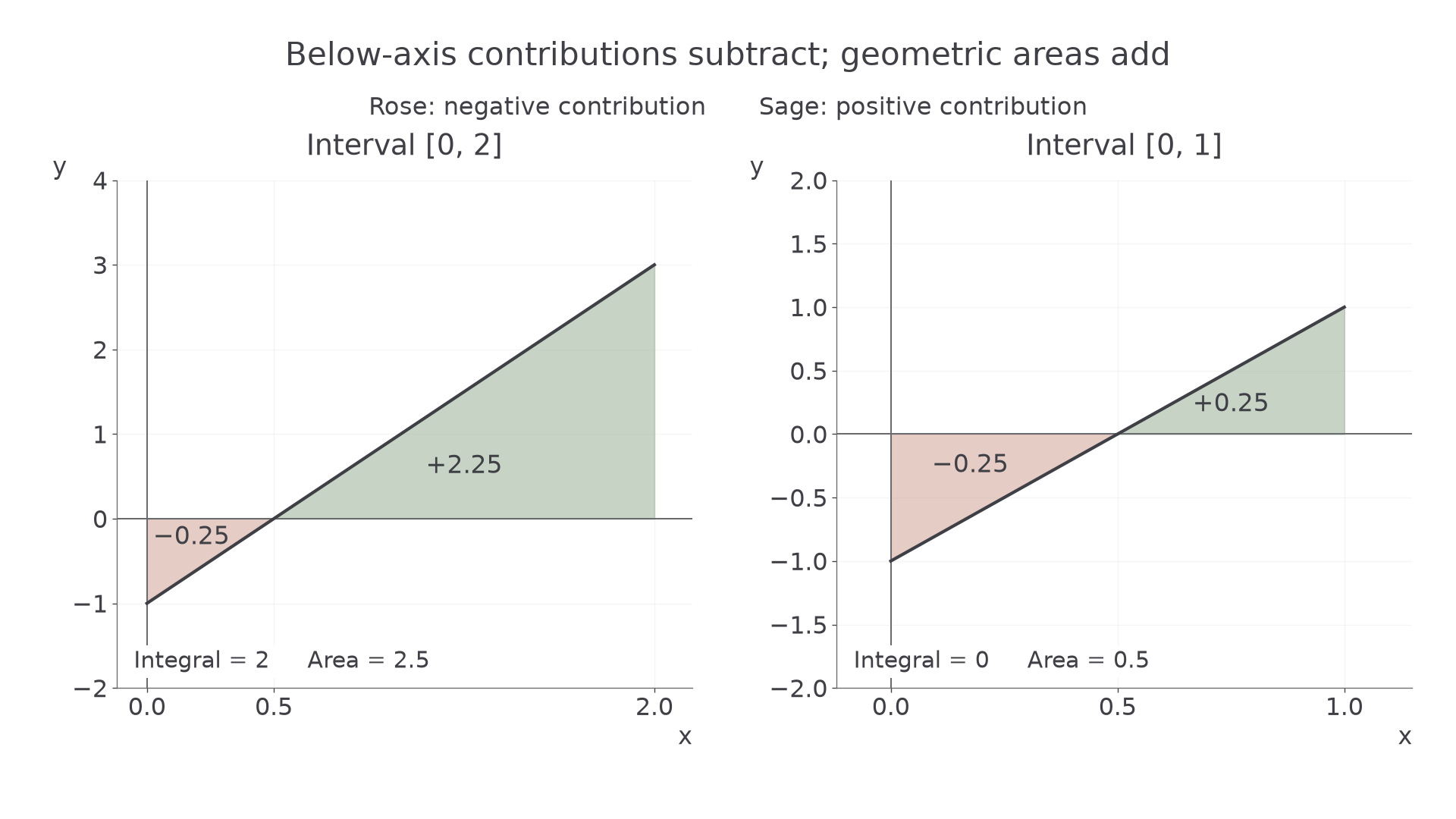
Start with unequal regions, then move just one boundary.
Worked example 3: signed sum and area
Question. For on , find the signed integral and geometric area.
Plan. Split at and use the antiderivative .
Why this step? Only the area calculation reverses the sign of a below-axis contribution.
Answer. Integral ; area square units.
Check. The triangle areas are and .
Change only the upper boundary to . Now the two triangles match.
Worked example 4: cancellation
Question. For on , find the signed integral and geometric area.
Plan. Evaluate the two contributions either side of .
Why this step? A zero net accumulation says the signed contributions balance, not that no region exists.
Answer. Integral ; area square unit.
Check. The two triangles have equal bases and equal heights .
Use square units for an abstract coordinate area. If both coordinates measure metres, the area unit is .
Watch out
Taking the magnitude at the end is too late: is not the area . Take each region's magnitude before adding.
Change just the upper limit again.
Locate every change of sign
Roots divide the interval into regions, but you still need to check each sign. Touching the axis is not the same as crossing it: has a root at zero and remains non-negative.
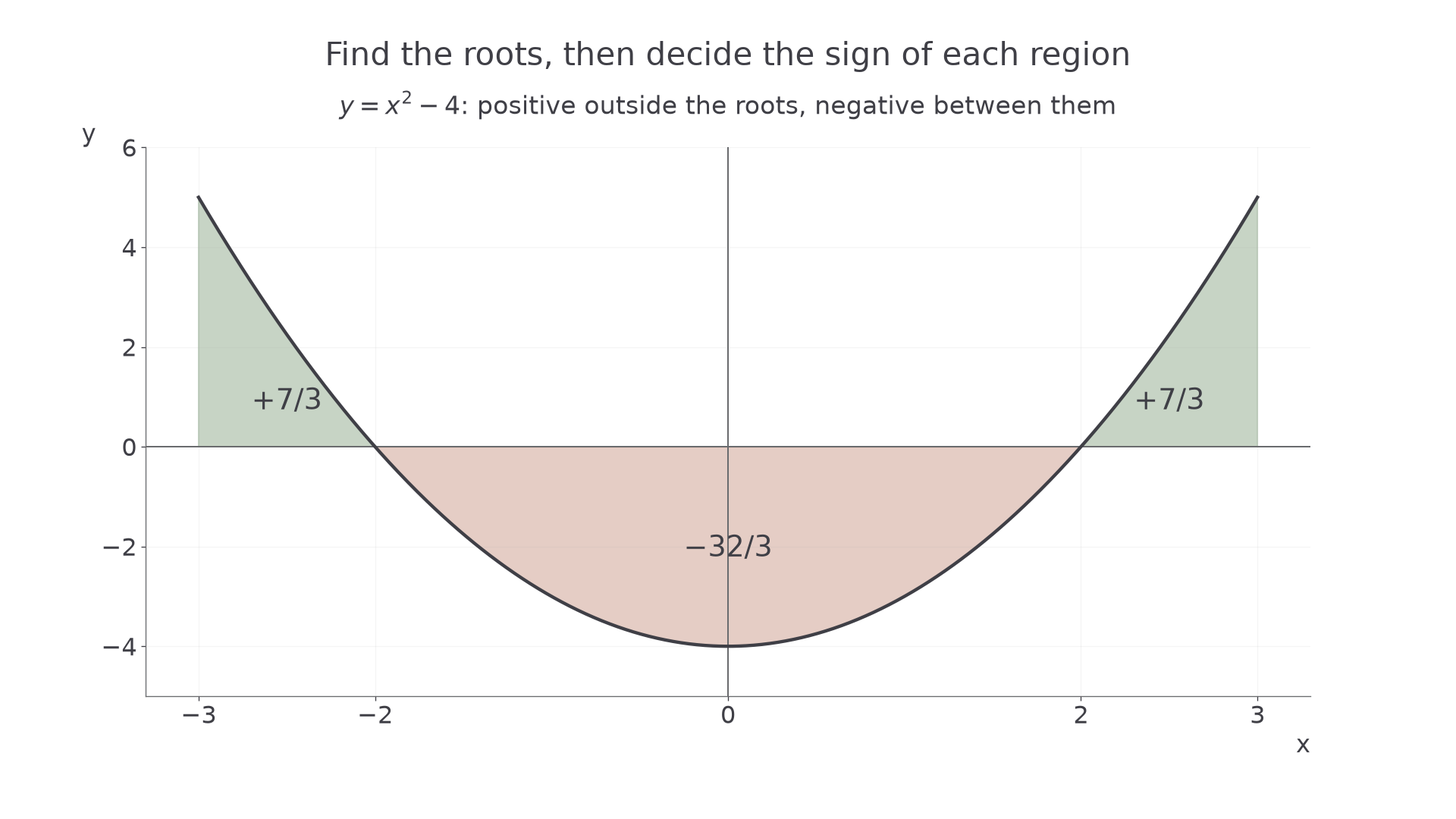
For , the roots are ; the sign is positive outside and negative between them. Use the stated vertical boundaries even when they cut through a lobe.
Worked example 5: three regions
Question. Find the geometric area and signed integral for on .
Plan. Split at and evaluate with .
Why this step? A single endpoint subtraction gives the net integral, but it hides how much area was cancelled.
Answer. Area square units; signed integral .
Check. The equal outer contributions agree with the symmetry of the graph.
Change only the upper endpoint to . One positive outer region is removed.
Worked example 6: a boundary at a root
Question. Find the geometric area and signed integral for on .
Plan. Keep only the left and central pieces from the previous calculation.
Why this step? An area beyond the supplied boundary cannot be included merely because it is part of a familiar sketch.
Answer. Area square units; signed integral .
Check. .
The entirely below-axis region on has area , the magnitude of its integral. An area is positive even when there is no positive part of the graph.
Continue this lesson.
You’re previewing NovaLearn without an account. Create a free account to read the rest.
Create free account