Mf4, Mf5 - Composite and inverse functions
A composite must use its functions in the right order and respect both domains. Learn to determine composite rules and domains, decide when a function can be reversed, and find the inverse's formula, graph, domain and range.
Following the order of a composite function
Start at . If you triple and subtract , then square, you reach . Square first, then triple and subtract , and you reach . Can either route be undone, and what must the reverse route accept as inputs?
You already know
A function's rule and domain work together. A whole expression substituted into an input slot needs brackets, especially before a power.
Name “triple and subtract ” as , and “square” as . Reading from the input outwards keeps the order visible.
Composite function
means apply first and second. It is one function feeding another, rather than the product of their outputs. Repeating is written ; squaring its output is .
These notation conventions are not in the formula sheet: learn them. The functions nearest the input act first, even though the letters are read in the opposite order in ordinary prose.
Worked example 1: keeping the inner rule intact
Question. and , both defined on . Determine , and .
Plan. Put the entire inner expression into the outer function's input slot.
Why this step? In the first composite, the square applies to the full linear output, including its subtraction.
Answer. , and , respectively.
Check. At , the first two values are and , agreeing with the opening routes.
Change only the exponent in from to . This changes the two routes using , while the repeated route stays fixed.
Worked example 2: changing the outer power
Question. and , both defined on . Determine , and .
Plan. Substitute in the same order, taking care to cube the complete inner expression.
Why this step? Composition order depends on which rule receives which input, not on whether a rule is linear, a square or a cube.
Answer. , and , respectively.
Check. At , the values are , and . Only the first two change from using a different .
There is no general equality . Some pairs do commute, such as adding and adding , but that must be established for the functions concerned.
Watch out
Wrong: . Right: feed one output into the other rule. With the first example's functions, the product is , a different expression.
Keep the substitution method and try two different linear functions.
Checking both stages of the domain
A composite's domain has two gates: the input must enter the first function, and its image must enter the second. A simplified expression cannot remove a restriction imposed by either gate.
Composite domain
The starting input belongs to ; the intermediate output belongs to .
Not in the formula sheet: learn it.
For example, on followed by on gives , but only on . Cancellation changes the written rule, not the permitted starting set.
Worked example 3: a root feeding a reciprocal
Question. , with domain , and , with domain . Determine and its domain.
Plan. Keep the first domain and find the input whose intermediate image is the forbidden value .
Why this step? The second function's input is , not the starting ; simply excluding would test the wrong quantity.
Answer. , with domain .
Check. is allowed: the route is . The input reaches the forbidden intermediate value .
Change only the order. The reciprocal now acts first, so the root imposes an inequality on that reciprocal's output.
Worked example 4: the reversed composite domain
Question. For the same two functions and domains, determine and its domain.
Plan. Exclude the pole, then require the intermediate image to be at least .
The numerator is zero at . On , numerator and denominator are negative; on , their signs differ; on , both are positive. The zero numerator at is allowed, but the pole at is not.
Why this step? A sign analysis avoids multiplying an inequality by an expression whose sign is unknown.
Answer. , with domain .
Check. At , the root argument is . At , it is , confirming why that interval is excluded.
A composite can therefore have a different domain from either component, and reversing its order can change the domain again.
Watch out
Wrong: use only the inner function's domain. Right: also test the entire inner image against the outer function's domain, including any explicitly stated restriction.
Move the root endpoint and pole, keeping the same kind of two-stage decision.
Making reversal a function
To reverse a function, an output must identify which input made it. If two inputs share an image, the reverse assignment would have two answers.
Inverse function
A one-to-one function has an inverse taking each image back to its unique input. A many-to-one function needs a restriction to a one-to-one domain first. The inverse's domain is , and its range is .
A horizontal line meeting the forward graph twice exposes a failure of one-to-one behaviour. Once the graph is reflected in , those intersections would lie on the same vertical line, so the reflection would fail the function test. These conditions are not in the formula sheet: learn them.
Worked example 5: selecting the increasing branch
Question. For , explain why no inverse function exists on , then find the inverse for the restriction .
Plan. Exhibit a repeated image, then reverse the rule using the non-negative distance from .
Why this step? The domain removes the negative-root possibility and makes the recovered input unique.
Answer. No inverse exists on . On , the inverse is , with domain and range .
Check. , then ; also .
Change only the chosen branch to . The output interval stays the same, but reversal must recover a different input.
Worked example 6: selecting the decreasing branch
Question. For , explain why no inverse function exists on , then find the inverse for the restriction .
Plan. Use the same ambiguity and select the non-positive distance from .
Why this step? A positive-root choice would return values above , outside this forward domain.
Answer. On , , with domain and range .
Check. , the new inverse sends back to , and applying again gives .
Another important inverse pair is and . The exponential has domain and range ; its inverse logarithm has domain and range . Thus for real , while needs . For example, : the logarithm recovers the exponential's input. This inverse relationship is not in the formula sheet: learn it. Their own lessons develop the rules; here notice the exchanged sets.
Watch out
Wrong: an inverse is the reciprocal. For , the inverse is , while the reciprocal is . Only the inverse reverses the operation.
Explain the existence decision for a new quadratic before selecting a domain.
Finding and checking an inverse
An inverse formula comes from solving the output equation for the input. Its domain and range come from the forward function, including every stated restriction.
Inverse domains and checks
Use a one-to-one forward function on its stated domain.
Not in the formula sheet: learn it.
For rational functions, collect the input terms before dividing. This also identifies any forbidden output value.
Worked example 7: inverse of a rational rule
Question. , with domain . Determine its inverse, stating the inverse's domain and range.
Plan. Rearrange , establish the forward range and exchange the sets.
Why this step? Output would imply , which is impossible. Every gives one input from this rearrangement, and that input cannot be .
Answer. , with domain and range .
Check. Both compositions reduce to the input:
Also and .
Change only the forward domain to . The algebraic rule remains identical, but the inverse cannot keep its old input set.
Worked example 8: the same formula with a restricted inverse
Question. , now with domain . Determine its inverse, stating the inverse's domain and range.
Plan. Use the same rearrangement, then find the images of the restricted forward domain.
For every , the recovered input is non-negative, so every output in this interval is attained.
Why this step? A denominator restriction alone only excludes ; the stated forward domain removes many more possible outputs.
Answer. , with domain and range .
Check. The same composition identities hold, now for and , respectively. At , and ; the included inverse input returns .
In a graph, inverse points exchange coordinates: , , on , , become , , . This is reflection in .
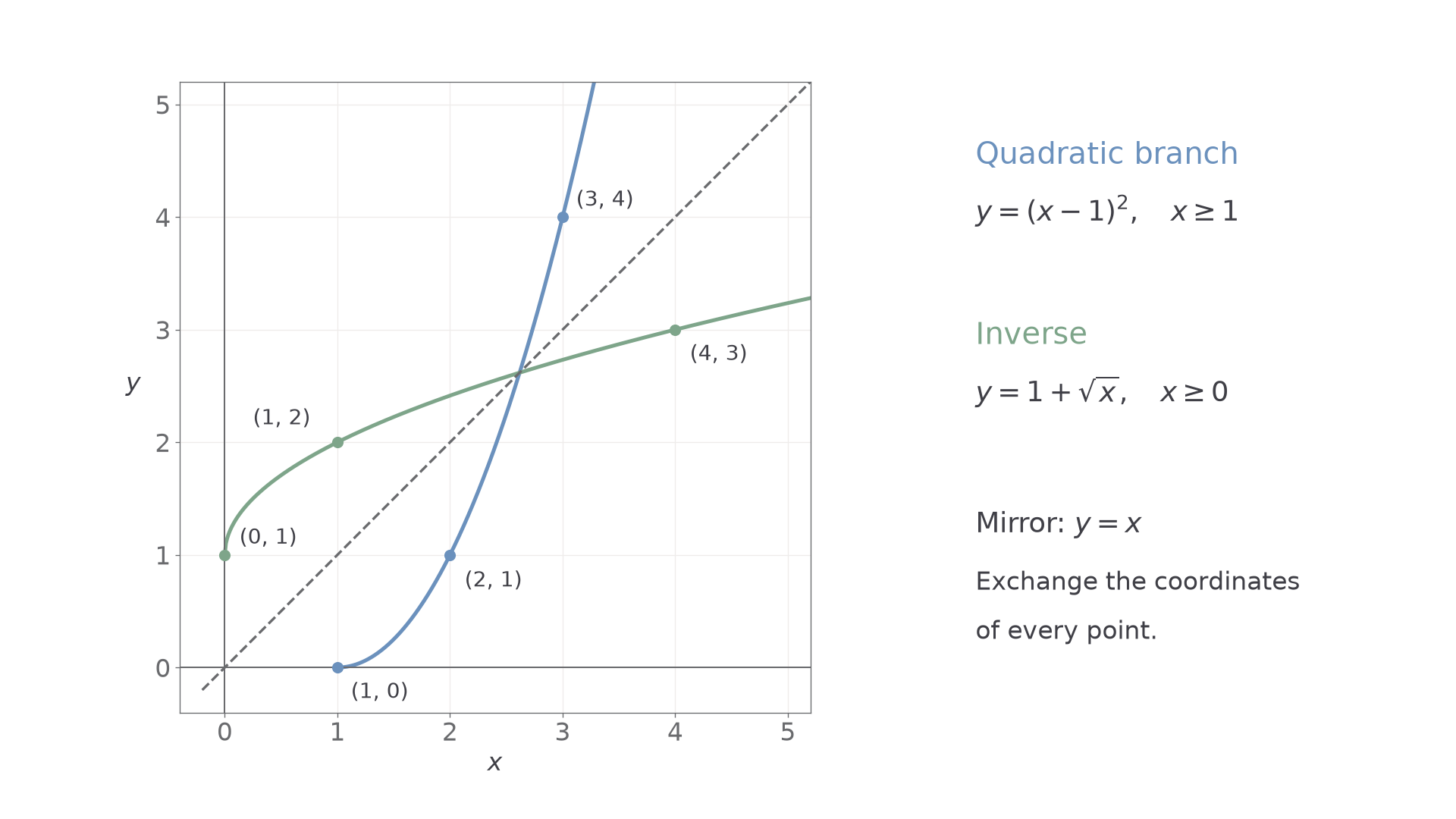
Reflect the complete permitted branch, including endpoint types. Intercepts exchange roles, and a vertical asymptote reflects to a horizontal one. For the unrestricted rational example, and exchange to and .
Some functions even undo themselves: on satisfies . Its inverse is itself, although it is not the identity function. Taking a second trip through the same rule reverses the first.
Exam tip
If asked for an inverse's domain and range, determine the forward range first. Repeating the forward domain twice loses the distinction the question is testing.
The opening linear operation can be reversed by adding , then dividing by . A following square can be reversed as a function only after choosing a suitable branch. Try the algebra with a different rational rule.
Quick Recap
- applies first; it is a composite, not a product.
- Its domain keeps every first-stage restriction and requires the image to enter the second domain.
- One-to-one behaviour makes reversal a function; a quadratic's domain chooses its root branch.
- Rearrange to find an inverse, exchange domain and range, check both compositions and reflect the graph in .
The opening routes reach and . Reversing a route requires reversing its order and choosing domains that make each reverse step unique.