Mc1–Mc4 - Derivatives as gradients and rates of change
Turn gradients between pairs of points into the gradient at one point. Mc1–Mc3 connect that tangent direction to the derivative, its notation and rates with units; Mc4 develops the gradient graph from the shape of a curve, including cases where flattening does not reverse its direction.
From a chord to a tangent
Can you measure a curve's slope at one point without pretending the curve is straight? On , the chord from to has gradient , but the chord to has gradient . Bringing the second point towards the first reveals a local direction.
You already know
For two distinct horizontal coordinates, a straight line's gradient is change in height divided by change in horizontal coordinate. A positive gradient rises to the right, a negative one falls, and a horizontal line has gradient zero.
Use a moving point on the curve, not a point chosen freely in the plane. Its height must change with its horizontal coordinate.
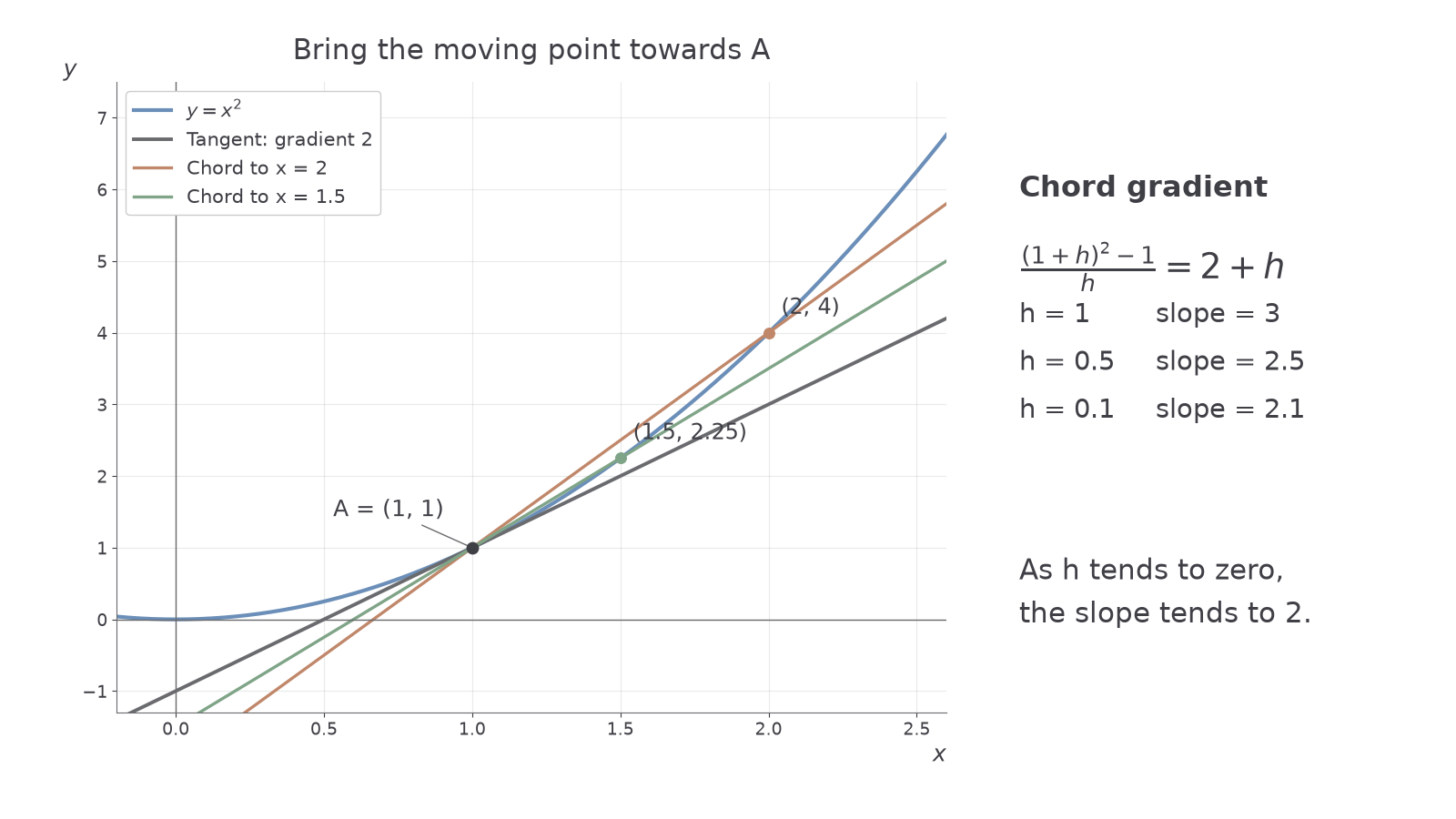
Chord and tangent
A chord joins two distinct curve points. A tangent, at a smooth point where a finite limiting chord gradient exists, is the line through the point with that gradient. It describes the local direction; it need not meet the curve only once. For example, the tangent to at meets the curve again at .
There is another useful surprise: lifting the entire graph by changes every height but none of its gradients. The two heights in a chord calculation both gain , so their difference is unchanged. That observation will help separate height from slope.
Tangent as a chord-gradient limit
For , when the same finite limit exists from both sides,
Simplify with , then take the limit. The first-principles limit definition is supplied.
In the formula sheet.
A table suggests a value, but exact simplification explains why that value is approached.
Worked example 1: nearby points on a parabola
Question. Determine the tangent gradient to at by considering the point .
Plan. Express the chord gradient in terms of , then let the increment tend to zero.
Why this step? Taking the limit of the simplified expression avoids the undefined quotient obtained by substituting zero too early.
Answer. The tangent gradient is .
Check. The chord gradients for are , and for are .
Now change only the graph's vertical position. The chord calculation tests whether a higher graph must be steeper.
Worked example 2: the same slope at a different height
Question. Determine the tangent gradient to at using a nearby point.
Plan. Use and subtract the whole fixed height.
Why this step? A translation adds equally to both heights, leaving their difference unchanged.
Answer. The tangent gradient is still , although the point's height is now .
Check. At , the chord gradient is , as before.
The limit always concerns nonzero intervals. We are not replacing the chord by two identical points and then calculating a gradient.
Watch out
Wrong: substitute into the unsimplified difference quotient. Right: simplify while , then take the limit. A zero denominator is not a very small denominator.
Keep the lifted graph and change its fixed input.
The derivative at a point and as a function
A derivative packages all the available tangent gradients into one function. At a general input, the chord gradient for is ; its limit is . The lifted curve has the same gradient function.
Derivative
For , the derivative is written or . It gives the tangent gradient at every input where that finite derivative exists. The value is a height; is a gradient. For example, and for .
A formula alone does not remove domain restrictions. Only evaluate a derivative where the function and derivative exist. At a domain endpoint, a one-sided rate may exist without a two-sided derivative.
Worked example 3: interpreting two outputs
Question. Given and , interpret and geometrically.
Plan. Evaluate the height and gradient separately.
Why this step? The prime changes what the output represents, not the input being used.
Answer. The graph passes through , with tangent gradient , rising locally as increases.
Check. Its nearby chord gradient is , tending to .
Change only the sign of the input. The height remains positive while the direction reverses.
Worked example 4: a negative gradient above the axis
Question. Interpret and for the same function.
Plan. Substitute carefully, keeping brackets around the negative input.
Why this step? The sign of the gradient describes direction; the sign of the height describes position relative to the axis.
Answer. The graph passes through and is locally falling to the right with tangent gradient .
Check. At , its height is , lower than .
You may also meet a derivative value in a table without knowing a formula. It has exactly the same meaning.
Watch out
Wrong: read as . Right: it denotes a limit of ratios of changes. On , at , the coordinate ratio is , while the derivative is .
Interpret the following information as two separate graph facts.
Rates of change and their units
Suppose a cooling model gives , where is in degrees Celsius and is in minutes, for . Between two times, the temperature difference gives an average rate. At a single interior time, the derivative gives the instantaneous cooling rate.
Continue this lesson.
You’re previewing NovaLearn without an account. Create a free account to read the rest.
Create free account