Ms1, Ms2 - Integer binomial expansion and combinations
A long product can hide a very short coefficient calculation. You will use factorials and combinations to expand positive integer powers, find selected terms and explain the connection with binomial probabilities.
Factorials and binomial coefficients
Why is the coefficient of in much larger than ? In six brackets, you must select two positions for ; the other four positions each contribute . Counting the positions is only the first job.
You already know
Each term in an expanded product comes from choosing one term from every bracket. In , choosing then , or then , produces two contributions of .
A selection records which positions supply the variable term. Naming the selected positions in a different order does not change the selection.
Factorial and binomial coefficient
For a positive integer , , and . The coefficient counts ways of selecting distinct objects from , without regard to order. The notation means the same count. Here we use selections of bracket positions and trial positions.
Selecting positions in order gives possibilities. Each selection has different orderings, which must be removed.
Combinations for binomial coefficients
For integers and ,
The count also satisfies , by selecting what is left out. The sheet prints the factorial ratio; the symmetry follows from it.
In the formula sheet.
Use a combinations key if you wish, but know what it counts: permutations would distinguish different orders.
Worked example 1: selecting two positions
Question. Find , the number of ways to choose two variable-term positions from six brackets.
Plan. Use the factorial ratio and cancel .
Why divide by ? Each pair has been counted in two orders.
Answer. selections.
Check. Counting by the smaller selected position gives .
Change only the selection size from two to four. The complementary positions offer a quicker way to think.
Worked example 2: selecting the positions left out
Question. Find and explain why it equals .
Plan. Evaluate the count and identify the pair left out of each selection.
Why is the pairing exact? Each selection of four leaves precisely two positions, and each pair left out determines one selection of four.
Answer. Both counts are .
Check. There is one way to choose no positions and one way to choose all six, so the same symmetry works at the endpoints.
The empty choice contributes the constant term of an expansion; it is a genuine single choice.
Watch out
Wrong: , which would make undefined. Right: , giving . Do not substitute fractional exponents into this factorial count.
Use complementary position counts for eight brackets.
Pascal's triangle and a finite expansion
Pascal's triangle gives the coefficients before any powers of the bracket's terms are included. Each row begins and ends with ; an interior entry is the sum of the two above it.
For example, . Either the fourth position is not selected, so choose two of the first three, or it is selected, so choose one of the first three. The diagram makes those two routes visible.
[DIAGRAM: asset_name: Pascal coefficients count bracket choices; caption: Pascal coefficients count bracket choices; asset_slug: h640-pascal-triangle; description: Pascal triangle from row 0 through row 6, with the two 3 entries in row 3 feeding the highlighted 6 in row 4 and the fourth-power row identified]
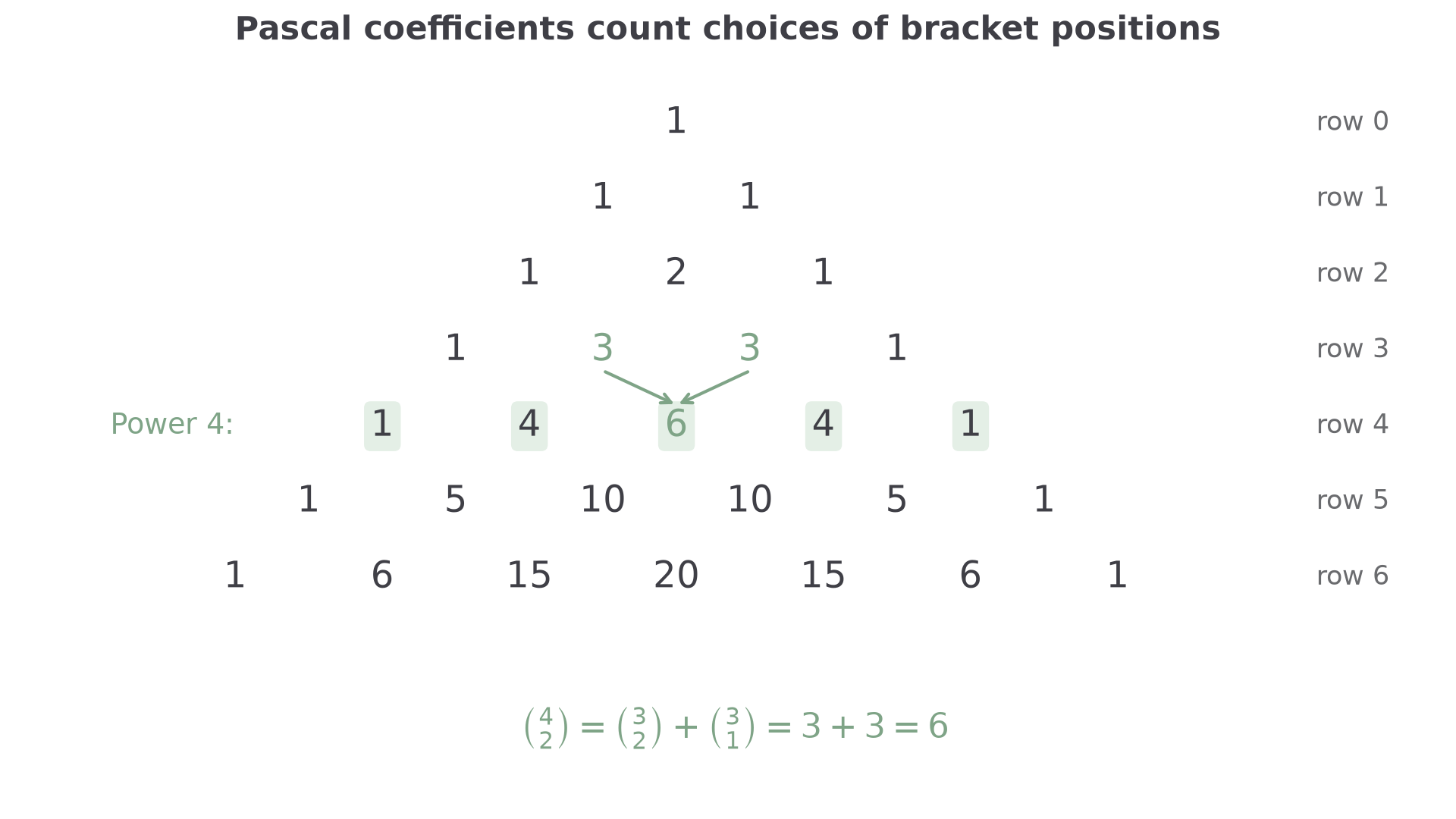
For every chosen set of variable positions, multiply copies of and copies of .
Positive integer binomial expansion
For a positive integer ,
This is exact for every real . It is the printed identity with replacing .
In the formula sheet.
The triangle also counts every possible success/failure pattern: row totals . For row , , the number of different strings of five binary outcomes. That doubling will explain a probability check later.
Worked example 3: a non-unit constant
Question. Expand in ascending powers of .
Plan. Use row , decreasing the power of as the power of increases.
Why is the constant ? At , all four brackets supply .
Answer. .
Check. At , the sum is .
Keep the exponent and constant, changing only the sign of .
Worked example 4: the signed variable term
Question. Expand in ascending powers of .
Plan. Replace by in the same finite expansion.
Why keep the even terms positive? An even number of negative factors has positive product.
Answer. .
Check. At , , matching .
The coefficients are the counts multiplied by the powers of the chosen terms.
Watch out
Wrong: . This forgets the constant factors. Right: include in the term containing .
Change the magnitude of the variable term while retaining this structure.
Finding a particular term or coefficient
You can go straight to the required power. A contribution of comes from selecting variable terms and constants, so its coefficient is . This is extracted from the supplied expansion, rather than a separate formula to learn.
The term contains ; the coefficient is the number multiplying it. In ascending powers, the constant comes first and the term is in position .
Worked example 5: the opening puzzle
Question. Find the coefficient of in .
Plan. Select two variable factors and retain the four constant factors.
Why is insufficient? Each of the selections contributes , not just .
Answer. The coefficient is , so the term is .
Check. The six-bracket row starts , consistent with selecting two positions.
Now change only the requested power. Selecting an additional removes one factor of .
Worked example 6: the next power
Question. Find the coefficient of in .
Plan. Select three variable factors and three constant factors.
Why does the coefficient fall even though the count rises? Each individual contribution has halved, from to .
Answer. The coefficient is ; the term is fourth.
Check. Counting ordered triples gives , agreeing with row .
For a signed variable coefficient, include its sign inside the power. For example, the coefficient in is . Its negativity comes from the odd power.
Exam tip
State the coefficient as a number. A displayed selection expression also shows which term you used, so a later arithmetic slip does not hide the method.
Change only the requested power again.
Why the same coefficients appear in probabilities
A string of successes and failures is another selection of positions. In four trials, exactly one success has four positions: SFFF, FSFF, FFSF and FFFS.
You already know
Independent trial probabilities multiply along one specified pattern. Mutually exclusive patterns have probabilities that add. With success probability , failure has probability .
If all trials have the same success probability, patterns with the same success count have equal probability. The binomial coefficient counts how many such patterns there are.
Binomial success count
For a fixed positive integer , independent two-outcome trials and constant ,
Here is an integer. At , all failures have probability ; at , all successes have probability . Handle these endpoint cases directly, without substituting .
In the formula sheet.
The probability formula is the finite expansion with probability factors attached to each position selection.
Worked example 7: one success position
Question. Four independent trials each have success probability . Find the probability of exactly one success.
Plan. Calculate one pattern's probability, then count all possible success positions.
Why multiply by ? The success can occupy any of the four positions.
Answer. .
Check. The four pattern probabilities are all .
Change only the required count to two successes. The number of patterns now comes from pairs of positions.
Worked example 8: two success positions
Question. For the same four trials, find the probability of exactly two successes.
Plan. Multiply one two-success pattern's probability by .
Why not patterns again? Two successes occupy a pair of positions, and .
Answer. .
Check. For successes, the probabilities are ; their sum is , matching .
If , every complete pattern has the same probability . Dividing a row total of by explains the total probability of directly.
Watch out
Wrong: use for the complete success-count event. That is one pattern. Right: multiply by , provided the trials are independent and the success probability is constant.
Keep four trials and two successes, changing only the success probability.
Quick Recap
- counts unordered position selections; keeps the endpoint counts equal to .
- Pascal's triangle records the finite expansion coefficients, but the bracket's constant and variable factors still need their powers.
- One selected coefficient can be found without a complete expansion.
- In binomial probabilities, count success positions and then multiply by each pattern's probability.
The opening coefficient is : position selections, each contributing .