MF10, MF11 - Contact forces, friction and limiting equilibrium
Contact with a rough surface supplies a normal push and friction along the surface. You will interpret their combined vector, check whether a proposed contact force is physically possible, and use different friction rules at rest, at the limit and during sliding.
Normal force, friction and overall contact
Can friction point in the same direction as acceleration? Push a sliding particle right while it is moving left: both your push and friction can point right, slowing the leftward motion. To make sense of this, separate motion, resultant force and the individual contact components.
You already know
A vector has signed components but a non-negative magnitude. Perpendicular components combine by Pythagoras. A force diagram contains forces acting on the selected body, with arrows showing their directions.
A rough surface's contact is one interaction described by two useful components.
Normal and frictional contact
The normal contact force is perpendicular to the surface and pushes away from it, so its magnitude cannot be negative. The frictional force is tangential and opposes sliding or its tendency. Smooth means friction may be ignored; rough means friction must be taken into account. Rough does not mean that friction must have its maximum value.
For a horizontal surface, with right and up, the vector consists of friction left and normal force up. Its overall magnitude is .
[DIAGRAM: asset_name: Components of rough contact; asset_slug: rough_contact_components; description: Equal force-component scales show friction (-12,0), normal reaction (0,35) and their resultant (-12,35) newtons, clearly marked as alternative descriptions; caption: Friction and normal reaction combine to give the overall contact force]
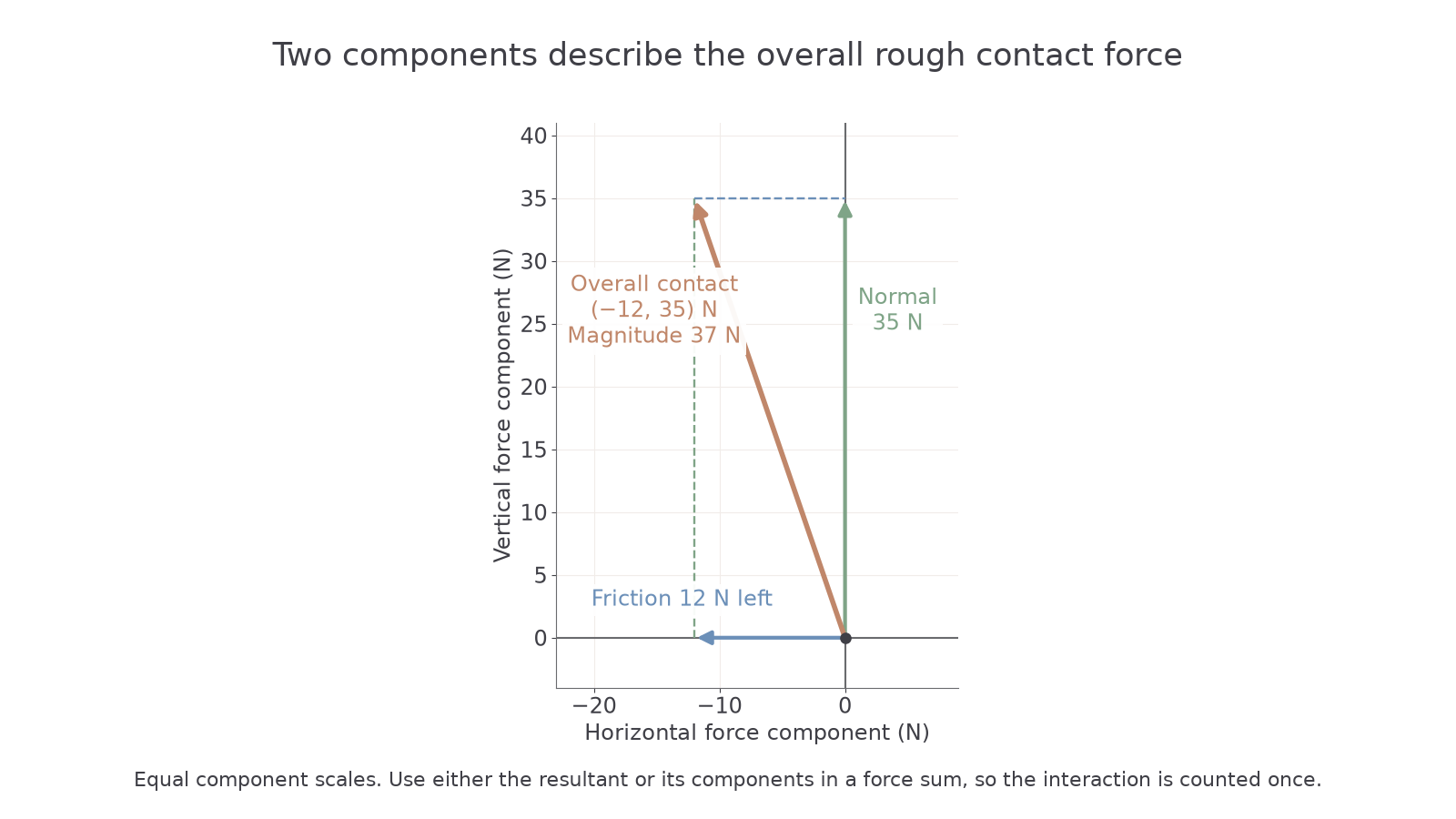
Use either the overall vector or its two components in a force sum. Including all three would count the interaction twice. The contact decomposition and the vector-magnitude rule are not in the formula sheet.
Worked example 1: checking a proposed contact force
Question. A calculation proposes contact force on a particle above horizontal ground, with right and up. Identify the normal and friction components, calculate the vector's magnitude, and state whether its normal component is compatible with pushing contact.
Plan. Separate the parallel and perpendicular components, then check the sign of the normal component.
Why check the sign? An algebraically defined vector need not represent a physically possible force from an unglued surface.
Answer. The normal force is upwards; friction is left; overall magnitude is . Its normal component is compatible with pushing contact. A friction-capacity check would require further information.
Check. The normal component points away from the ground, as a supporting push should.
Change only the sign of the proposed normal component. The vector still has a magnitude, but its physical interpretation changes.
Worked example 2: an impossible normal component
Question. The calculation instead proposes . Identify the normal and friction components, calculate the vector's magnitude, and state whether its normal component is compatible with pushing contact.
Plan. Perform the same component calculation and test the perpendicular sign.
Why reject the model? The surface cannot supply a downward pulling normal force on a particle above it.
Answer. The proposed normal component is , the tangential component is left, and the proposed vector has magnitude . It cannot be the contact force under this pushing-contact model.
Check. Taking an absolute value would hide the physical failure rather than repair it.
When the normal reaction reaches zero, the surface provides no supporting push and the contact assumption needs checking. A computed negative value cannot be repaired by simply drawing the normal arrow downwards.
Watch out
Wrong: replace a calculated negative reaction by its positive magnitude and continue. Correct: reject or revise the assumed contact, since a normal push cannot pull the particle onto the surface.
Now interpret a physically possible contact vector.
Actual friction and its upper bound
For a particle to remain at rest, contact must supply the required normal push and enough friction to balance tangential forces.
The coefficient of friction is dimensionless. It specifies a ratio in an ideal model, not the value of friction by itself.
Static friction and its limit
While contact is maintained, static friction magnitude satisfies
The limiting value is . Limiting equilibrium is equilibrium on the point of sliding, with . Friction acts opposite the tendency to slide.
Not in the formula sheet: learn it.
Calculate the friction required for rest first. Then compare with the capacity; setting equality at the outset would assume limiting equilibrium.
Worked example 3: unused friction capacity
Question. A box rests on horizontal ground with coefficient . A horizontal force acts right, and the only other forces are weight and contact. Use . Find normal reaction, friction required, limiting friction, and whether rest is possible and limiting.
Plan. Balance perpendicular and parallel to the ground, then test the inequality.
Why distinguish the two values? Actual friction is determined by balance, while limiting friction is a capacity.
Answer. ; friction is left; limiting friction is . Rest is possible and not limiting.
Check. The horizontal resultant is , rather than .
Continue this lesson.
You’re previewing NovaLearn without an account. Create a free account to read the rest.
Create free account