ME2–ME5, ME10 - Logarithms, natural logs and their laws
Read a logarithm as an exponent and sketch it as the inverse of an exponential. Derive and apply the logarithm laws, including fractional and negative powers, while keeping every argument inside its real domain.
From exponents to logarithms
How can the positive number 8 have a negative logarithm? In base one half, three negative powers are exactly what is needed: . A logarithm records an exponent, not the sign of the input.
You already know
Positive-base exponentials other than base 1 are one-to-one. The laws , and let you recognise exact powers.
Writing the exponent in a new notation makes inverse questions much shorter.
Logarithm
For , , and ,
The logarithm's argument is ; its value is the exponent . For example, means .
Base 1 is excluded because it cannot identify a unique exponent. Non-positive bases fail to define a real exponential for every real exponent. The argument of a real logarithm must be positive; its value need not be.
Logarithms of one and the base
For a valid base , ,
These follow from and .
Not in the formula sheet: learn it.
The base stays fixed when you convert between forms.
Worked example 1: a reciprocal base
Question. Evaluate , and state the equivalent index equation.
Plan. Express 8 as a power of one half.
Why this step? A negative exponent reverses the reciprocal base, producing an output greater than 1.
Answer. , equivalent to .
Check. , so its reciprocal is indeed 8.
Change only the argument to its reciprocal; this reverses the exponent's sign.
Worked example 2: a reciprocal argument
Question. Evaluate , and state the equivalent index equation.
Plan. Recognise the positive power of one half.
Why this step? With a base below 1, a positive exponent gives a positive output below 1.
Answer. 3, equivalent to .
Check. The product of the two arguments is 1, and the two exponents add to zero.
Fractional values are allowed too: . A logarithm is not restricted to integer exponents.
Watch out
, but is undefined in the real numbers. “The logarithm is negative” and “the logarithm has a negative argument” describe different things.
Use another reciprocal base and a zero exponent.
Inverse functions and logarithmic graphs
Reflecting an exponential in swaps every point's coordinates and gives the corresponding logarithm.
For every valid base, for , and for real . Thus on becomes on . These inverse identities are not supplied on the formula sheet.
Natural logarithm
The natural logarithm is , inverse to . Its domain is , its range is , its horizontal-axis intercept is , and its vertical asymptote is .
The natural logarithm increases, becoming less steep. It has no vertical-axis intercept. Towards , its value decreases without bound; towards infinity, it increases without bound, so there is no horizontal asymptote.
Natural inverse relationships
In particular, , , , and .
Not in the formula sheet: learn it.
A huge input can have a modest logarithm: exactly. No enormous decimal expansion is needed to undo the exponential.
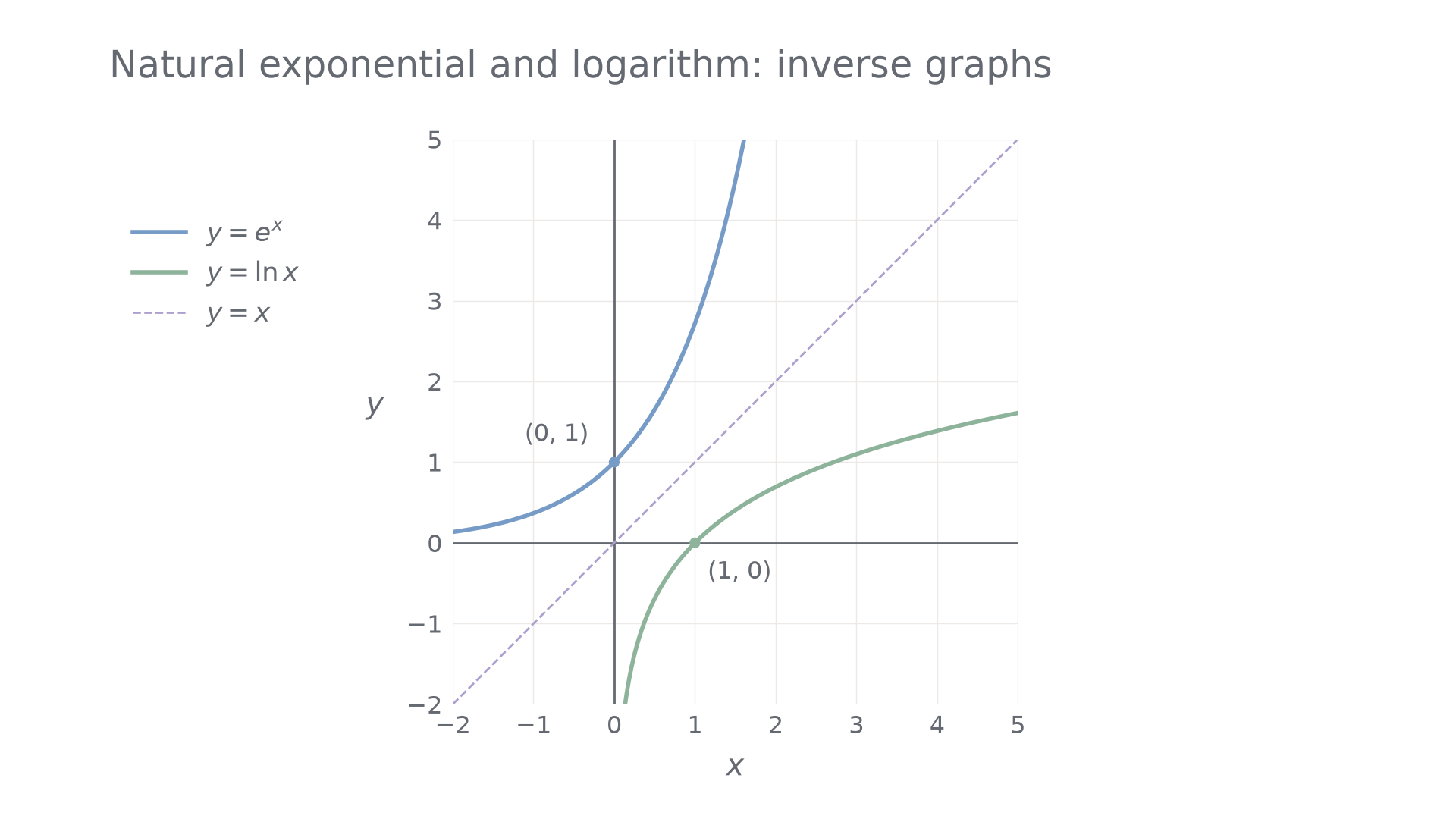
For other bases, retain the same positive-input domain but inspect the direction of the exponential being inverted.
Worked example 3: an increasing logarithm
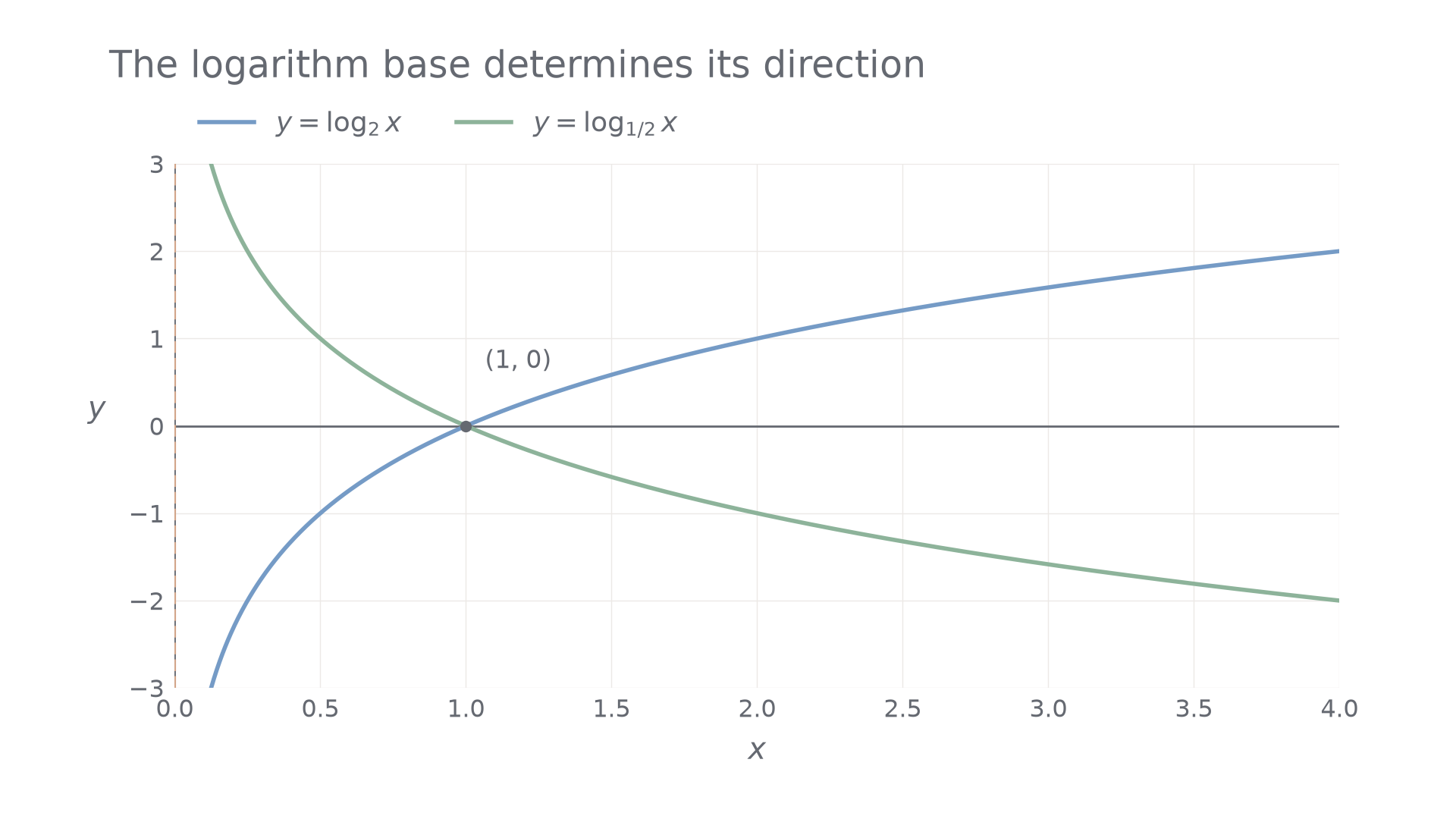
Question. Determine three points, the domain, range and asymptote of .
Plan. Swap the coordinates of the points of at inputs .
Why this step? Inversion exchanges all inputs and outputs, not only the intercept.
Answer. The three displayed points, domain , range , and asymptote . The curve increases.
Check. , confirming that .
Change only the base to its reciprocal.
Worked example 4: a decreasing logarithm
Question. Determine the corresponding features of .
Plan. Invert the decreasing exponential instead.
Why this step? Taking a reciprocal base reverses each exponent needed for the same output.
Answer. Points , domain , range , asymptote , and decreasing direction.
Check. At , the logarithm is , as .
The graph goes down because the base is below 1, not because its arguments are negative.
Continue this lesson.
You’re previewing NovaLearn without an account. Create a free account to read the rest.
Create free account