Mg1–Mg6 - Straight lines, distances and gradients
Use coordinates to determine straight lines, lengths and meeting points. You will choose an equation that suits the information, handle horizontal and vertical exceptions, and read a short geometric argument to reconstruct a line.
Gradient and direction
Which points are equally far from and ? Their midpoint is one: both squared distances are . By the end, you will describe every such point with one line equation.
You already know
Coordinates give horizontal position then vertical position. Pythagoras connects the two perpendicular coordinate changes to the straight-line distance. Keep subtraction orders consistent.
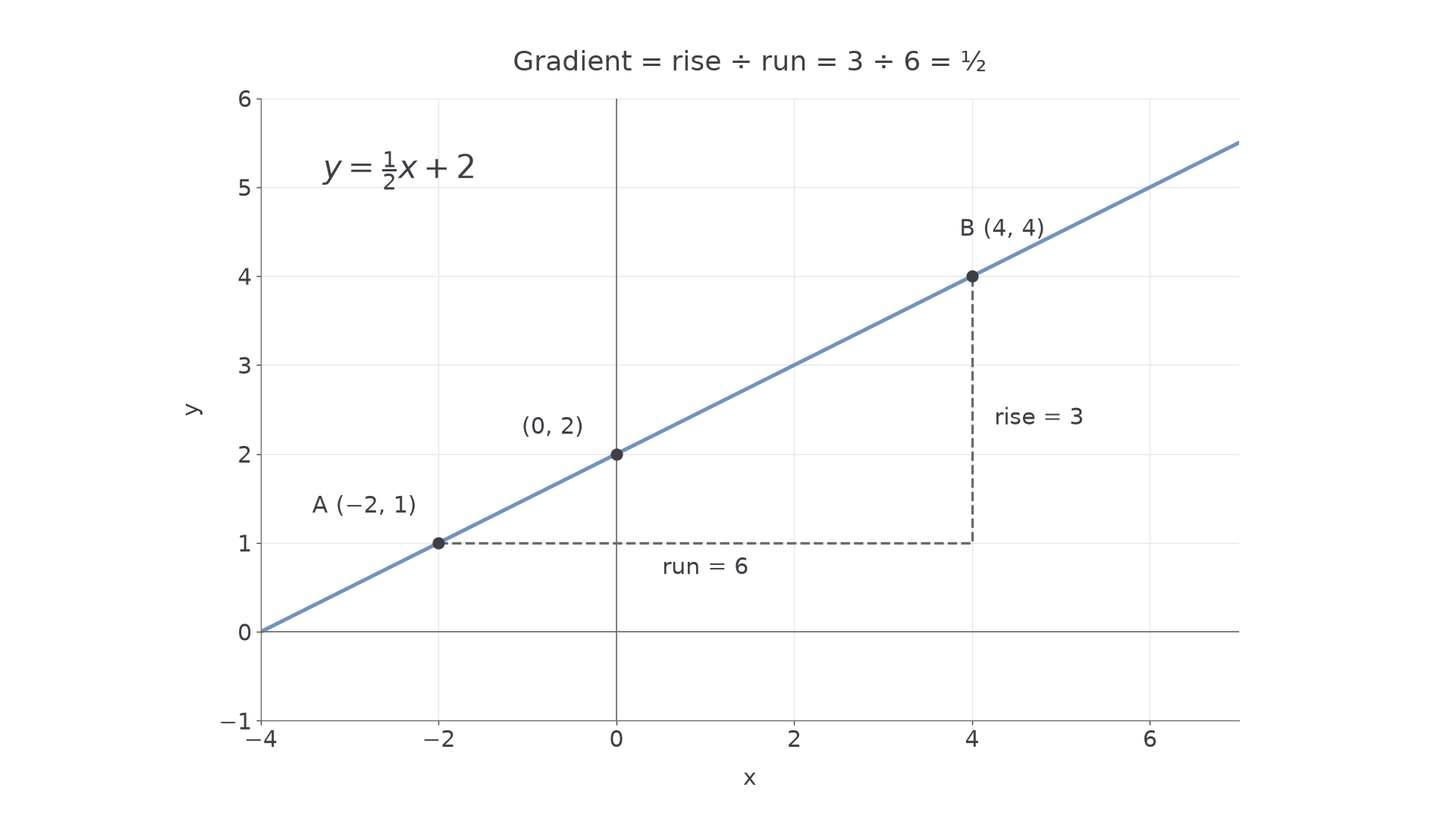
First capture a line's direction. The line below rises units while moving units right, so it rises half a unit for each unit right.
[DIAGRAM: asset_name: Rise and run on a straight line; caption: Corresponding coordinate changes determine the gradient; asset_slug: h640-gradient-line; description: Equal-scale axes show y equals one half x plus 2 through A minus 2 comma 1 and B 4 comma 4, with run 6, rise 3 and vertical intercept 2.]
Gradient
The gradient of a non-vertical straight line is the change in its vertical coordinate per unit increase in its horizontal coordinate. It is constant along that line.
The sign gives the direction of change; the size gives its rate.
Gradient
For distinct points with ,
A horizontal line has gradient ; a vertical line has undefined gradient.
Not in the formula sheet: learn it.
Choose one journey between the points and use that journey for both changes.
Worked example 1: a negative direction
Question. Determine the gradient through and .
Plan. Divide the vertical change by the matching horizontal change.
Why keep the minus sign? The line falls as the horizontal coordinate increases.
Answer. .
Check. A horizontal change of predicts a vertical change , as required.
Change only the sign of the vertical change: move the second endpoint to .
Worked example 2: reversing the rise
Question. Determine the gradient through and .
Plan. Retain the same subtraction order with the new height.
Why is this positive? Both changes are now positive on the journey to the right.
Answer. .
Check. Reversing both differences gives too.
On equal-scale axes, the inclination , measured anticlockwise from the positive horizontal direction, gives by the right-triangle ratio. This result is not in the formula sheet. At , ; at , . A vertical line such as has zero horizontal change, so its gradient is undefined, rather than an enormous number.
Watch out
Wrong: reverse just the numerator, obtaining in Worked example 1. Right: reverse both differences or neither.
Keep the journey consistent for these new points.
Equations and drawing a line
A line equation connects every point on that line. The familiar form displays the gradient and vertical intercept; point–gradient form makes a known point useful immediately.
Forms of a straight-line equation
Through with finite gradient ,
For two points, if both coordinate differences are nonzero, an equivalent form is
The general form , with not both zero, includes vertical lines. If , its gradient is .
Not in the formula sheet: learn it.
The two-point ratios express the same fraction of the total vertical and horizontal changes. Cross-multiplication gives ; this last equation also handles a zero coordinate difference without dividing by it.
Worked example 3: the two-point form
Question. Determine the line through and , giving a general-form equation.
Plan. Match the fractions of the two coordinate changes, then simplify.
Why subtract in the numerator? The change starts from the first point's height.
Answer. .
Check. The two points give and .
Change only the second point's height to . The line becomes horizontal and one ratio's denominator would be zero.
Worked example 4: a horizontal exception
Question. Determine the line through and , in general form.
Plan. Use the unchanged vertical coordinate directly, or use the cross-multiplied equation.
Why avoid the ratio form here? Its denominator would be zero.
Answer. .
Check. Both points have height , and the gradient is .
With equal horizontal coordinates, the same reasoning gives a vertical line. With a point and gradient supplied instead, substitute straight into point–gradient form: gradient through gives , or .
To draw , mark the intercepts and , then extend their line. Alternatively use : start at the vertical intercept and move one right, two down. If both intercepts coincide at the origin, choose another point; you still need two distinct points. Reading a point and rise over run from a graph reverses this process and supplies its equation.
Watch out
Wrong: divide by to construct a horizontal line. Right: write , or use the cross-multiplied relation. For a vertical line, write .
This time the horizontal coordinate stays fixed instead.
Parallel and perpendicular lines
Parallel lines keep their direction. Perpendicular lines turn through a right angle. Work with gradients only when the gradients exist.
Parallel and perpendicular gradients
For finite gradients, parallel directions have . Perpendicular directions have
Horizontal and vertical lines are perpendicular, although the vertical gradient is undefined. Equal gradients describe distinct parallel lines only when the lines are not coincident.
Not in the formula sheet: learn it.
A right-angle rotation turns a direction into . The gradients and multiply to . Notice something neat: doubling both coordinate changes doubles the distance but leaves their ratio, and therefore the direction, exactly unchanged.
Worked example 5: keeping the direction
Question. Determine the line through parallel to .
Plan. Rearrange to read the gradient and use that gradient through the new point.
Why change the intercept? The new point is not on the given line, so the parallel line has a different position.
Answer. .
Check. At , ; the gradient remains .
Keep the point and given line but change the requested relationship to perpendicular.
Worked example 6: turning through a right angle
Question. Determine the line through perpendicular to .
Plan. Use the negative reciprocal gradient , then point–gradient form.
Why ? Its product with is .
Answer. .
Check. , and .
A line perpendicular to is horizontal; a line perpendicular to is vertical. Those directions settle the cases without a gradient product.
Exam tip
For MEI's “Determine”, justify the direction and position: show the required gradient relationship and use the given point. A correct-looking equation alone does not explain how the conditions are met.
Use the same two checks for a new perpendicular line.
Midpoints and distances
The midpoint is halfway in each coordinate, not halfway between the two numbers written within one point. Pythagoras then gives the length of the segment from its two coordinate changes.
Midpoint and distance
For , ,
The distance is non-negative, including for horizontal and vertical segments.
Not in the formula sheet: learn it.
Squaring makes the distance independent of the direction in which you measure the segment.
Worked example 7: two coordinate changes
Question. Find the midpoint and length between and .
Plan. Average like coordinates and add the squares of the two changes.
Why add the squares? The horizontal and vertical changes are perpendicular sides of a right triangle.
Answer. Midpoint , length .
Check. From to either endpoint the squared distance is .
Change only the sign of the vertical displacement, moving to .
Worked example 8: negative change, positive distance
Question. Find the midpoint and length from to .
Plan. Repeat the midpoint average and square the signed changes.
Why has the length stayed the same? Only the sign of one change altered, and its square did not.
Answer. Midpoint , length .
Check. The two midpoint-to-endpoint changes are opposites, with squared length .
A missing endpoint can be recovered from the average. If and , then . This is the midpoint formula solved for the unknown coordinates.
Watch out
Wrong: the vertical change contributes to the distance calculation. Right: , so squared changes are added.
Use exact arithmetic rather than rounding a length before the calculation is finished.
Intersections and exceptional cases
At a meeting point, both line equations hold. Solve them simultaneously and keep the two coordinates together in the answer.
Worked example 9: eliminating a coordinate
Question. Determine the intersection of and .
Plan. Add the equations to eliminate , then substitute for .
Why add? The vertical coefficients are opposites.
Answer. .
Check. and .
Change only the second line to a vertical one. Its fixed coordinate can be substituted immediately.
Worked example 10: substituting a fixed coordinate
Question. Determine the intersection of and .
Plan. Substitute the known horizontal coordinate into the first equation.
Why is an undefined vertical gradient harmless? The equation already gives all the information needed.
Answer. .
Check. , with horizontal coordinate .
Equal gradients require another check. The pair , leads to , a contradiction: there is no common point. The pair , leads to , an identity: they are coincident, with infinitely many common points. A zero coefficient after elimination is information, rather than an instruction to divide by zero.
Watch out
Wrong: equal gradients mean the equations have no common points. Right: compare their positions too. Distinct parallel lines have none; coincident equations describe the same entire line.
Now use a different fixed horizontal coordinate.
A line defined by equal distances
An unfamiliar description can lead to familiar straight-line algebra. Read the definition below before deciding which formula to use.
Passage. Fix distinct points and . Call a point balanced when its distances from and are equal. Since distances are non-negative, this is equivalent to
Expanding cancels both squared variable terms, leaving
Because , the two coefficients cannot both vanish. Balanced points therefore form a line. Each statement follows from the definition; the final equation has not been assumed.
Equal-distance line
The points equally distant from two distinct fixed points lie on their perpendicular bisector: the line through their midpoint at right angles to their joining segment.
The definition is not an extra formula supplied in the sheet. You can derive its equation by the squared-distance equality, then check its midpoint and direction.
Worked example 11: a horizontal pair of fixed points
Question. Use the passage to determine the balanced-point line for , .
Plan. Expand the equal squared distances and cancel matching terms.
Why square the distances? Equality is preserved and the square roots disappear.
Answer. The line is .
Check. It passes through the midpoint and is perpendicular to the horizontal segment . At , both squared distances equal .
Change only the height of , from to . The equal-distance line will now slope.
Worked example 12: an oblique pair of fixed points
Question. Use the passage to determine the balanced-point line for , .
Plan. Form the squared-distance equality and collect its linear terms.
Why do no quadratic terms remain? Both squared distances contain exactly one and one .
Answer. .
Check. The midpoint satisfies . The segment gradient is ; the new line's gradient is , giving product .
This is the reading habit needed for a longer mathematical article: identify what is defined, translate it faithfully, and justify the intermediate steps. The equal-distance equation and its expanded form are not in the formula sheet; derive them when needed.
Problem-solving
When a new geometric word is defined by an equation, start from that definition. A numerical check confirms a case; the cancellation of the squared terms explains the whole line.
Return to the opening points with the same reasoning. All the data are repeated so your argument stands on its own.
Quick Recap
- Use matching coordinate changes for gradient, coordinate averages for midpoint and Pythagoras for length.
- Point–gradient, two-point and general forms describe the same line when their conditions are respected.
- Parallel gradients agree; finite perpendicular gradients multiply to .
- Simultaneous equations distinguish one intersection, no intersection and coincident lines.
- Translate unfamiliar geometric definitions into equations before choosing a method.
The opening points are equally far from and exactly when , their perpendicular bisector.