Mt9, Mt13–Mt15 - Reciprocal and inverse trigonometric functions
Use the inverse functions in Mt9 and the reciprocal definitions in Mt13 without confusing their notation. Mt14 connects their graphs, domains and ranges to sine, cosine and tangent; Mt15 supplies two squared identities for exact values and algebra.
Reciprocal functions and their domains
Can cotangent exist where tangent does not? At , sine is and cosine is . Tangent divides by zero, but cosine divided by sine is . That is the value of cotangent. A careful definition reveals a valid value that a careless reciprocal button sequence would miss.
You already know
A quotient is defined only when its denominator is nonzero. Sine and cosine are signed coordinates on the unit circle, and on its domain.
The three reciprocal functions are defined using those coordinates.
Secant, cosecant and cotangent
For integer , secant excludes , while cosecant and cotangent exclude . In degrees the exclusions are and . These definitions are not in the formula sheet: learn them.
On the common domain where tangent is nonzero and defined, cotangent also equals . That shorter expression has a smaller domain than the cosine-over-sine definition: at , cotangent equals zero. Do not throw that point away.
Worked example 1: exact reciprocals in quadrant II
Question. Find , and exactly.
Plan. Use the signed sine and cosine values before taking reciprocals or their ratio.
Why this step? The reciprocal retains the sign of the value inverted; the reference angle alone does not determine that sign.
Answer. The three values are , and .
Check. The reciprocal products with cosine and sine equal ; cotangent times sine equals cosine.
Keep the reference angle but move to quadrant III. This changes sine's sign while cosine stays negative.
Worked example 2: changing the quadrant
Question. Find the three values for .
Plan. Apply the definitions to two negative coordinates of equal magnitude.
Why this step? A quotient of two negative values is positive, even though both reciprocal values are negative.
Answer. , and , respectively.
Check. Neither coordinate is zero, and each result meets its defining equation.
Another notation needs separating: means , whereas conventionally means an inverse function, not .
Watch out
Wrong: use to conclude that cotangent is undefined. Right: evaluate . The defining denominator is sine.
Move the same reference angle into quadrant IV.
Reading reciprocal graphs
A reciprocal graph keeps the sign of the denominator, becomes large near its zeros and retains its values and .
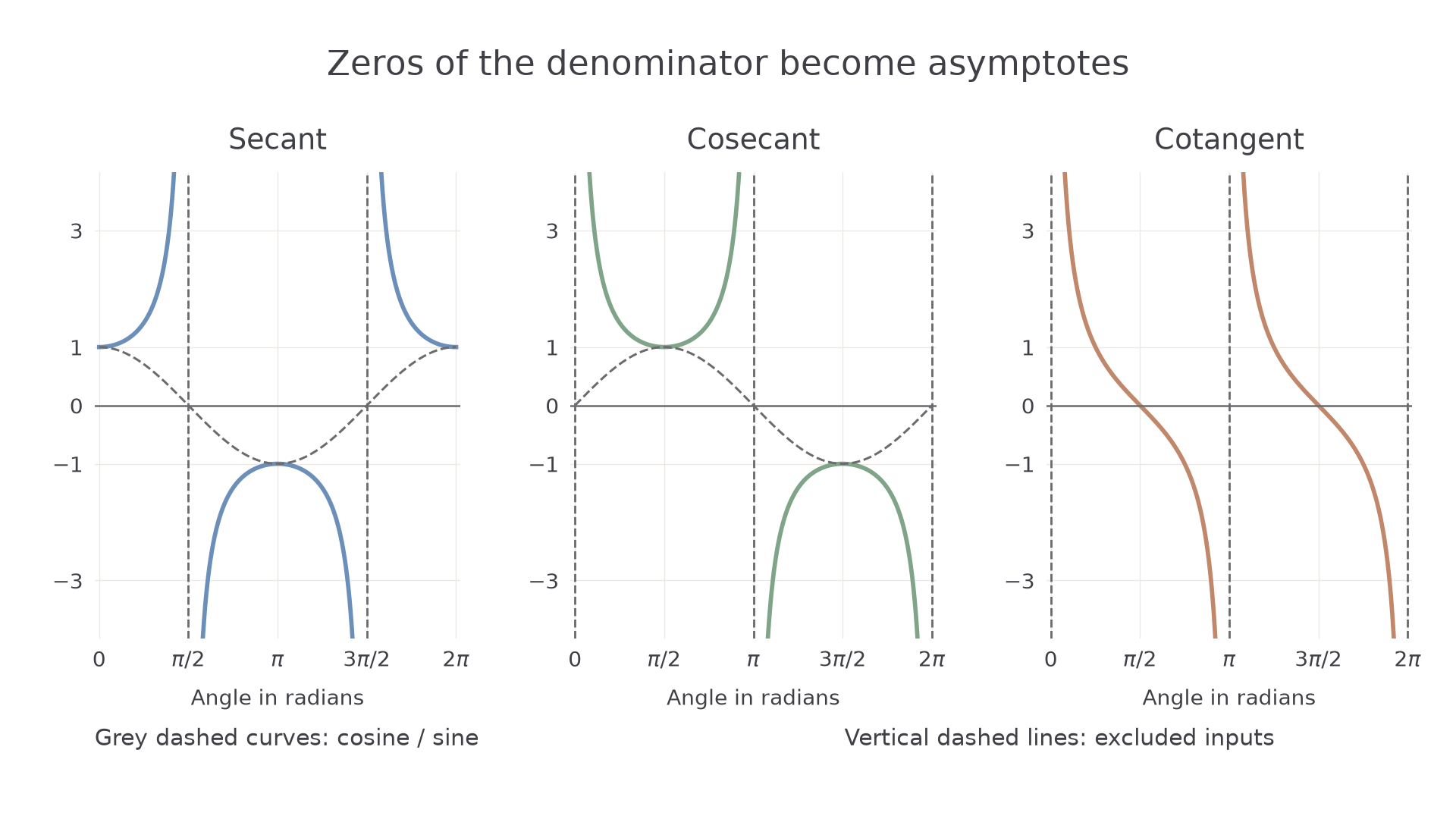
For secant and cosecant the range is , because reciprocating a nonzero value with magnitude at most gives magnitude at least . Both have period and no zero. Secant is even; cosecant is odd. Their excluded inputs and vertical asymptotes are and , respectively.
Cosecant has a minimum at on , and a maximum at on . Secant has and , with branches separated by the zeros of cosine.
Cotangent has domain , range , period and odd symmetry. On it decreases from arbitrarily large positive to arbitrarily large negative values and crosses zero at . Its zeros are . Where both are defined, tangent and cotangent are reciprocals, but their excluded inputs differ. These graph properties are not in the formula sheet: rebuild them from the definitions.
Worked example 3: using the denominator's graph
Question. Describe the asymptotes, period and branch vertices of on .
Plan. Map zeros and extrema of to reciprocal features.
Why this step? Zeros of the denominator locate missing inputs; the reciprocal function itself never crosses zero.
Answer. Asymptotes occur at . The branches have vertices and , with period .
Check. The signs are positive on and negative on , just as for .
Change only the reciprocal family, from cosecant to secant. The argument and interval stay fixed, but the denominator's zeros move.
Worked example 4: changing sine to cosine
Question. Give the corresponding features of on .
Plan. Use zeros and extrema of .
Why this step? The period stays the same, but using the sine's zeros would place every asymptote incorrectly.
Answer. The asymptotes are . There are positive branch portions at the included endpoints and , and a negative branch with vertex . The period is .
Check. At the centre, , so its reciprocal is .
When sketching, draw separate branches beside dashed asymptotes. A finite line joining across an asymptote would assert values at excluded inputs.
Watch out
Wrong: reciprocal sine and reciprocal cosine still have range . Right: their values have magnitude at least ; the gap between and contains no curve.
Apply the same denominator reasoning to cotangent, whose period differs.
Identities with reciprocal functions
Divide the unit-circle identity by a nonzero square to turn it into a reciprocal identity, retaining the division condition.
For example, dividing by gives . Division by cosine squared gives the other form.
Squared reciprocal identities
Not in the formula sheet: learn it.
The squares determine magnitudes. A quadrant or interval is still needed to determine an unsquared value. They also show why is impossible for real : its square would be below .
Worked example 5: recovering a positive cosecant
Question. Given and , find exactly.
Plan. Use the cotangent identity and choose the sign from sine's quadrant.
Why this step? Negative cotangent does not mean negative cosecant; cotangent is the ratio of two signed values.
Answer. .
Check. Take , . Their squares sum to and their ratio is .
Continue this lesson.
You’re previewing NovaLearn without an account. Create a free account to read the rest.
Create free account