Ma3, MC3 - Quadratic graphs and the discriminant
Use MC3's completing-the-square method to reveal a parabola's turning point, symmetry line and shape. Link the picture to Ma3's discriminant so you can classify real roots, interpret a parameter and explain why a boundary value matters.
Completing the square
Can the curve ever reach height ? At its height is ; at it reaches . A graph suggests a highest point, but completing the square will prove that no hidden peak lies elsewhere.
You already know
Expand to get . A real square is non-negative, even when the number being squared is negative.
Completing the square means writing the same quadratic in a form that exposes one square and one constant. No particular value of is being selected: this is an identity.
Quadratic function
A quadratic function has the form , where are real and . Its graph is a parabola. Setting changes the degree, so the expression is no longer quadratic.
For a leading coefficient of one, halve the linear coefficient to find the number in the bracket. Subtract the constant that its square adds.
Worked example 1: building a square
Question. Express in completed-square form.
Plan. Use , then compensate for its constant term.
Why this step? The square supplies the required linear term but also introduces , which must be removed.
Answer. .
Check. Expanding gives .
Change only the leading coefficient to minus one. Factoring that sign out changes the linear coefficient inside the bracket.
Worked example 2: a negative leading coefficient
Question. Express in completed-square form.
Plan. Take out the minus sign from the variable terms before completing the square.
Why this step? Negating the whole bracket makes its correction positive; leaving the minus sign outside protects that change.
Answer. .
Check. Expansion gives .
The same procedure handles any nonzero leading coefficient. For example, : the outside factor also multiplies the correction.
Completing a general quadratic
For real , with ,
The result has the form .
Not in the formula sheet: learn it.
A small surprise: integer coefficients do not guarantee an integer lowest point. Since , its least real value is , attained halfway between the two integer inputs and where its value is zero.
Watch out
Wrong: . Right: the correction changes sign, giving . Apply an outside factor to every term inside its bracket.
Change the leading coefficient once more, keeping the other two coefficients fixed.
Turning points and sketches
Read the turning point from where the square is zero, then use the sign outside the square to decide which way the curve opens.
For , equal distances either side of give the same square. That explains the vertical symmetry line rather than merely supplying a rule to remember.
Turning point and symmetry line
The turning point, or vertex, of is ; its symmetry line is . The point is a minimum when , or a maximum when . For example, has maximum , not .
The square is non-negative, so the possible outputs for unrestricted real satisfy if , and if . These vertex, symmetry and bound results are not in the formula sheet: learn them.
Worked example 3: a curve with a maximum
Question. Find the turning point, line of symmetry and axis intercepts of , and describe its shape.
Plan. Complete the square for the maximum and factorise for the horizontal intercepts.
Why this step? The completed square and the factors reveal different features of the same parabola.
Answer. The maximum is , the symmetry line is , and the intercepts are . It opens downwards.
Check. Both horizontal intercepts are units from the symmetry line. At , the expanded form gives .
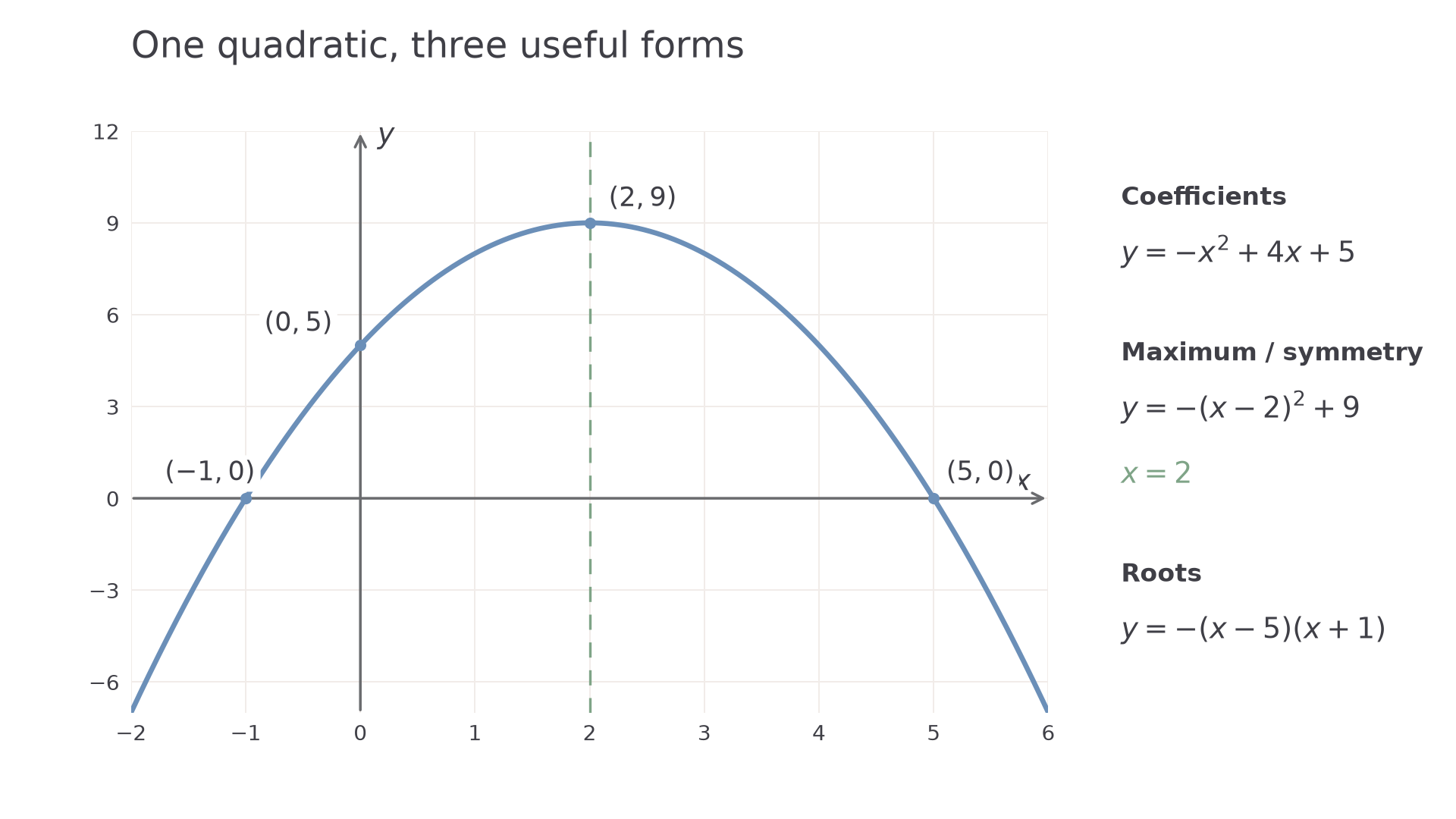
The highest point belongs to all three algebraic forms of this curve.
Change only the constant from to . The whole graph moves down, while its symmetry line remains fixed.
Worked example 4: lowering the maximum to the axis
Question. Find the turning point, line of symmetry and axis intercepts of , and describe its shape.
Plan. Complete the square, then set each coordinate to zero in turn.
Why this step? A zero maximum makes the vertex itself the only horizontal-axis intersection.
Answer. The maximum is , the symmetry line is , and the intercepts are . The downward parabola touches the horizontal axis.
Check. , while for every real .
To sketch a quadratic, place labelled axes, the vertex and intercepts in their correct relative positions, then draw a smooth parabola continuing on both sides. A sketch needs the features and shape, not identical axis scales or a large table of points.
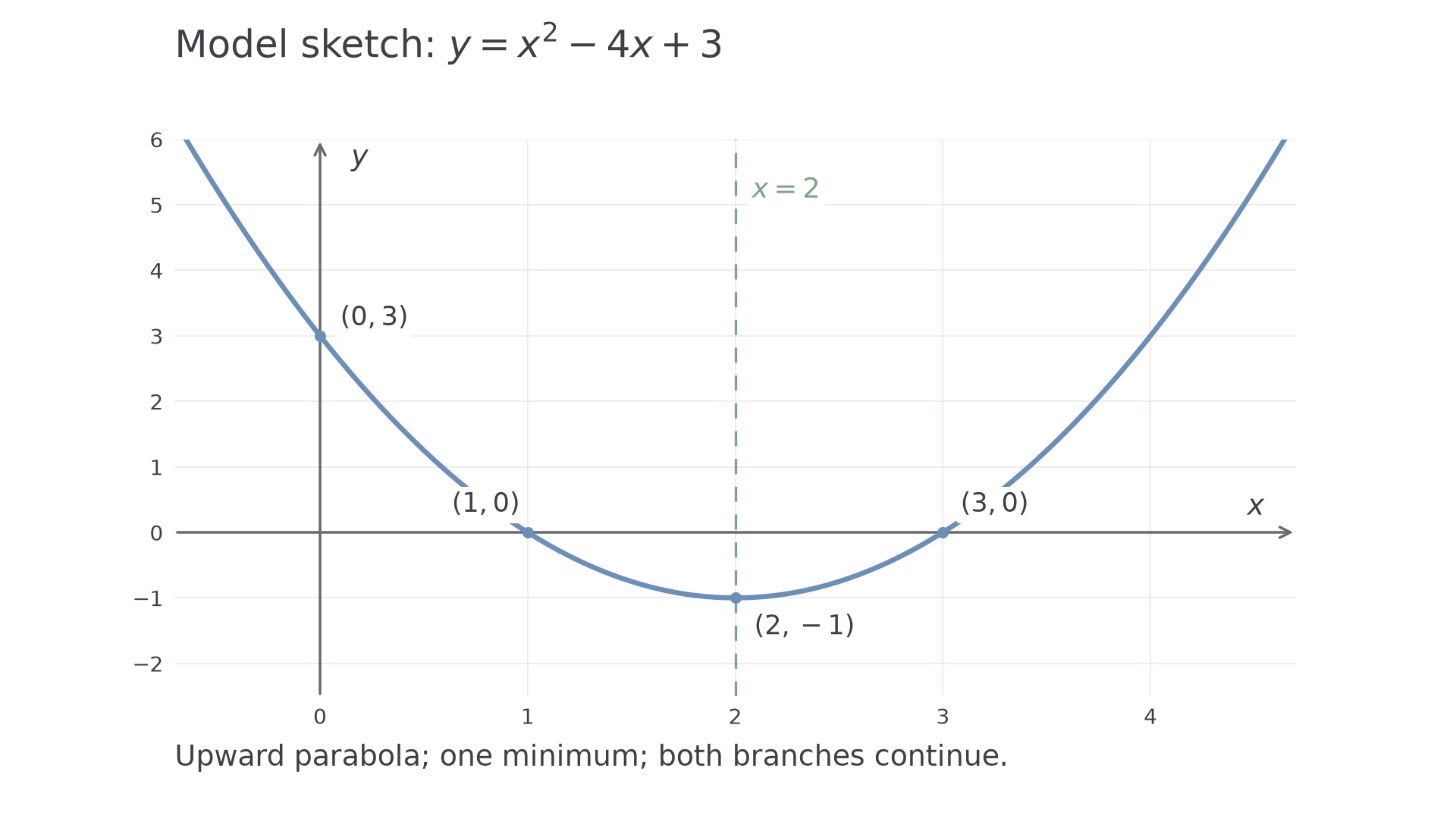
The upward curve has roots and minimum .
A graphical check needs a window containing the relevant intercepts and vertex. A narrow screen can hide a crossing, and a rounded cursor position cannot establish exact coordinates.
Watch out
Wrong: has symmetry line . Right: the bracket vanishes at , so the line is . Write an equation for a line, not just the number .
Raise only the constant in the last worked example by one. Read the resulting maximum directly.
The discriminant and real roots
The sign of the discriminant links the coefficients to the number of horizontal-axis intersections.
A repeated root gives a single point of contact, even though its linear factor appears twice. Two distinct real roots give two crossings; no real roots means the graph misses the horizontal axis.
Discriminant
For , with , the discriminant is . Substitute each coefficient with its sign; in particular, square the whole signed value of .
Setting completed-square form equal to zero gives
Since , the sign of decides whether a real square has two possible values for its unsquared bracket, one, or none.
Classifying real roots
For a quadratic equation , with ,
The repeated root counts twice algebraically but gives one distinct intersection. Finding complex roots is outside this course's requirement.
Not in the formula sheet: learn it.
A completed square makes a good second check, especially for a downward-opening curve.
Worked example 5: a curve below the axis
Question. Determine the number of real roots of , using its discriminant.
Plan. Substitute , then interpret the sign.
Why this step? The product is positive here; the two minus signs do not turn into a positive term.
Answer. There are no real roots, so the graph has no horizontal-axis intersection.
Check. ; its maximum is below zero.
Change only the constant from to . This moves the maximum onto the axis.
Worked example 6: contact at a repeated root
Question. Determine the number of real roots of , using its discriminant.
Plan. Recalculate , then identify the repeated factor.
Why this step? A zero discriminant gives one distinct value of the unsquared bracket, which is the repeated root.
Answer. The root is repeated; the graph touches the axis at its maximum.
Check. , and occurs twice.
The same classification works for positive leading coefficients. For example, has , while has , with roots and . Also, has and repeated root .
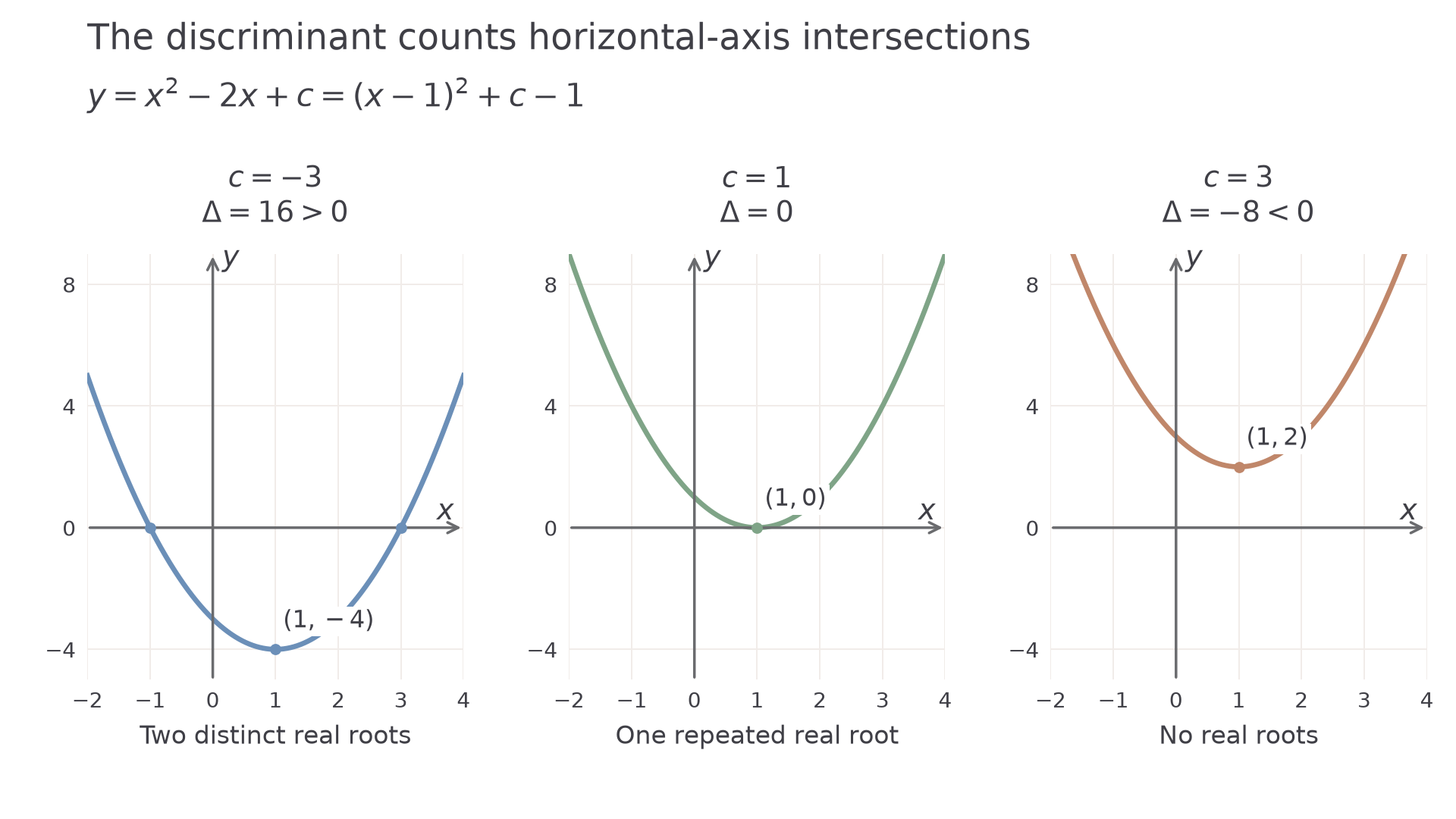
These upward parabolas show the same three root cases; the sign rule also works for downward parabolas.
Read a general argument carefully: completing the square writes the vertex height as . If , then when , but when . Thus “negative discriminant means the graph lies above the axis” needs the extra assumption . The correct unrestricted conclusion is that it misses the axis. This is a useful habit when reading a mathematical article: track the condition that permits each inference. The derived vertex-height relation is not in the formula sheet: learn it.
Watch out
Wrong: means “the graph does not exist”. Right: the real quadratic graph exists and has no real roots. Its leading coefficient decides which side of the axis contains the curve.
Change only the constant in the last worked example and connect the new sign to the picture.
Conditions on a coefficient
Translate the words about roots into the right condition before doing algebra with a parameter.
For , the minimum changes height but stays at . It is below the axis for , on it for and above it for , agreeing with discriminant . The graphs are examples of the family; the algebra proves the full boundary.
Worked example 7: allowing a repeated root
Question. Determine the values of for which has real roots, allowing a repeated root.
Plan. Use a non-negative discriminant and solve the inequality.
Why this step? A repeated root is real, so the equality case belongs to the requested set.
Answer. .
Check. At , the expression is , with repeated real root . For , its minimum is negative and the upward curve crosses twice.
Change only the wording to “two distinct real roots”. The boundary now has to be excluded.
Worked example 8: requiring distinct roots
Question. Determine the values of for which has two distinct real roots.
Plan. Make the same discriminant strictly positive.
Why this step? Equality would merge the two roots into the single repeated root, which the word “distinct” rules out.
Answer. .
Check. At , the factors give the distinct roots ; at , the repeated-root boundary is correctly excluded.
If the parameter is the leading coefficient, check the degree as well. For to be a quadratic with real roots, and . Hence , . At the equation is linear with solution , so do not describe it as a quadratic with discriminant-classified roots.
Now return to the opening curve:
It reaches at , and can never reach . Completing the square supplies the exact bound that a graph suggested.
Watch out
Wrong: “real roots” always means . Right: use when repeated roots are allowed. Reserve for distinct real roots, for a repeated root, and for no real roots.
MEI's “Determine” needs the argument that produces the answer, including any degree restriction or endpoint decision.
Exam tip
Write the discriminant and its condition before the parameter range. If detailed reasoning is requested, an inequality copied from a calculator cannot replace those steps. A boundary substitution is a useful check on whether equality belongs.
Change the leading coefficient in the distinct-root example, and explain why the new endpoint stays out.
Quick Recap
- MC3 completes the square as , revealing vertex and symmetry line .
- A positive leading coefficient gives a minimum; a negative one gives a maximum. Label the vertex and intercepts in a smooth quadratic sketch.
- Ma3 uses to distinguish two distinct real roots, a repeated root and no real roots.
- Translate the exact root wording into a strict or inclusive condition, and check any leading-coefficient parameter cannot be zero.
The opening curve has maximum height at ; height is impossible.