Mc9 - Tangents and normals to curves
Construct tangent and normal equations from a curve point and its derivative, as required by Mc9. You will deal with horizontal and vertical directions, find contacts from a specified gradient, and read a short mathematical passage which develops a new relation from familiar normals.
A tangent needs a point and a gradient
Can a line capture a curve's direction at one point and still be useful somewhere else? At , the curve passes through the horizontal axis with tangent gradient . A point and direction are enough to identify that line exactly.
You already know
A line through with finite gradient has equation . Differentiate first and evaluate afterwards; the derivative gives the tangent gradient, while the function gives the contact height.
Keep the contact input fixed when writing the tangent. Its slope is a number, even though the gradient function varies along the curve.
Tangent at a curve point
For , at with a finite derivative,
Not in the formula sheet: learn it.
The point-gradient form makes both ingredients visible and works without first finding an intercept.
Worked example 1: constructing the tangent
Question. Find the tangent to at .
Plan. Find the contact point and the derivative value, then combine them.
Why this step? Using the derivative function itself as a changing slope would produce a curve, rather than this straight tangent.
Answer. .
Check. The line contains and has the required gradient .
Change only the sign of the contact input. The height changes, although this derivative happens to have the same value.
Worked example 2: a parallel tangent elsewhere
Question. Find the tangent to the same curve at .
Plan. Evaluate the new point and gradient separately before writing the line.
Why this step? Equal gradients give parallel lines, but different contact points can give different intercepts.
Answer. .
Check. At , the line gives . It is units above the previous tangent at every input.
A tangent can meet the curve again away from contact. For the first line,
So it also meets the cubic at . That is the useful surprise: tangent means the local direction, not “a line with only one intersection”.
Watch out
Wrong: use a supplied point without checking it lies on the curve. Right: confirm its height and evaluate the derivative at the same input. The right slope through the wrong point gives a parallel line.
Choose a fresh contact input on the same cubic.
The normal is perpendicular to the tangent
A normal keeps the contact point but turns the tangent direction through a right angle. Think about the two directions before doing any algebra with gradients.
Normal
The normal at a curve point is the line through that point perpendicular to its tangent. The derivative gives the tangent's gradient; it does not directly give the normal's gradient.
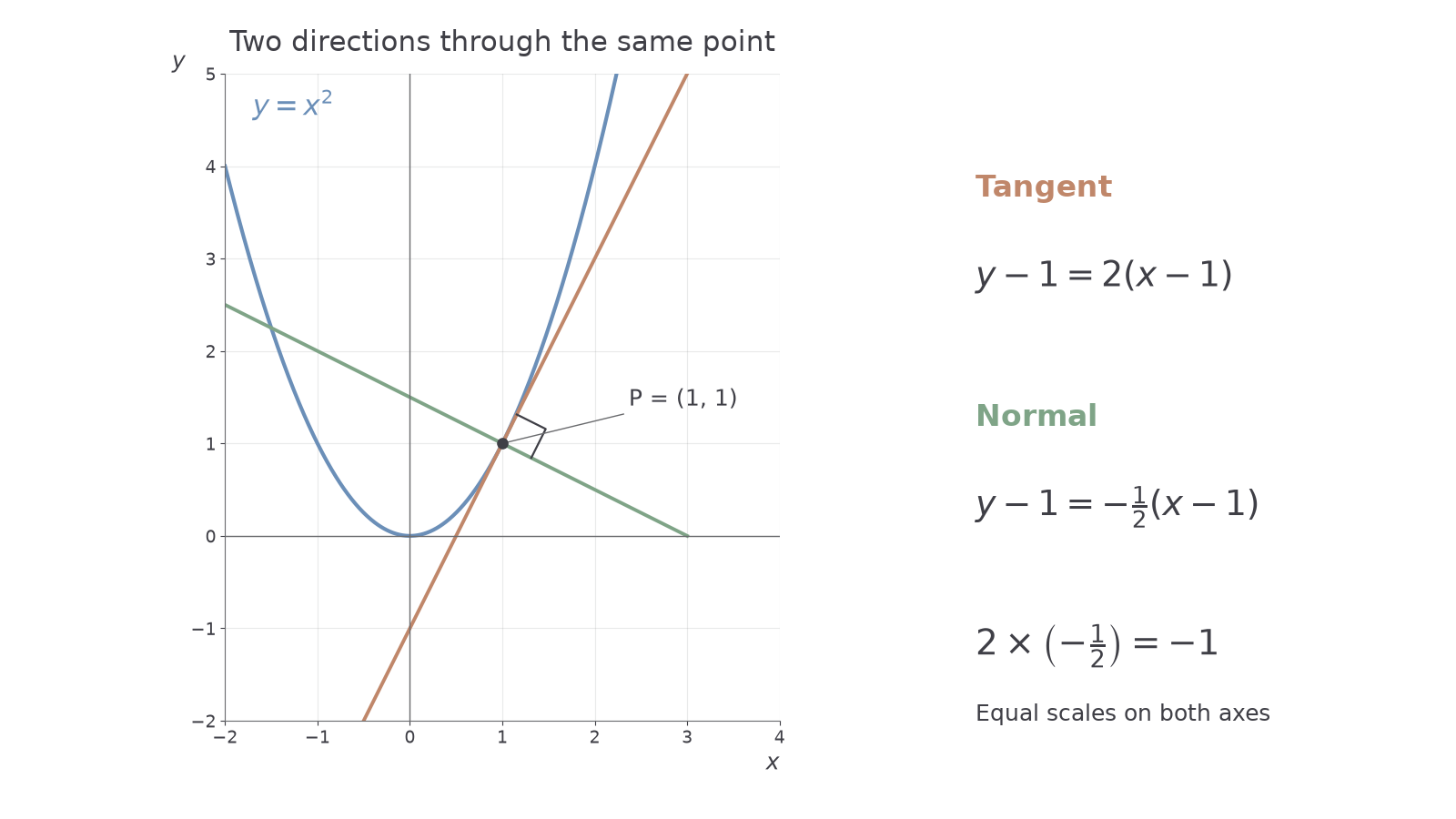
In this equal-scale diagram, the tangent and normal to at have gradients and . Both pass through the same curve point.
Normal gradient and equation
If the tangent gradient is finite and nonzero, then
The negative-reciprocal step requires .
Not in the formula sheet: learn it.
For a fractional gradient, invert the fraction as well as changing its sign. Tangent gradient gives normal gradient , since their product is .
Worked example 3: finding a normal
Question. Find the normal to at .
Plan. Calculate the contact height and tangent gradient, then use the perpendicular direction.
Why this step? The line must be perpendicular at the curve point, so keep the point while replacing the gradient.
Answer. .
Check. , and .
Change only the contact input's sign. This checks both the reciprocal and the signs in the point-gradient form.
Worked example 4: a reflected normal
Question. Find the normal to at .
Plan. Use the new point and derivative value before taking the negative reciprocal.
Why this step? The tangent's negative gradient produces a positive normal gradient, not another negative gradient.
Answer. .
Check. The line contains , and .
Writing separate symbols and is a small habit that prevents answering a tangent question when a normal was requested.
Exam tip
Check both conditions: the line contains the curve point, and its gradient is perpendicular to the tangent's. Passing through the correct point alone does not establish that a line is the normal.
Move the contact input to a fresh value.
Horizontal and vertical directions
A horizontal tangent has gradient zero. Its perpendicular normal is vertical and has no finite gradient, so this case needs geometry rather than division by zero.
Horizontal and vertical pair
At , if ,
Not in the formula sheet: learn it.
One equation keeps height constant; the other keeps the horizontal coordinate constant. Check which direction the question asks for.
Worked example 5: a normal with no finite gradient
Question. Find the tangent and normal to at .
Plan. Find the contact point and verify that the tangent gradient is zero.
Why this step? A zero tangent gradient makes the normal vertical; assigning it gradient zero would make it parallel instead.
Answer. Tangent ; normal .
Check. Both contain and have perpendicular directions.
Change only the constant term. The derivative remains unchanged, but the contact height moves.
Worked example 6: the same vertical normal
Question. Find the tangent and normal to at .
Plan. Recalculate the height and use the same derivative.
Why this step? Moving a curve upwards changes its horizontal tangent's height, but not its vertical normal's horizontal position.
Answer. Tangent ; normal .
Check. The tangent has moved up , matching the curve's translation.
Vertical tangents are possible too. For the real cube-root curve , the derivative exists for and grows positively without bound towards zero from both sides. At the origin, write : the horizontal change divided by vertical change is . This establishes a vertical tangent and horizontal normal . Their equations come from the geometry and are not in the formula sheet: learn the reasoning.
Continue this lesson.
You’re previewing NovaLearn without an account. Create a free account to read the rest.
Create free account