ME1, ME8, ME9 - Exponential functions and the number e
Connect exponential graphs with repeated multiplication and interpret their intercepts, ranges and asymptotes. Use the special gradient of to explain when an exponential is a sensible model for change.
Positive bases and repeated multiplication
If a device loses one fifth of its remaining charge each hour, does it lose the same amount every hour? Starting from 100 units gives 80, then 64: the losses are 20 and 16, although the multiplier stays .
You already know
For , , and . A geometric sequence multiplies by the same ratio at each step.
The same multiplication pattern can describe a continuous curve.
Exponential function
An exponential function has a fixed positive base and a variable exponent. For example, is exponential; is not.
A non-positive base does not give the required real output for every real input: is not real, and a zero base fails at negative exponents.
Positive-base graph features
For , . When ,
The graph increases for , and decreases for . For , it is the constant , with range .
Not in the formula sheet: learn it.
To sketch, establish the direction and intercept before joining a few exact points.
Worked example 1: building a growth sketch
Question. Find the points on at , and state its range and asymptote.
Plan. Evaluate powers and use positivity to locate the whole curve.
Why this step? Points to the left of zero show that positive outputs need not exceed 1.
Answer. The points are . The curve increases, has range , and approaches as .
Check. Each output is three times the previous one.
Change only the base to its reciprocal, which reverses the input direction.
Worked example 2: building a decay sketch
Question. Give the corresponding points, range and asymptote for .
Plan. Write and reverse the powers.
Why this step? The reciprocal base reflects the graph in the vertical axis, without making any output negative.
Answer. The points are . The curve decreases, has range , and approaches as .
Check. The multiplier is at each step.
The two reciprocal bases give the reflected shapes below; the dashed line shows the constant exception.
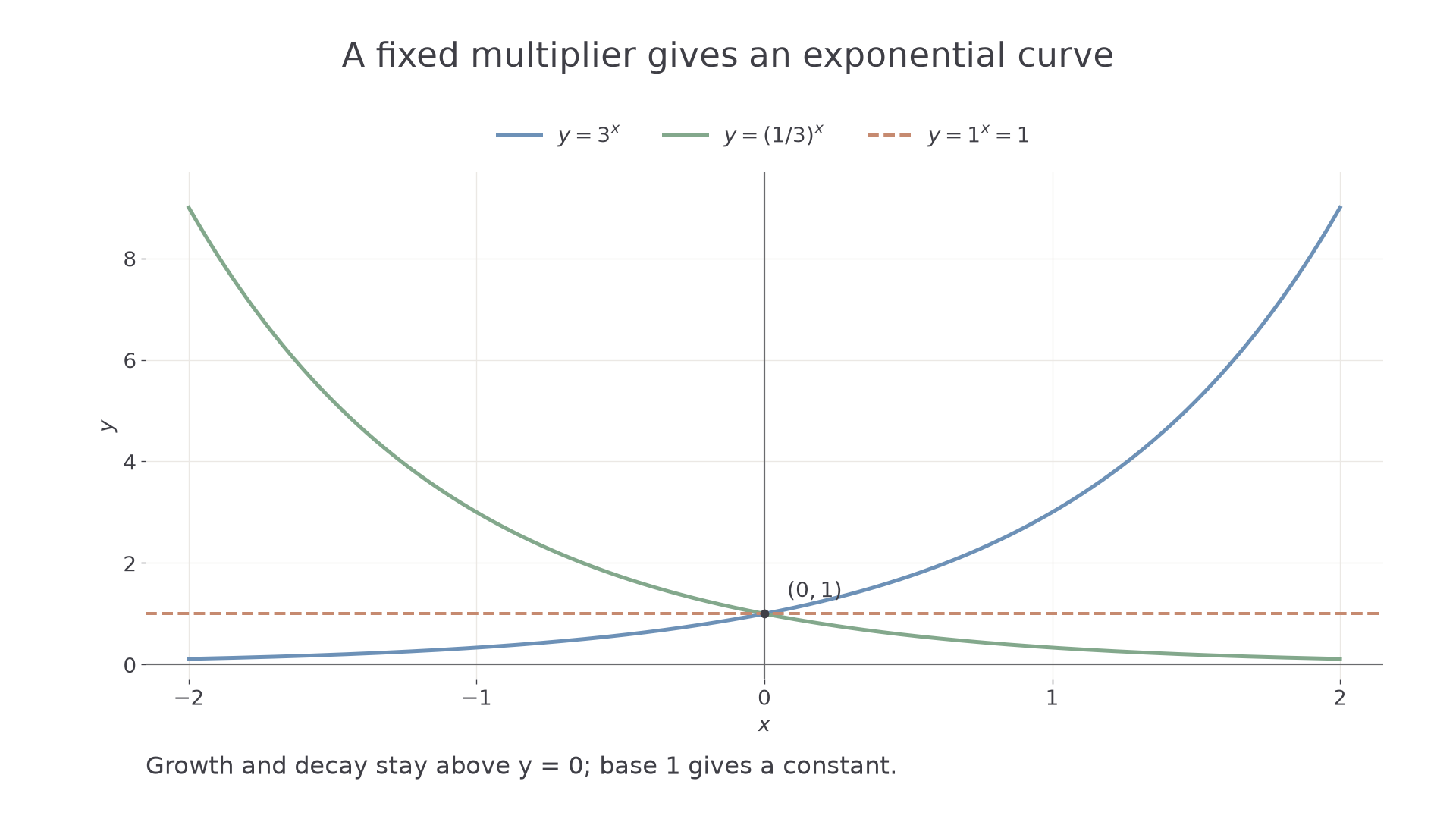
Integer observations form a geometric sequence. Interpreting at fractional hours assumes a smooth decay between readings; it is an additional modelling choice.
Watch out
A constant loss gives a straight-line model; a constant proportion of the remaining amount gives an exponential model. These descriptions predict different second-hour losses.
Change the reciprocal base once more.
The number e and its graph
The natural exponential has the special property that its tangent gradient always equals its height.
Natural exponential
The natural exponential is , where . It increases through , has domain , range , and horizontal asymptote as .
The constant is a base, not a variable or a percentage. A tangent records the graph's instantaneous rate of change.
Natural exponential gradient
At input , the graph has gradient .
Not in the formula sheet: learn it.
For example, chord gradients near zero are and . Their approach towards 1 illustrates the property rather than proving it.
Worked example 3: a tangent at height e
Question. Determine the tangent to at .
Plan. Find the point and use its height as the gradient.
Why this step? Exact values expose the cancellation of the two constant terms.
Answer. . This tangent passes through the origin, although the exponential itself stays strictly above the horizontal axis.
Check. Substituting gives the contact point .
Change only the input of the point of contact.
Worked example 4: a steeper tangent
Question. Determine the tangent to at .
Plan. Use the same property at the new point.
Why this step? The gradient changes with the point; it is not always .
Answer. , with horizontal-axis intercept .
Check. At , the line has height ; its gradient exceeds the previous tangent's because .
At zero, the same method gives , shown beside the curve.
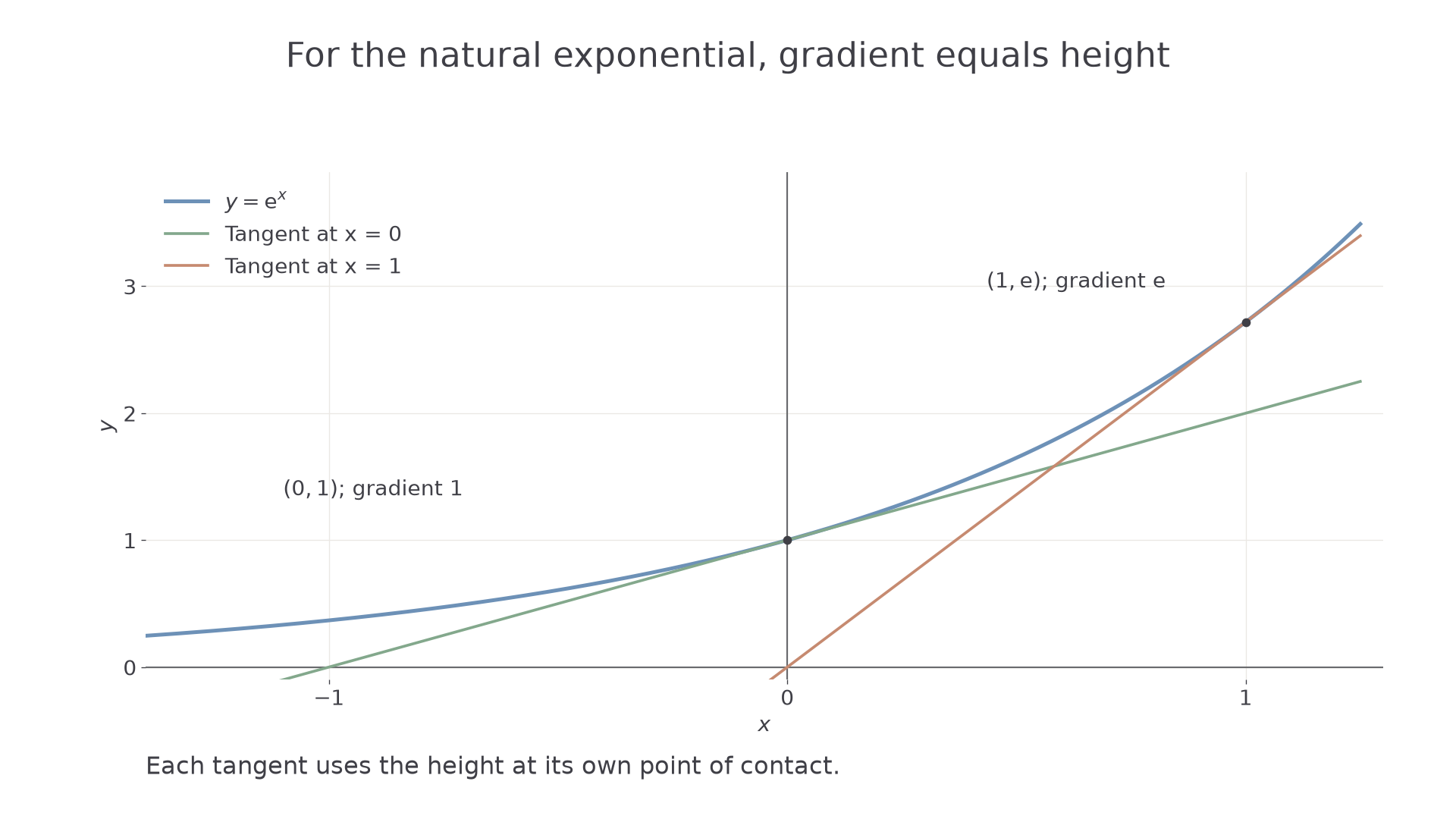
That tangent is a useful local approximation, not an identity for all inputs.
Continue this lesson.
You’re previewing NovaLearn without an account. Create a free account to read the rest.
Create free account