Mf6, Mf7 - Modulus graphs, equations and inequalities
Read a modulus as a distance, then connect that distance to a graph with two straight arms. You will find intersections, retain valid branches and express inequality solutions with the right intervals and endpoints.
Modulus as distance and bounds
A sensor accepts a position when it is at most 2 units from 3. How can you describe every accepted position in one inequality? Positions 1 and 5 are at the boundary; position 3 is accepted too. Modulus packages this two-sided requirement into .
Modulus
The modulus of a real number is its distance from zero. For example, , and . More generally, measures the distance from to . A modulus is non-negative; it need not be positive.
A negative input has a positive distance because its sign is reversed. This is not the same as putting a minus sign in front of every input.
Distance and bounds
For real ,
For real and ,
A strict bound excludes the endpoints. A distance greater than selects or .
Not in the formula sheet: learn it.
The sensor example shows why the two bounds belong together: the position must satisfy both of them.
Worked example 1: a bounded position
Question. Solve .
Plan. Replace the distance requirement by lower and upper bounds, then add 3 throughout.
Why this step? The inside expression may be positive or negative, so bounding only would miss half the condition.
Answer. , or .
Check. The endpoint distances are both 2 and the centre distance is 0, so all three are accepted.
Change one feature: apply the distance bound to a general linear expression rather than . Bound that entire expression before isolating .
Worked example 2: bounding a linear expression
Question. Solve .
Plan. Put between and 7, then rearrange both bounds together.
Why this step? The coefficient 3 multiplies the whole input, so it must divide both bounds when you isolate .
Answer. .
Check. Substitution of the endpoints gives inside values and 7. At , the modulus is 2, within the bound.
A zero bound is worth a pause: allows only . A negative upper bound allows no real inputs, and also has no solutions.
Watch out
Wrong: gives only .
Right: the lower bound matters too, giving . A value such as satisfies that single upper bound but fails the modulus inequality.
Keep the bounds together in the next linear expression.
Folding a linear graph
A graph of a single linear modulus turns negative line outputs into positive ones while keeping their horizontal positions.
You already know
For , solve to locate its horizontal intercept. The gradient tells you which side of that intercept has negative outputs.
Start with . Its zero is 2. The part to the left is below the horizontal axis, so reflect just that part upwards.
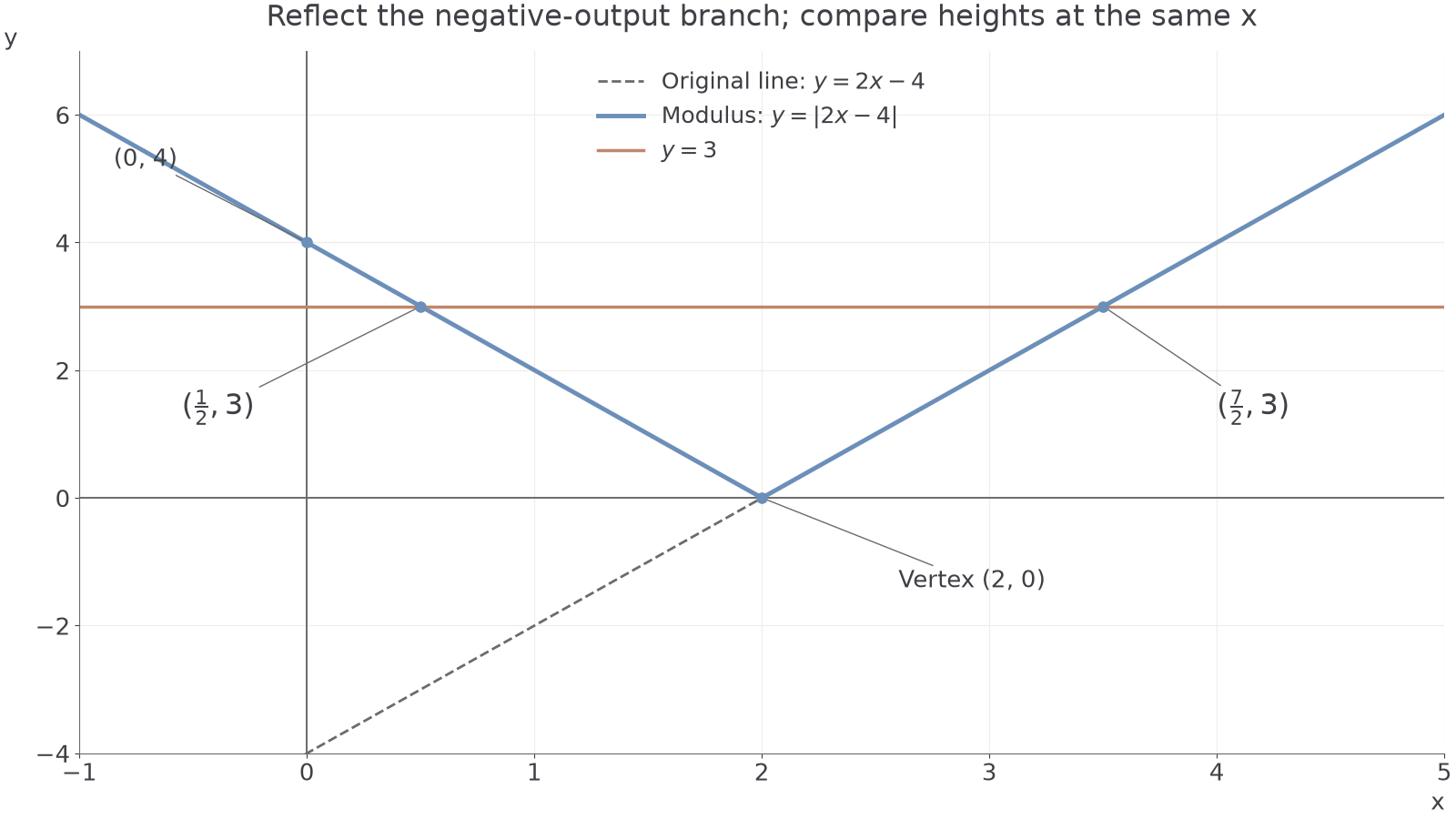
The unchanged and reflected branches meet at the vertex . They are straight on both sides of the corner.
Shape of a linear modulus
For real ,
The vertex is , the branch gradients have magnitude , and the graph is symmetric about . For , the graph is the constant line .
Not in the formula sheet: learn it.
A sketch needs the vertex, the vertical intercept and straight arms with the right slopes. A dense point table is unnecessary.
Worked example 3: locating the fold
Question. Give the vertex, vertical intercept and branch equations for .
Plan. Find the zero and the sign of , then keep or reverse its output.
Why this step? The negative arm changes its output sign, rather than its input sign.
Answer. Vertex , vertical intercept ; left gradient , right gradient 2.
Check. The two branch equations both give 0 at the vertex; at and , both outputs are 2.
Reverse the sign of the inside expression, changing nothing else. The underlying line reverses, but its distances from zero do not.
Worked example 4: the same V from another line
Question. Describe the graph of , with its branch equations.
Plan. Decide where is non-negative and reflect its other branch.
Why this step? A number and its negative have the same modulus, so two different lines can produce exactly the same folded graph.
Answer. It is the same V, with vertex and vertical intercept .
Check. At , both descriptions give 4; at , both give 4 again.
That is the lesson's small surprise: the modulus graph does not tell you which of those two opposite lines was folded.
Watch out
Wrong: replace the whole line by .
Right: reflect only negative outputs. The other arm must remain in place, or your result is still a line rather than a V.
Try a new linear function, keeping the same sign-based reasoning.
Equations and admissible intersections
A modulus equation asks where a V-shaped graph and another graph have equal heights.
At an intersection with , the line underneath can have output 3 or . With a sloping comparison line, remember that a modulus cannot equal a negative output.
Admissible solutions
For real and ,
Using branch domains is another way to enforce the sign condition. Squaring alone is insufficient when can be negative.
Not in the formula sheet: learn it.
The horizontal comparison has an especially clear picture: two arms, two intersections.
Worked example 5: reading two intersections exactly
Question. Determine the solutions of .
Plan. Solve the two possible inside values and connect them to the graph.
Why this step? The two signed outputs of the underlying line fold onto the same height 3.
Answer. or . These are the horizontal coordinates of the intersections with .
Check. Substitution gives and .
Replace the horizontal line with a sloping one. This changes which extended-line intersections actually belong to the V.
Worked example 6: a branch check rejects a candidate
Question. Determine all solutions of .
Plan. Solve on each side of the vertex and retain only candidates on their stated branch.
Why this step? Extending a straight arm beyond the vertex creates points that are not part of the modulus graph.
Answer. The only solution is .
Check. Both sides are at . At , the sides are 14 and , so the rejected candidate cannot work.
A graphical reading might suggest approximately ; the algebra establishes the exact fraction. Keep that distinction when a question asks for an exact answer.
Watch out
Wrong: keep both solutions of automatically.
Right: substitute into the unsquared equation or check the branch. Equal squares can come from opposite signed values.
The next line genuinely meets both arms. Show why neither candidate is discarded.
Choosing intervals from modulus inequalities
An inequality compares graph heights over intervals, rather than only at individual intersections.
For , the V must be below the horizontal line. With a sloping line, compare it with each arm and keep only the appropriate branch inputs. The inequalities here use a single modulus sign applied to a linear expression.
Below, above and endpoints
For functions defined at ,
means that the first graph is on or below the second. Intersections belong for or ; they do not belong for or .
Not in the formula sheet: learn it.
First use the existing graph to see the interval directly.
Worked example 7: choosing the middle interval
Question. Solve , using its graph to select the solution interval.
Plan. Locate the two intersections and choose where the V is lower than the line.
Why this step? Solving the boundary equation alone gives two points, not the interval asked for.
Answer. .
Check. The vertex input 2 works because . Input 0 fails because . Equality at either boundary is excluded.
Change only the type of comparison graph: a sloping line replaces the horizontal one, keeping and the strict sign. Do not assume that the solution is still between two boundaries.
Worked example 8: joining the valid branch intervals
Question. Determine the solution of .
Plan. Solve the inequality on each arm, intersect with its branch domain, then join the results.
Why this step? An answer obtained from an arm only applies on that arm; cannot extend the first case below its domain .
Answer. .
Check. At , both sides are , so this strict comparison excludes the endpoint. At , the sides are 6 and 0, so that input is rejected.
The sensor at the start also selected graph heights: its distance graph had to stay on or below height 2. Branch reasoning gives the same interval as the direct distance bound.
Watch out
Wrong: square and accept intervals with .
Right: a non-negative modulus cannot lie below a negative number. Use its two linear branches, or retain that sign restriction when squaring.
An outside comparison gives two intervals again. Express their union clearly.
Quick Recap
- Modulus is distance and can equal zero.
- A single linear modulus folds negative line outputs upwards, giving two straight arms.
- Check equation candidates against their branches or the unsquared equation.
- Inequalities select intervals of graph heights; their signs decide endpoint membership.
The sensor accepts exactly , because these and only these positions are at most 2 units from 3.