Mt10, Mt11 - Radians, arc length and sector area
Define angles through arc length, convert between radians and degrees, and derive circle formulae that distinguish curved boundaries, sectors and segments.
An angle defined by arc length
A paper sector has curved edge and area . Can you recover its radius without being given the angle? Yes: radians connect those two measurements so neatly that the unknown angle will cancel.
Begin with a simpler case. An arc of length on radius subtends one radian. The same angle on radius has arc length . The ratio, rather than either length alone, defines the angle.
You already know
A circle of radius has circumference , area and full-turn angle . Convert all lengths to matching units before dividing them.
Enlargement multiplies arc and radius together, leaving their ratio unchanged.
Radian measure
One radian is the angle subtended at the centre of a circle by an arc equal in length to the radius. In general, radians for arc length , radius , and matching length units.
The full circumference is times the radius, so one full turn is radians. A useful surprise: laying six radius-length arcs around a circle still leaves a gap of . Six radians is close to a turn, but is not a turn.
Degrees and radians
A change of units preserves the direction of a rotation.
Not in the formula sheet: learn it.
For example, radians converts back to . Keep exact multiples of exact when requested; a decimal radian measure such as does not secretly contain another factor of .
Worked example 1: a turn beyond a straight angle
Question. Convert to radians exactly.
Plan. Use radians per degree and simplify the fraction.
Why not reduce the angle into an acute one? The question asks for the stated rotation, so the amount of turn must be preserved.
Answer. radians.
Check. , matching .
Change only the direction: clockwise is written .
Worked example 2: preserve a negative rotation
Question. Convert to radians exactly.
Plan. Keep the negative sign throughout the same unit conversion.
Why retain the sign? Conversion changes the measuring unit; it does not change clockwise motion into anticlockwise motion.
Answer. radians.
Check. Multiplication by returns .
Negative and multiple-turn measures describe rotations. For the boundary and area of a particular physical sector, instead use the positive angle covering that region.
Watch out
Wrong: radians as a directed rotation. Right: . The two arguments can have the same endpoint without being the same amount of rotation.
Change the size of the clockwise rotation for your conversion.
Arc length and sector area
A sector's fraction of the circle is its angle divided by a full-turn angle, .
Sector
A region bounded by two radii and their joining arc. The arc is its curved edge; the perimeter includes the two radii as well. A reflex sector has angle between and .
Multiplying the angle fraction by circumference and circle area gives
The cancellation is the reason radians are so convenient. No degree-conversion factor remains.
Sector measurements
Use and the positive angle of the selected region in radians, normally . Length and perimeter use length units; area uses squared units.
Not in the formula sheet: learn it.
Read the region as carefully as the numbers. The diagram's chord is an internal line of the sector, not one of its bounding radii.
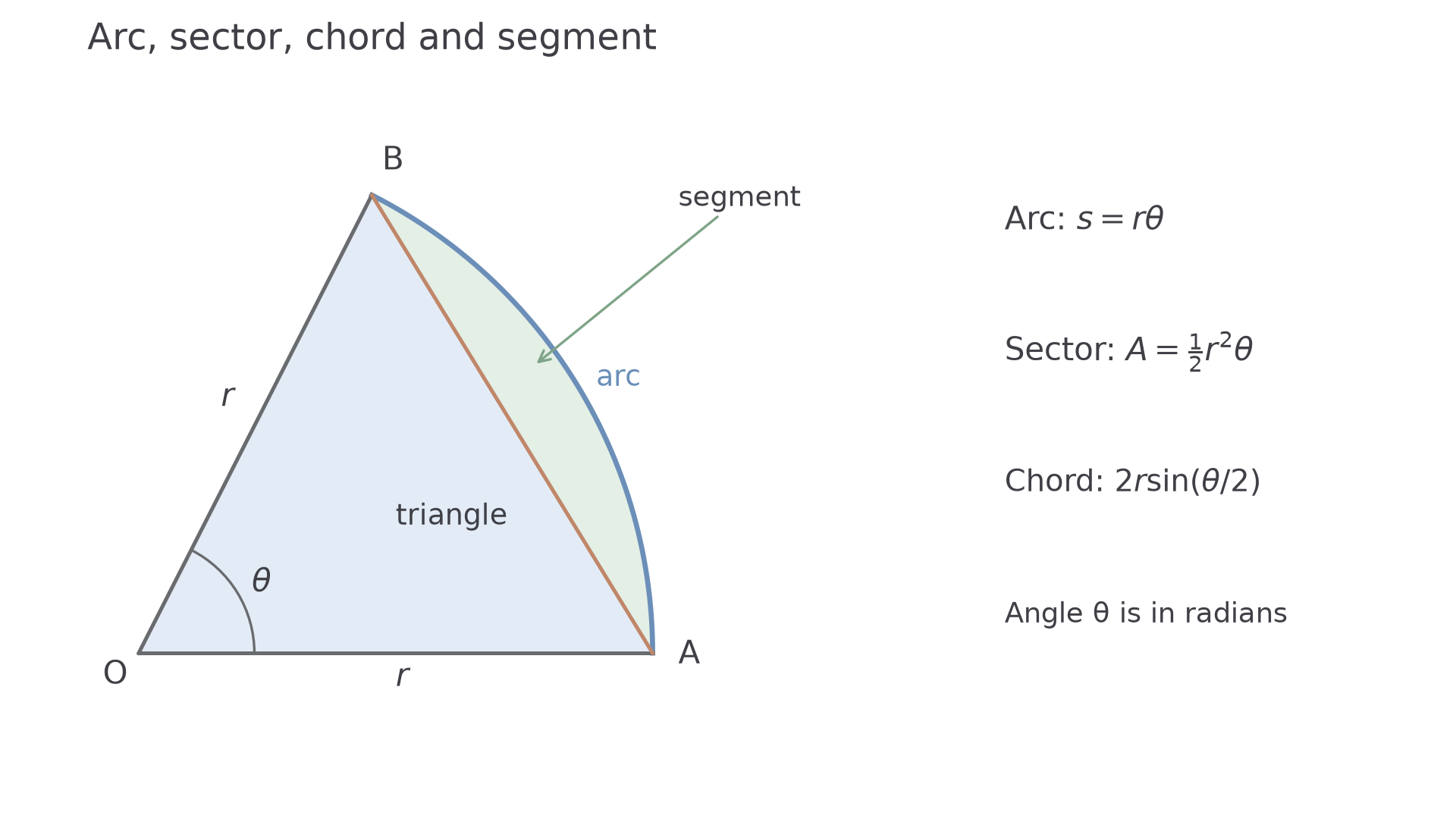
An equilateral triangle formed by two radii and their chord has central angle . That can identify a small missing sector without any calculator trigonometry.
Worked example 3: the small sector
Question. A circle has radius , and two radii make angle . Find the minor sector's arc length, area and perimeter exactly.
Plan. Substitute the given radian angle into the length and area formulas, adding both radii for the perimeter.
Why are both radii counted? They are on the sector's outside boundary.
Answer. Arc , area , perimeter .
Check. These arc and area values are one sixth of the full-circle values.
Change only the chosen region to the reflex sector between the same radii. Now the small sector is the gap.
Worked example 4: choose the reflex region
Question. Find the corresponding measurements of the reflex sector in that circle.
Plan. Use , the remaining five sixths of a turn.
Why subtract a sector, not a triangle, from the circle? The gap is bounded by two radii and an arc; its curved boundary makes it a sector.
Answer. Arc , area , perimeter .
Check. The two areas sum to , and the two arcs sum to .
Continue this lesson.
You’re previewing NovaLearn without an account. Create a free account to read the rest.
Create free account