MF12 - Motion on rough surfaces
Apply Newton's laws to sliding on rough surfaces, including a force that changes normal contact. Separate uphill motion, first rest and any reversal, then extend the force model to connected particles.
Sliding on a horizontal surface
Would the same angled force make a box accelerate more when you pull upwards or push downwards? Its forward component can be identical in both cases, yet the accelerations differ because the normal reaction changes.
Take a box with and . A force with horizontal component and vertical component gives reaction when pulling up, but when pushing down. The forward drive is unchanged; friction is not.
You already know
Resolve the forces and use resultant force . For constant acceleration, and are in the formula sheet. Use them only while the same acceleration applies.
A rough-surface sliding model uses , opposite sliding. Here the stated coefficient also supplies the static bound at rest. Model the box as a particle, ignoring toppling.
An angled force during rightward sliding
For an upward force at acute angle to horizontal,
For a downward force, instead use , giving . Require maintained contact and rightward sliding throughout the interval.
Not in the formula sheet: learn it.
The acceleration expressions are derived by eliminating ; using the two component equations is just as effective.
Worked example 1: an upward force while sliding
Question. A particle slides right at on rough horizontal ground with . A force acts right and up, with cosine and sine relative to horizontal. Take . Determine acceleration and speed after , assuming contact persists.
Plan. Find the reduced reaction and friction, then use the horizontal resultant and velocity equation.
Why include the vertical component? It reduces friction even though it creates no vertical acceleration.
Answer. Acceleration is right, and speed after is .
Check. , velocity remains rightwards, and , the horizontal resultant.
Change only the vertical sense of the applied force, so it pushes downwards at the same angle. Determine the same quantities after the same time.
Worked example 2: a downward force while sliding
Question. The same particle starts at right with . The force now acts right and down, with cosine and sine . Take . Determine acceleration and speed after , assuming contact persists.
Plan. Increase the reaction by the downward component before calculating friction.
Why is the acceleration smaller? The same horizontal drive must now overcome more friction.
Answer. Acceleration is right, and speed after is .
Check. Contact and rightward sliding persist. The resultant equals .
The opening question is settled: lifting reduces friction and gives greater acceleration in these two models. The force need not lift the particle completely off the ground to matter.
Watch out
Wrong: friction opposes acceleration. Right: friction opposes sliding. A particle moving right may accelerate left while its friction also points left.
Try a push strong enough vertically to make the rightward sliding slow down.
Motion down a rough incline
Sliding downhill does not necessarily mean speeding up downhill. Weight drives down the slope, friction opposes it, and their difference determines the acceleration.
Use the line of greatest slope for the motion here. Normal equilibrium gives , where is the acute inclination to the horizontal. Friction acts uphill while sliding is downhill.
The downhill equation
With only weight and contact, and downhill positive,
The mass cancels. This expression is valid only during downhill sliding; if the particle stops, test static equilibrium before continuing.
Not in the formula sheet: learn it.
Mass-independent acceleration is a useful consequence of this model. It relies on both weight and sliding friction being proportional to mass.
Worked example 3: gravity wins along the slope
Question. A particle is projected downhill at on a plane with , , and . Only weight and contact act, with . Determine its downhill acceleration and distance travelled in the first second. Give exact values.
Plan. Resolve weight and friction, then use the signed acceleration to find displacement.
Why does displacement equal distance? The velocity stays downhill throughout the interval.
Answer. Downhill acceleration is , and distance is .
Check. Final velocity is downhill, giving average speed .
Change only , from to . Determine the same quantities over the same second.
Worked example 4: friction wins while motion stays downhill
Question. The same particle is projected downhill at on the same plane, but . Only weight and contact act, with . Determine its downhill acceleration and distance travelled in the first second. Give exact values.
Plan. Recompute uphill friction and check that downhill velocity stays positive.
Why keep friction uphill? The negative acceleration means slowing down, not that the particle has already reversed.
Answer. Downhill acceleration is , meaning uphill. Distance is .
Check. Final velocity is downhill. First rest is at , after the interval used.
The coefficient changes the acceleration without changing the sliding-friction direction. That direction changes only if sliding reverses.
Watch out
Wrong: substitute the weight into on an incline. Right: first find the normal reaction , then calculate friction.
Try a slope given by its angle rather than a component ratio.
Stopping, holding or reversing on an incline
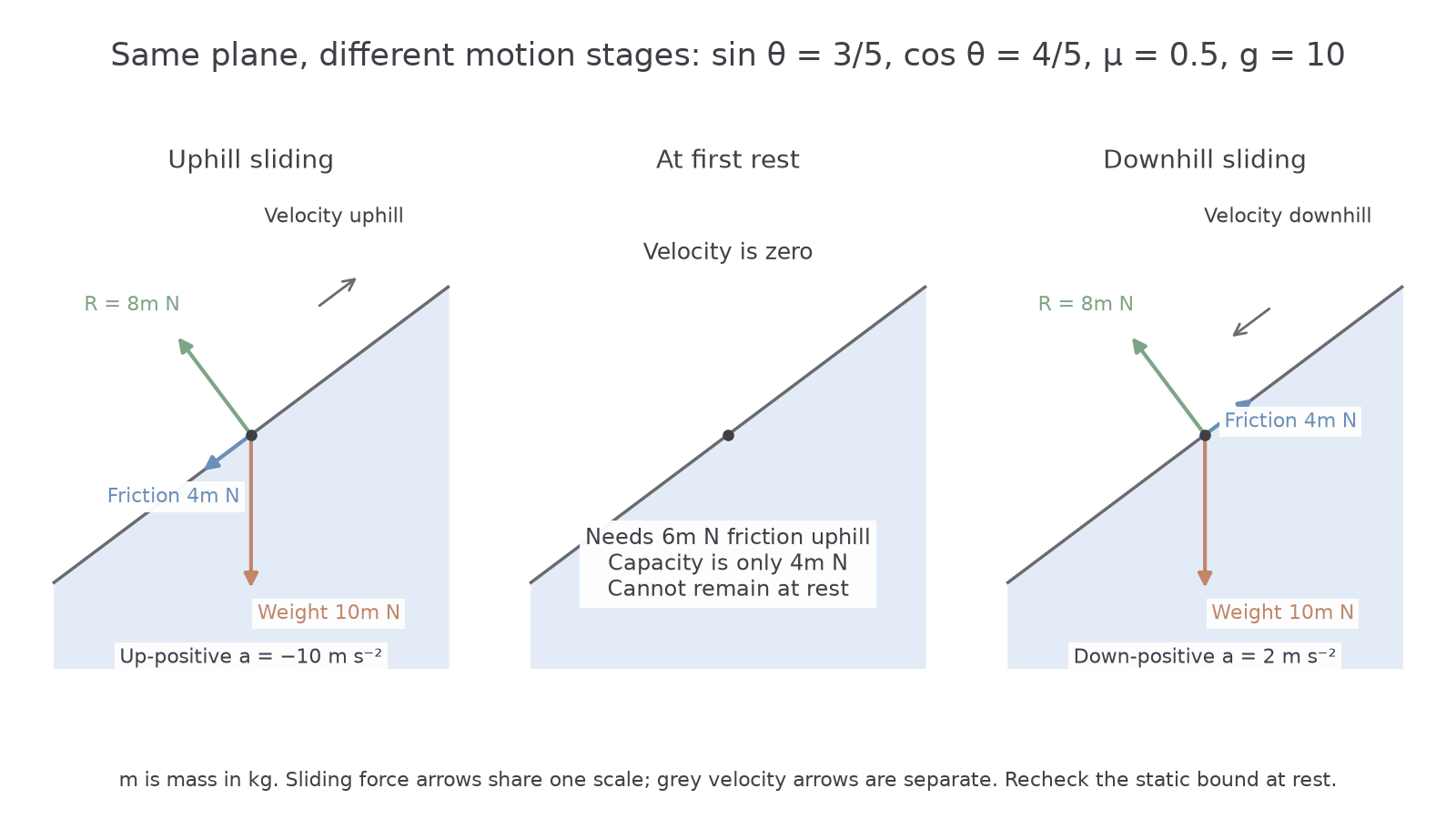
An uphill launch has two phases to investigate: sliding until first rest, then whatever the static force comparison allows. Reaching zero velocity does not guarantee a reversal.
At the boundary , friction can just hold the particle after it stops. This is limiting equilibrium, not a command to move downhill. The same model predicts no spontaneous motion from a balanced state.
[DIAGRAM: asset_name: Friction changes at reversal; asset_slug: incline_friction_stages; caption: First rest separates the uphill equation from the static decision and any downhill equation; description: Three panels on the same incline show uphill sliding with friction downhill, first rest with required uphill friction tested against capacity, and downhill sliding with friction uphill if capacity was insufficient.]
Continue this lesson.
You’re previewing NovaLearn without an account. Create a free account to read the rest.
Create free account