Mc19–Mc21 - Integration, antiderivatives and constants
Recover a function from its derivative, integrate powers and select a particular curve using given information. Explain how the fundamental theorem connects reverse differentiation with accumulated signed area.
Recovering a family from a derivative
Can a graph's gradients tell you its height? Consider , and . All three have derivative . Even knowing the gradient at every real input leaves the vertical position unresolved. We will find the missing information and see why an area calculation does not need it.
You already know
A vertical translation leaves gradients unchanged. The derivative of a constant is zero, while .
Integration reverses differentiation, but it cannot recover information differentiation has erased.
Antiderivative and indefinite integral
An antiderivative of is a function with . The indefinite integral represents all these functions on an interval. The integrand is ; specifies the variable. For example, is an antiderivative of ; is not.
Here is a fixed real number, the constant of integration. It can vary between members of the family but cannot vary with within one member. Two antiderivatives have a difference with derivative zero, so that difference is constant on an interval. Separate domain intervals may have separate constants.
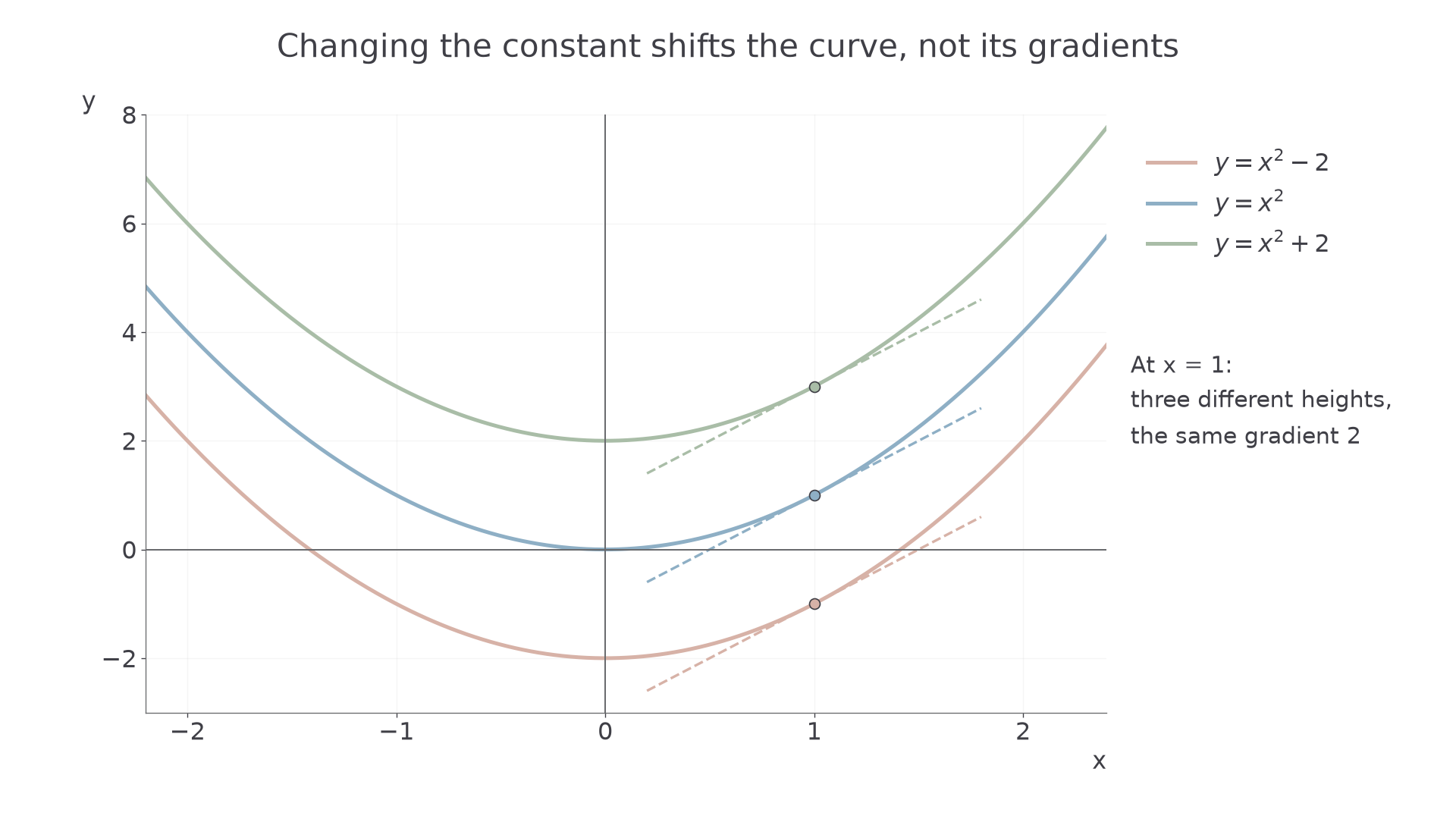
The tangents at are parallel. You could keep adding curves between these three without introducing a new gradient function: there are infinitely many possible heights.
Worked example 1: determine a family
Question. Determine all functions whose derivative is , on the real line.
Plan. Reverse the two known derivatives and include every constant shift.
Why this step? A correct candidate identifies one curve; the arbitrary constant supplies all the other vertical translations.
Answer. , where .
Check. Taking or gives the same derivative.
Change only the constant term in the derivative. Notice which term of the recovered function responds.
Worked example 2: change the constant slope term
Question. Determine all functions whose derivative is , on the real line.
Plan. Replace the linear term while keeping the arbitrary vertical shift.
Why this step? The derivative's comes from , not from the arbitrary constant.
Answer. .
Check. Its derivative is whatever fixed value takes.
A numerical constant in a candidate does not make it the whole family.
Watch out
Wrong: “The integral is only .” That is one antiderivative. The indefinite integral is .
Make one further change to the constant slope term.
Reversing the power rule and combining terms
If differentiation multiplies by the old exponent, integration must divide by the new one. This works for fractional and negative powers as well as whole-number powers.
Integrating powers
For constants , with , on an interval where the real powers are defined and differentiable,
Differentiate the result to recover . A more general reverse-chain power result is printed on the sheet; this elementary rule is required recall.
Not in the formula sheet: learn it.
Integrate sums and differences term by term and combine their constants into one. For instance, a constant integrand gives . Expand brackets when that reveals familiar powers; .
Worked example 3: powers hidden in a quotient
Question. Find , for .
Plan. Rewrite the two quotients as powers, then increase each exponent and divide.
Why this step? Dividing the final coefficient by reverses its sign.
Answer. , for .
Check. Differentiation gives .
Change only the power in the final denominator. Keep track of the new negative exponent.
Worked example 4: change the reciprocal power
Question. Find , for .
Plan. Keep the first two integrals and reverse the derivative of .
Why this step? The exponent increases to ; integration does not reduce it to .
Answer. .
Check. The derivative of is .
Real domains matter. Negative powers exclude zero, while an even root may restrict you to positive inputs when a derivative is required. Odd-root powers can also make sense for negative inputs; do not discard those branches automatically.
Watch out
The rule fails at , because . Writing is not an antiderivative. The integral of uses a logarithm, taught separately.
Now vary just that final reciprocal power again.
Continue this lesson.
You’re previewing NovaLearn without an account. Create a free account to read the rest.
Create free account