Mc5 - First principles and the power rule
Use a limiting difference quotient to explain derivatives of small positive integer powers, then differentiate rational powers much faster with the power rule. Mc5 also covers constant multiples, sums and differences, with roots and reciprocals rewritten carefully and their real domains preserved.
Deriving a derivative from its definition
Can an arbitrarily small change reveal an exact gradient? For at , an input change produces output change . Dividing gives , whose limit is exactly . The increment never has to equal zero.
You already know
A tangent gradient is the limit of chord gradients. Expand brackets before collecting terms, and subtract a multi-term function value inside brackets. A factor can be cancelled only while it is nonzero.
Replace the fixed input by a general , and the same idea becomes a proof valid along the whole curve.
First-principles definition
At an input where the finite two-sided limit exists,
Form and simplify the quotient for , then take the limit.
In the formula sheet.
The added area in this square picture has two strips and a small corner. Their combined area explains the algebraic numerator.
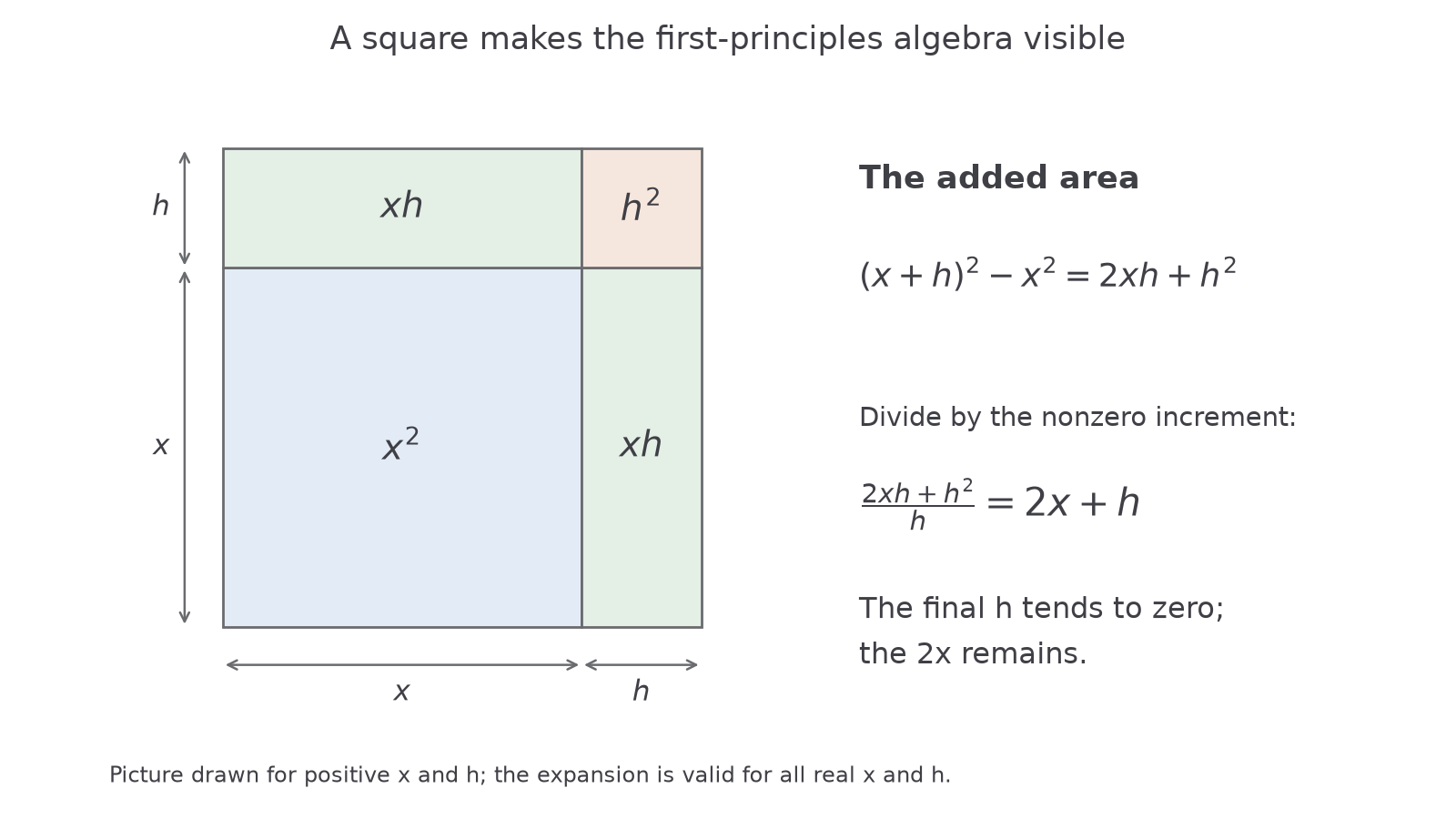
Worked example 1: a rule from a limit
Question. Show from first principles that has derivative .
Plan. Expand the changed square and simplify before taking the limit.
Why this step? The expression equals the chord gradient for every nonzero increment, so it has the same limit.
Answer. for every real .
Check. At , it gives , agreeing with the opening calculation.
Change only a constant multiplier. It must multiply the entire difference of function values.
Worked example 2: a constant multiple
Question. Show from first principles that the derivative of is .
Plan. Keep the factor throughout the quotient.
Why this step? Multiplying all heights by multiplies every height difference, and hence every slope, by .
Answer. , for all real .
Check. At , the quotient is , approaching .
A linear function and a constant provide quick checks on the definition:
Thus and . These results are not in the formula sheet: learn them. For a sum such as , expanding its quotient gives , and the derivative is .
Watch out
Wrong: put into the fraction and call zero. Right: keep while simplifying. The limit describes nearby values, not division by zero.
Change the multiplier again, including its sign, and justify the given result.
First principles for cubic and quartic powers
The binomial theorem extends the argument to small positive integer powers. After dividing by , only the term which originally contained exactly one factor survives the limit.
You already know
In a binomial expansion, keep the coefficients and powers in order. For a fixed input , every remaining positive power of tends to zero as .
Begin with the cubic and track the cancellation explicitly.
Worked example 3: deriving the cubic rule
Question. Show from first principles that .
Plan. Expand the cube, remove the fixed function value and divide by the increment.
Why this step? Subtracting removes the only term without an increment, leaving a factor throughout.
Answer. The derivative is , for all real .
Check. At , the quotient is , tending to , a positive gradient at a negative height.
Change only the power from to . The same method handles the additional term.
Worked example 4: deriving the quartic rule
Question. Show from first principles that .
Plan. Put the quartic expansion into the difference quotient before taking its limit.
Why this step? The binomial coefficient becomes the derivative's coefficient because the other changed terms vanish after taking the limit.
Answer. The derivative is , for all real .
Check. At , the quotient is , tending to .
These derivative formulas are not in the formula sheet: learn them. A constant factor remains throughout the calculation: has derivative . The small-positive-integer derivations explain the pattern, but are not a proof of the rational-power rule which follows.
Key idea
The difference quotient contains a contribution that survives and contributions that vanish. Expanding clearly shows which is which; “put the exponent in front” alone does not establish a first-principles result.
Apply the same proof with a fresh multiplier on the cubic.
Continue this lesson.
You’re previewing NovaLearn without an account. Create a free account to read the rest.
Create free account