Ma7–Ma9 - Inequalities, sets and graphical regions
Use Ma7's linear and Ma8's quadratic inequalities to find intervals and describe regions in the plane. In Ma9, communicate the answer with “and”, “or” or set notation, making every included region and boundary clear.
Preserving order in linear inequalities
Can a curved boundary belong to a region while its endpoints do not? Try the conditions and . The point works because and . The point lies on the parabola, yet fails the strict upper condition. We will describe every permitted point after developing the sign tools.
You already know
Expand brackets and collect like terms. Adding the same number to both sides preserves order. A denominator cannot be zero, and a real square cannot be negative.
Multiplication has a sign decision. For example, , but : multiplying by reflects positions through zero and reverses their order.
Order under multiplication
If , then for real ,
The same rules apply to non-strict inequalities and to division by a non-zero constant of known sign.
Not in the formula sheet: learn it.
A strict sign excludes equality; a non-strict sign allows it. Keep that distinction while rearranging.
Worked example 1: reversing after division
Question. Solve .
Plan. Expand and isolate , reversing the inequality at a negative divisor.
Why this step? A negative divisor reverses order; it does not merely change the sign of the number on the right.
Answer. .
Check. At , the left side is ; at , it is , so equality and the selected side both work.
Change just the inequality sign to strict. The boundary value remains , but it no longer belongs to the answer.
Worked example 2: a strict boundary
Question. Solve .
Plan. Repeat the rearrangement, retaining strictness.
Why this step? The equality case no longer passes the condition, although it still separates the two sides.
Answer. .
Check. works; gives , which is false.
For , multiply by positive : , giving . No reversal is needed. A compound inequality combines two restrictions: gives . Apply each operation to all three expressions; division by a negative constant reverses both signs.
Watch out
Wrong: . Check a value: fails the given inequality. The correct answer is . Multiplying by zero is not reversible either.
Use a new bracket and threshold while keeping the same sign decision.
Quadratic roots and sign intervals
A quadratic's roots mark zero outputs. Between those boundaries, inspect signs to select the whole set of solutions.
The familiar curve below is . Both factors are negative to the left of , opposite in sign between and , and both positive to the right of . Thus its non-positive outputs occur for .
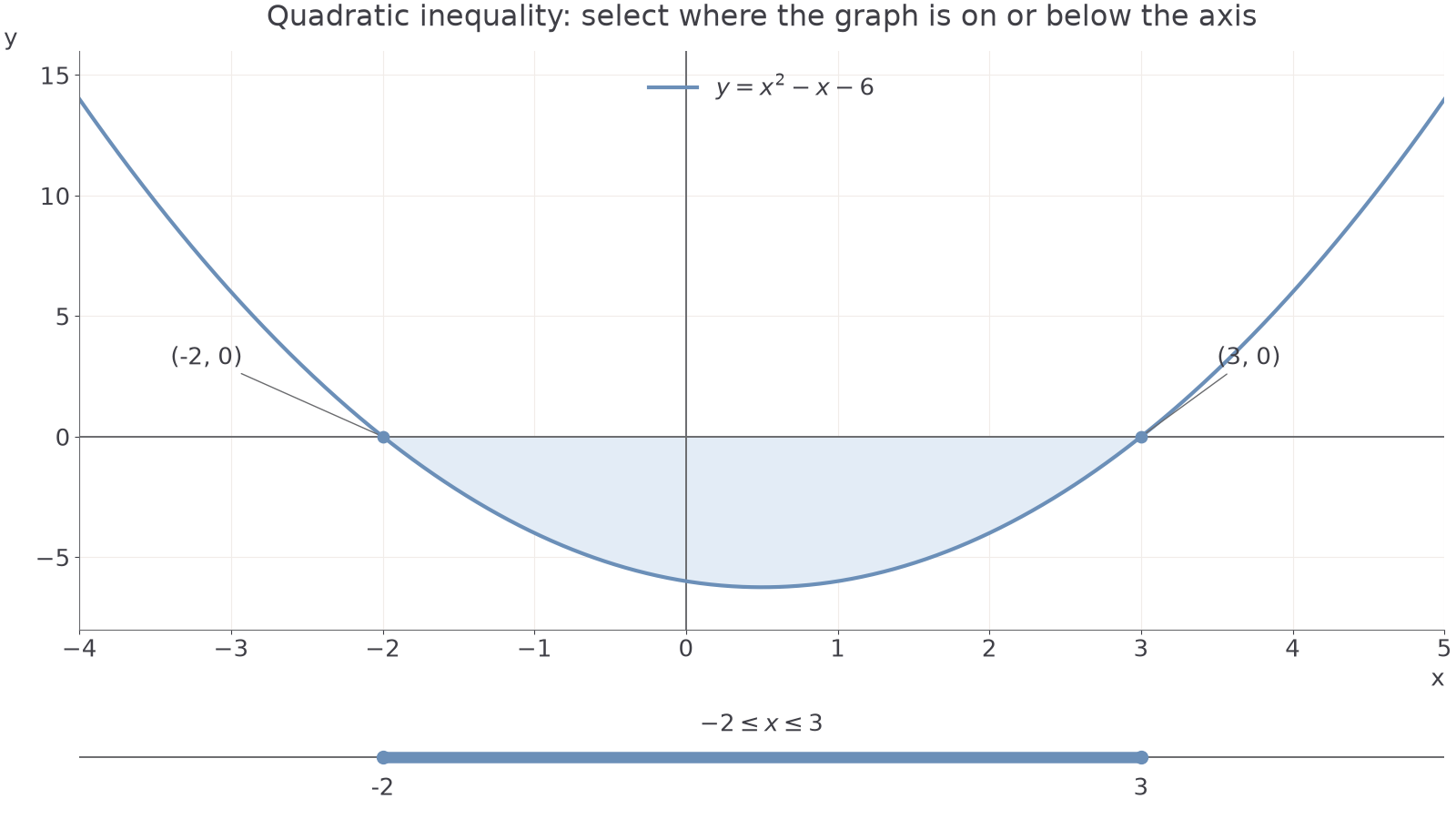
That picture transfers to other roots. Use algebra for their exact positions, then read the sign from a factor table or the parabola's direction.
Worked example 3: selecting the interval between roots
Question. Solve .
Plan. Factorise, locate the boundaries and select non-positive outputs.
Why this step? Between the roots, is positive and negative, so the product is negative.
Answer. .
Check. The output is at and at , confirming the selected side of each boundary.
Change only the overall sign of the quadratic. The roots stay fixed but every non-zero output changes sign.
Worked example 4: selecting outside a downward quadratic
Question. Solve .
Plan. Reverse the sign pattern of Worked example 3.
Why this step? A downward quadratic is non-positive outside its two distinct roots; “between the roots” would select positive outputs here.
Answer. or .
Check. At the given output is , so it fails; at it is , so it works.
Here is a sharp change caused by one symbol: has just the solution , has none, and holds for every real number. A repeated root need not change the sign. These arguments use real squares; complex roots are outside this work. The sign method is not supplied in the formula sheet.
Exam tip
Under “In this question you must show detailed reasoning”, show the roots and the reason for your selected intervals. A list of calculator roots is a boundary list, not a complete inequality solution.
Keep the downward shape, but find a fractional boundary this time.
Fractions, signs and excluded values
A variable denominator introduces an excluded value and a sign decision. Keep both when using the linear or quadratic sign methods inside a fraction.
Sign intervals for a quotient
Numerator zeros and denominator zeros split the domain into intervals. A zero numerator can give an allowed zero output; a zero denominator gives no output and is always excluded.
Like signs give a positive quotient; unlike signs give a negative quotient. Inspect them rather than assuming a variable multiplier is positive.
Worked example 5: distinguishing the two boundaries
Question. Solve .
Plan. Exclude , locate the numerator zero and compare signs on the three intervals.
Why this step? Non-strictness includes a zero value, not a missing value caused by division by zero.
Answer. or .
Check. At , the quotients are , respectively, confirming the sign intervals.
Change only the right side to . You must subtract it before judging a sign relative to zero.
Worked example 6: combining into one quotient
Question. Solve .
Plan. Combine the left side minus into a single fraction, retaining the domain.
Why this step? The numerator cannot be zero, so equality is impossible even though the sign permits it.
Answer. .
Check. At , the given quotient is ; at , it is , which fails.
You can instead split into positive- and negative-denominator cases, reversing order in the negative case and keeping each case condition. A useful further check is : subtracting gives , hence , with excluded. This domain-preserving reasoning also helps when an unfamiliar passage defines a rational expression. It is not supplied on the formula sheet.
Watch out
Wrong: multiply by and obtain only . That misses the sign change and admits forbidden values. Check the denominator's sign or use a sign table.
Change the coefficients so the constant numerator after subtraction is negative.
And, or and solution sets
Use “and” when both conditions must hold, and “or” when either condition is enough. MEI accepts a suitable inequality description or set notation: make the set unambiguous.
Union and intersection
is the union: values in either or . is the intersection: values in both. For example, and gives ; and gives the empty set .
Set-builder notation records the condition directly: . State another domain explicitly if the question restricts to integers or another set.
Intervals
An interval's square bracket includes a finite endpoint; a round bracket excludes it. Thus means , while includes zero too. Infinity always takes a round bracket: means .
Interval notation is a useful additional representation; it is not the only permitted way to express a MEI solution. Number lines with open and filled endpoints help you check any representation.
Worked example 7: intersection of two sets
Question. For real , let and . Find .
Plan. Keep only values that belong to both sets.
Why this step? A value in only one set fails an intersection condition.
Answer. , equivalently .
Check. belongs to both; fails , while belongs only to .
Change only the operation to union. The same two sets now contribute all their values.
Worked example 8: union without filling a gap
Question. With and , find .
Plan. Join overlapping pieces, preserving the gap between them.
Why this step? No value in belongs to either set, so those values stay excluded.
Answer. or , equivalently .
Check. and are excluded; is included through .
For simultaneous inequalities, take the intersection, even if one inequality's own solution contains an “or”. These set operations and notations are not supplied on the formula sheet.
Watch out
Wrong: describe two outside pieces with and . Their intersection is empty. The intended alternatives need or, or a union sign.
Use a union again, with new boundaries and a new endpoint choice.
Regions and their boundaries
For inequalities in two variables, describe which points are included, and whether each boundary is included. Compare the two heights at the same horizontal coordinate.
For , take points above the line. For , take points on or below the parabola: that includes points outside the bowl, not only an apparent interior.
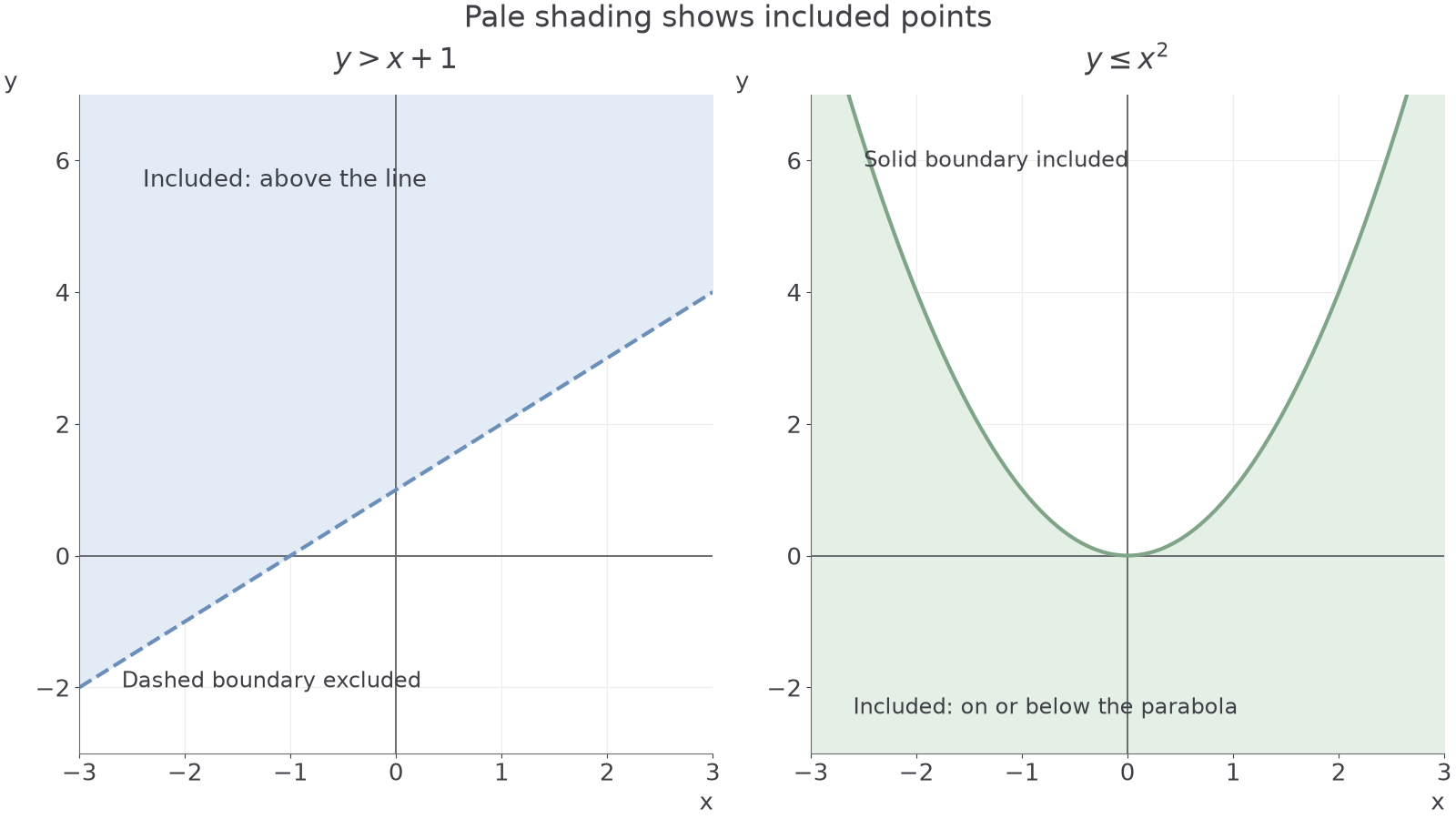
Here pale shading denotes included points, dashed lines exclude a boundary and solid lines include it. MEI prescribes no particular shading convention. You may shade included or excluded points provided your labels make the region and each boundary clear. A test point away from a boundary helps: fails but satisfies .
Worked example 9: a permitted curve with excluded endpoints
Question. Describe and , stating the allowed -values and boundary inclusions.
Plan. Find where the lower parabola is strictly below the upper horizontal line.
Why this step? If both bounds coincide, the upper strict inequality forbids their only possible height.
Answer. On or above the parabola, below the line, for . Include the parabola in this interval, exclude , and exclude .
Check. works; each meeting point fails .
Change only the upper inequality to non-strict. Coinciding bounds now allow one height at each end.
Worked example 10: allowing the meeting points
Question. Describe and .
Plan. Allow equality between the lower and upper bounds.
Why this step? At each end, permits exactly , so both meeting points belong.
Answer. Between and on the parabola and horizontal line, for , including .
Check. At , gives a vertical interval; at , it contracts to .
That resolves the opening puzzle: the parabola can be allowed while its meeting points are forbidden by another condition. Boundary and region conventions are not supplied on the formula sheet.
Watch out
Wrong: include a point because it satisfies one allowed boundary. A point in the combined region must satisfy every inequality, including any strict condition.
Shift both the parabola and the horizontal boundary for the final check.
Quick Recap
- Negative multiplication or division reverses order; preserve strict or non-strict signs.
- Quadratic roots split sign intervals; repeated roots need not change the sign.
- A zero numerator may be allowed; a zero denominator never is.
- Use “and” for an overlap and “or” for alternatives, or equivalent set notation.
- State the included graphical region and every boundary clearly; no particular shading convention is required.
Yes: , includes the parabola for , but its meeting points are excluded by .