Mc26 - Areas between curves and parametric areas
Describe a region with vertical or horizontal strips, then calculate its exact area. Use intersections and signs to choose the bounds, and interpret a supplied parametric strip conversion geometrically.
Find the region before integrating
Could moving two curves below the axis change the area between them? Consider and : their enclosed area is . Moving both down by makes their heights negative throughout the enclosed interval, but leaves every gap unchanged. Area belongs to the gap.
You already know
Solve simultaneous equations to locate intersections. A definite integral gives a signed accumulation; geometric area uses non-negative strip lengths.
A sample point identifies which boundary is higher after the exact intersection calculation.
Vertical strips
If on ,
The limits come from intersections or supplied vertical lines. Not in the formula sheet: learn it.
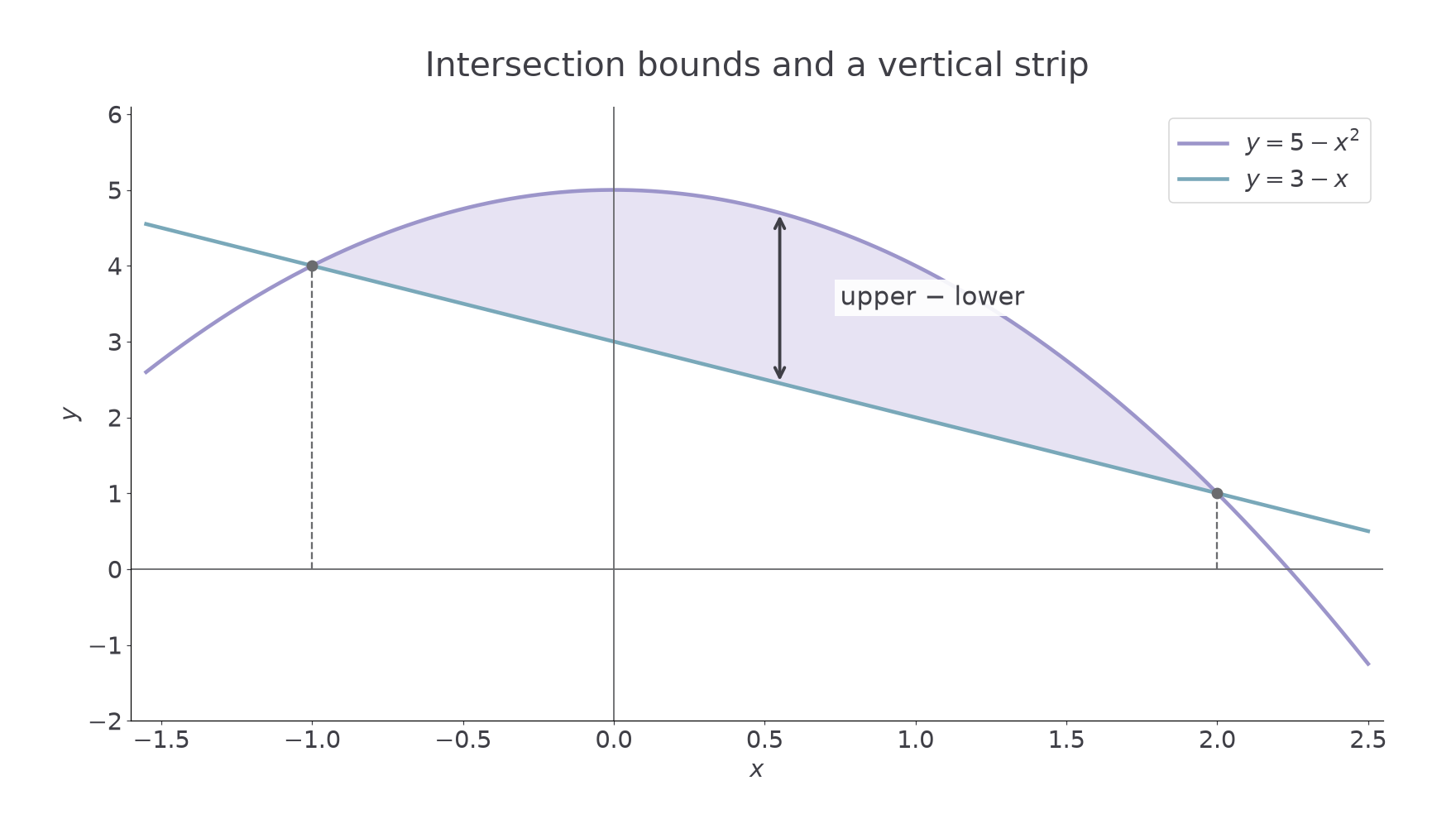
This picture shows why subtraction, rather than either separate height, is the useful quantity.
Worked example 1: finding the enclosed interval
Question. Determine the area enclosed by and .
Plan. Solve for the intersection abscissae, then integrate upper minus lower.
Why this order? At , , and no intervening intersection changes the order.
Answer. square units.
Check. Width times maximum gap exceeds the answer.
Change only the line's gradient from to . The region shifts horizontally, but its strip lengths form a reflected pattern.
Worked example 2: reflecting the gap
Question. Determine the area enclosed by and .
Plan. Recalculate the bounds and integrate the new difference.
Why recalculate? The area happens to agree, but the first example's limits describe the wrong region here.
Answer. square units.
Check. Replacing by reflects the first gap into this one.
The familiar pair , has area ; the pair , has the same gap as example 1. Boundary heights may change while the difference stays fixed.
Exam tip
“Determine” asks for justification. Show the intersection equation, the subtraction order and the endpoint evaluation, even if a calculator checks the answer.
Alter the line's gradient again and make those decisions explicitly.
Split where the upper graph changes
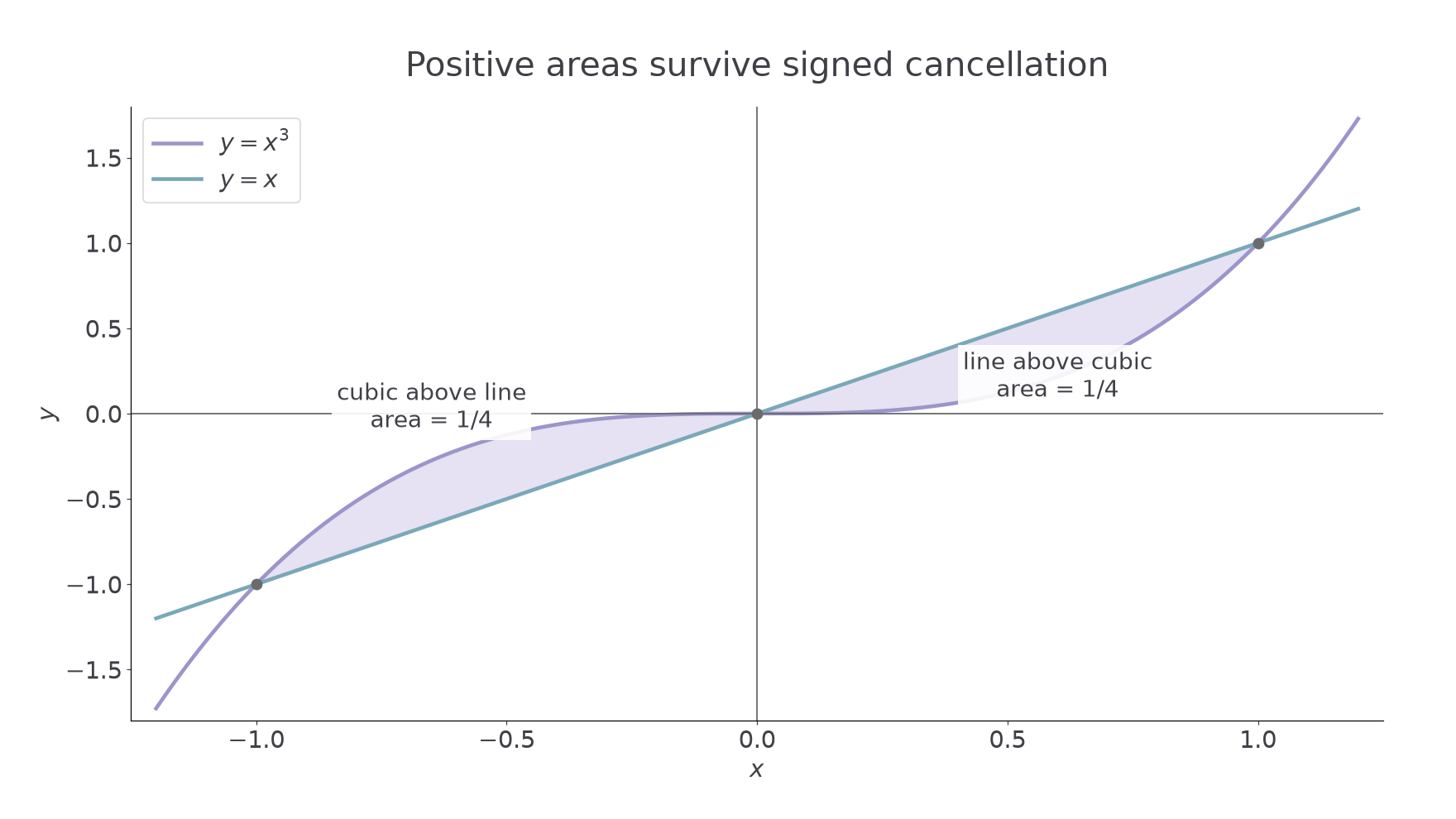
A supplied interval may contain several regions. For and on , the cubic is higher on the negative side and lower on the positive side: each lobe has area , while the signed difference integrates to zero.
Piecewise area
When the gap changes sign, calculate area separately on each interval of constant order and add the positive pieces. A repeated intersection can be a touch, with no change of order.
A line crossing a parabola gives an especially clear example with supplied end boundaries.
Worked example 3: a crossing inside the interval
Question. Find the area between and on .
Plan. Split at , where the upper graph changes.
Why split at ? The other intersection, , is outside the stated interval.
Answer. square units.
Check. The separate areas are positive; their signed difference would lose area through cancellation.
Change only the upper end boundary from to . The first piece survives unchanged.
Worked example 4: extending the interval
Question. Find the area between and on .
Plan. Keep the split at and extend the second integral.
Why keep the split? Extending a boundary does not remove the crossing already inside the region.
Answer. square units.
Check. The added area from to is , so .
Taking an absolute value helps only after you have separated intervals of constant sign.
Watch out
Wrong: always gives total area. Right: split at sign-changing intersections before adding magnitudes.
Move the endpoint once more, keeping the same crossing.
Continue this lesson.
You’re previewing NovaLearn without an account. Create a free account to read the rest.
Create free account