Mk1–Mk4 - Motion language and kinematics graphs
Distinguish motion quantities and connect position, displacement, distance, velocity, speed and acceleration graphs. Use signed quantities to describe journeys and find one object's velocity as observed from another on the same line.
Position, displacement and distance
Can a moving car have zero average velocity? Drive along a straight road and return to the starting place: the journey has positive length but zero overall displacement. The same endpoint can hide a very different journey.
You already know
A scalar has magnitude; a vector has direction as well. Along a line, choose a positive direction and an origin, then represent vectors by signed components.
Suppose a trolley starts left of a marker, moves right and left. Its final coordinate is , its coordinate change is , and its route length is .
Four different measures
Position locates the particle relative to an origin. Displacement is final position minus initial position. Distance from the origin is the magnitude of position. Distance travelled adds all route lengths positively. Position and displacement are signed on a line; distances are non-negative.
Write for position. The difference remains the same if the origin is moved. Average rates must use the whole elapsed time, including stops.
Average motion measures
For elapsed time ,
Not in the formula sheet: learn it.
The following calculations keep coordinate, change and travel separate.
Worked example 1: signed movement
Question. A trolley starts at , moves right and left in . Find final position, displacement, distance travelled, average velocity and average speed.
Plan. Use signed leg lengths for displacement and positive lengths for distance.
Why subtract the initial coordinate? Final position includes the arbitrary choice of origin.
Answer. , , , and , respectively.
Check. The distance from the origin is , different from both travel totals.
Change only the return leg to . Keep the five requested quantities and the elapsed time.
Worked example 2: travelling past the start
Question. A trolley starts at , moves right and left in . Find final position, displacement, distance travelled, average velocity and average speed.
Plan. Recalculate the signed and unsigned totals.
Why can average velocity be negative? The trolley finishes left of its starting point.
Answer. , , , and , respectively.
Check. Distance is greater than displacement magnitude .
An equation of motion links motion quantities on a stated interval; define its coordinate and positive direction before using it.
Watch out
Wrong: “The final position is , so displacement is .” Correct: displacement is . A starting coordinate contributes no extra travel.
Change the return leg again and track all five meanings.
Velocity, speed and acceleration signs
A velocity sign gives direction of motion; an acceleration sign gives direction of velocity change.
Signed rates and magnitudes
Velocity is rate of change of position. Speed is . Acceleration is rate of change of velocity; its magnitude is . Velocity and acceleration are vectors; speed and magnitude of acceleration are scalars.
For example, a velocity changing steadily from to in has average acceleration , found from . Its speed falls from to , despite positive acceleration. Swap the endpoint velocities and acceleration becomes , making speed increase. Both acceleration magnitudes are .
The average-acceleration rule, velocity change divided by elapsed time, is not in the formula sheet. At an instant with , speed increases when and have the same sign and decreases when their signs differ. At , inspect the neighbouring motion: rest at an instant does not imply zero acceleration or a reversal. Constant velocity throughout an interval does imply zero acceleration.
Key idea
A negative acceleration can mean speeding up or slowing down. Its direction must be compared with the velocity direction.
Read the claim carefully: acceleration and its magnitude are different quantities.
Velocity from a displacement graph
The gradient of a position or displacement graph gives velocity; shifting the graph vertically leaves that velocity unchanged.
[DIAGRAM: asset_name: Piecewise displacement against time; asset_slug: displacement_segments; description: Displacement-time graph through (0,0), (2,6), (4,6) and (7,0), with time in seconds and displacement in metres; caption: Piecewise displacement against time]
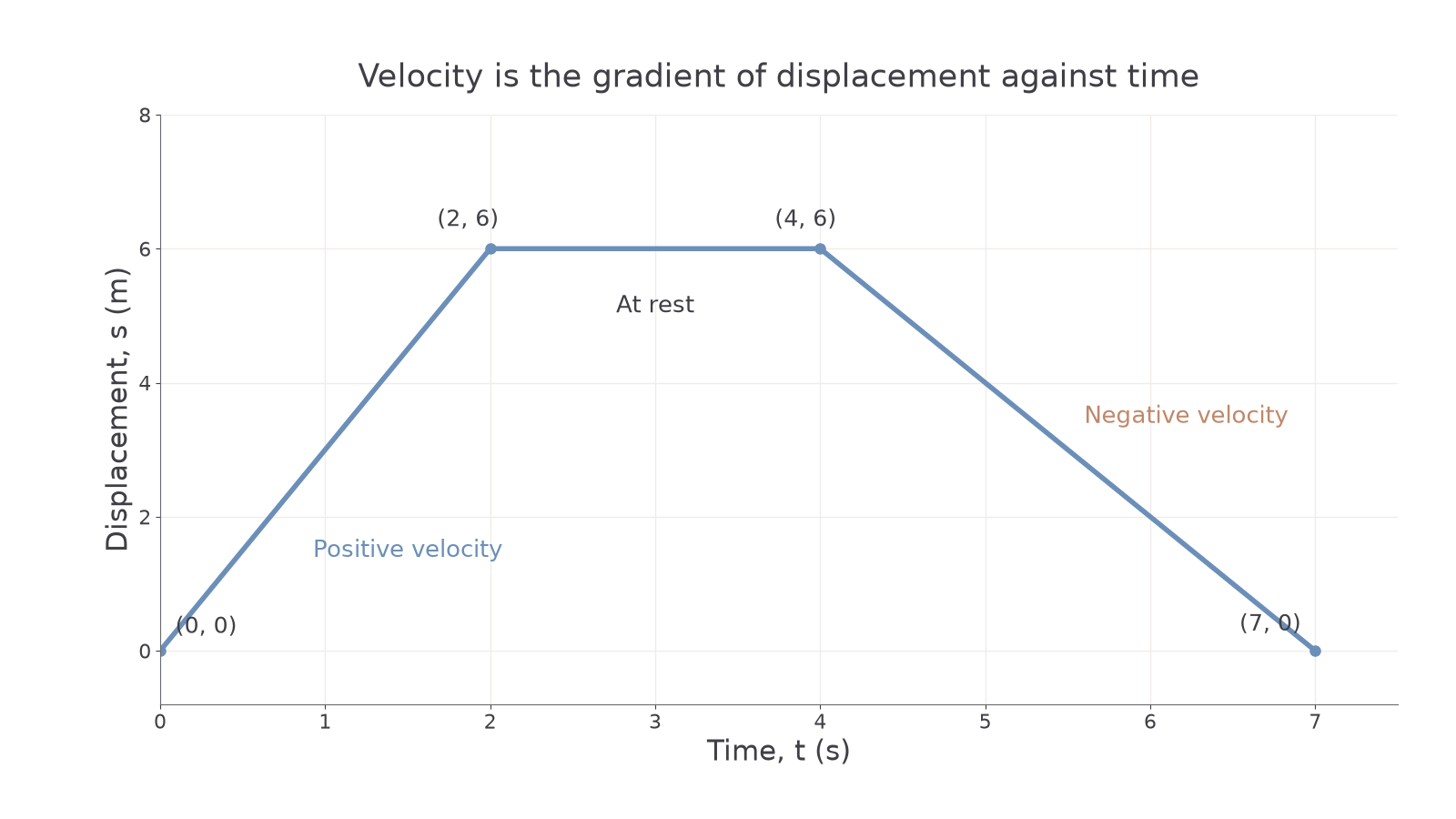
A rise of over gives . The flat part means rest, not movement along a level road.
Reading a position gradient
On a straight segment,
A chord gradient gives average velocity over an interval; a tangent gradient gives instantaneous velocity on a curve. The same rule holds for displacement-time graphs.
Not in the formula sheet: learn it.
For a sketch, label time and the vertical quantity with units. Straight segments represent constant velocity, horizontal segments rest, and curved segments changing velocity. A smooth maximum or minimum has zero instantaneous velocity. Ideal sharp corners stand for abrupt changes which real objects take time to make.
Worked example 3: from a displacement record
Question. A position-time graph joins with straight segments, in SI units. It has the same coordinates as the displayed displacement graph because the starting position is zero. Find the three velocities, overall displacement and distance travelled.
Plan. Take gradients, then compare signed and absolute position changes.
Why use slopes rather than heights? A height records displacement at that time.
Answer. Velocities , displacement , distance .
Check. Signed travel agrees with the graph's endpoints.
Change only the position graph's vertical offset by adding to every coordinate.
Worked example 4: a different origin
Question. A position graph joins with straight segments, in SI units. Find the three velocities, overall displacement and distance travelled.
Plan. Form differences; a shared vertical offset cancels.
Why is displacement zero rather than ? It is change in position, not the final coordinate.
Answer. ; displacement; distance.
Check. Subtracting from the whole graph returns the first graph without changing any gradient.
Passing the origin and reversing direction are different events: one concerns graph height, the other a change in gradient sign.
Watch out
Wrong: “A position graph below the axis means negative velocity.” Correct: a downward gradient means negative velocity, wherever the graph lies.
Use a new offset to test whether the origin distracts you.
Acceleration and travel from velocity graphs
A velocity graph tells you acceleration through slope and displacement through signed area.
[DIAGRAM: asset_name: Positive and negative areas under a velocity graph; asset_slug: velocity_signed_areas; description: Velocity-time graph through (0,4), (2,4), (6,-4) and (8,-4), with its zero at t=4 and positive and negative travel regions shaded; caption: Positive and negative areas under a velocity graph]
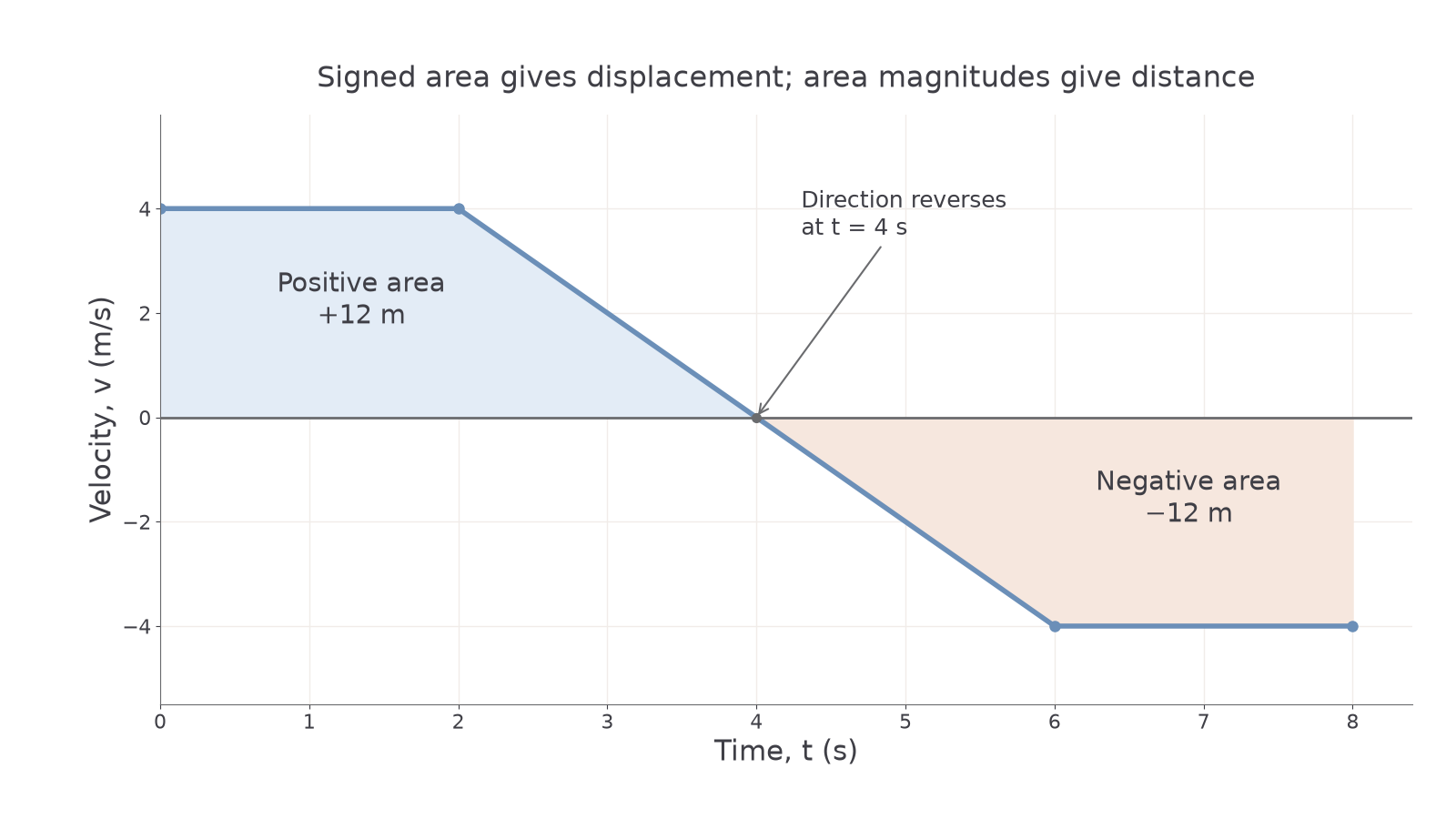
The displayed positive travel is , and negative travel contributes . The endpoint change is zero, although the journey length is .
Continue this lesson.
You’re previewing NovaLearn without an account. Create a free account to read the rest.
Create free account