Mc10 - Differentiating exponential and logarithmic functions
Differentiate , and , together with related sums, differences and constant multiples, as required by Mc10. You will keep the input-rate factors and logarithm domains, and interpret a derivative as an instantaneous rate rather than an average over an interval.
The natural exponential and its rate factor
An amount falls from 120 grams to 60 grams in three hours under the model . Is its loss rate therefore always 20 grams per hour? The average loss rate is 20; the instantaneous rate keeps changing. We will calculate it.
Start with the natural exponential. For , height and tangent gradient agree at every point: at zero both are 1, and at both are 2. Equality of a function and its derivative is a special property, not a rule for all exponentials.
You already know
and are inverse functions. Exponential laws give for . A constant multiple stays as a multiplier when you differentiate.
The first-principles argument separates the current height from one fixed limiting factor:
For , substituting into the corresponding limit introduces a factor . The first-principles definition is supplied in the formula sheet, but this limiting value and the derivative rule are not.
Differentiating the natural exponential
For real constant :
Both functions have domain . When , the derivative is zero because the function is constant.
Not in the formula sheet: learn it.
The extra factor is the constant rate of the linear input, not the input itself. General composite-function differentiation comes later.
Worked example 1: a fractional negative input rate
Question. Differentiate , and find its gradient at zero.
Plan. Multiply the exponential term by ; differentiate the constant to zero.
Why this step? The exponent changes by per unit change in , so it contributes that fixed factor.
Answer. ; gradient at zero.
Check. The curve approaches 4 from above as increases, agreeing with a negative gradient.
Change only the exponent's sign. The vertical shift stays constant and still contributes zero.
Worked example 2: reversing the input rate
Question. Differentiate , and find its gradient at zero.
Plan. Use input rate , retaining the coefficient 6.
Why this step? A constant vertical shift changes heights, but never tangent gradients.
Answer. ; gradient 2 at zero.
Check. The derivative is positive everywhere, matching the growing exponential above its baseline.
The exponent's rate, rather than its current value, supplies the multiplier.
Watch out
Wrong: differentiating gives . The input has constant derivative , so the correct result is .
The factor can be any real constant, including a fraction or zero. Keep it exact rather than rounding it before differentiating.
Other bases introduce a logarithm factor
To differentiate another positive-base exponential, convert it into a natural exponential: . Now its linear input rate is visible.
Differentiating another positive base
For positive constant and real constant :
This includes , giving zero because . Negative bases are excluded from this all-real-input rule.
Not in the formula sheet: learn it.
It is , not , that enters the coefficient. Its sign, together with that of , determines growth or decay.
Worked example 3: introducing the logarithm of the base
Question. Differentiate , giving its exact gradient at zero.
Plan. Rewrite with base , then differentiate the linear exponent.
Why this step? The base contributes a logarithm factor that would be missed by treating this as .
Answer. ; gradient at zero.
Check. , agreeing with the function's increasing direction.
Change only the sign of the input coefficient. The logarithm of the base does not change.
Worked example 4: a negative input coefficient
Question. Differentiate , giving its exact gradient at zero.
Plan. Multiply by the new input rate .
Why this step? The negative input coefficient reverses growth even though the base is still greater than one.
Answer. ; gradient at zero.
Check. , whose base lies between zero and one, confirming decay.
Neither the base nor the exponent's coefficient determines the sign alone.
Watch out
A base greater than one can still give a decreasing function when the input coefficient is negative. Use the sign of in the derivative of ; the exponential factor itself is positive.
A base below one and a negative input coefficient reverse the sign twice. For comparison, has derivative ; changing its input sign would make its gradient positive.
The natural logarithm and its real domain
Reflection of an exponential graph in gives its inverse logarithm graph. Corresponding tangent gradients are reciprocals because horizontal and vertical changes exchange roles.
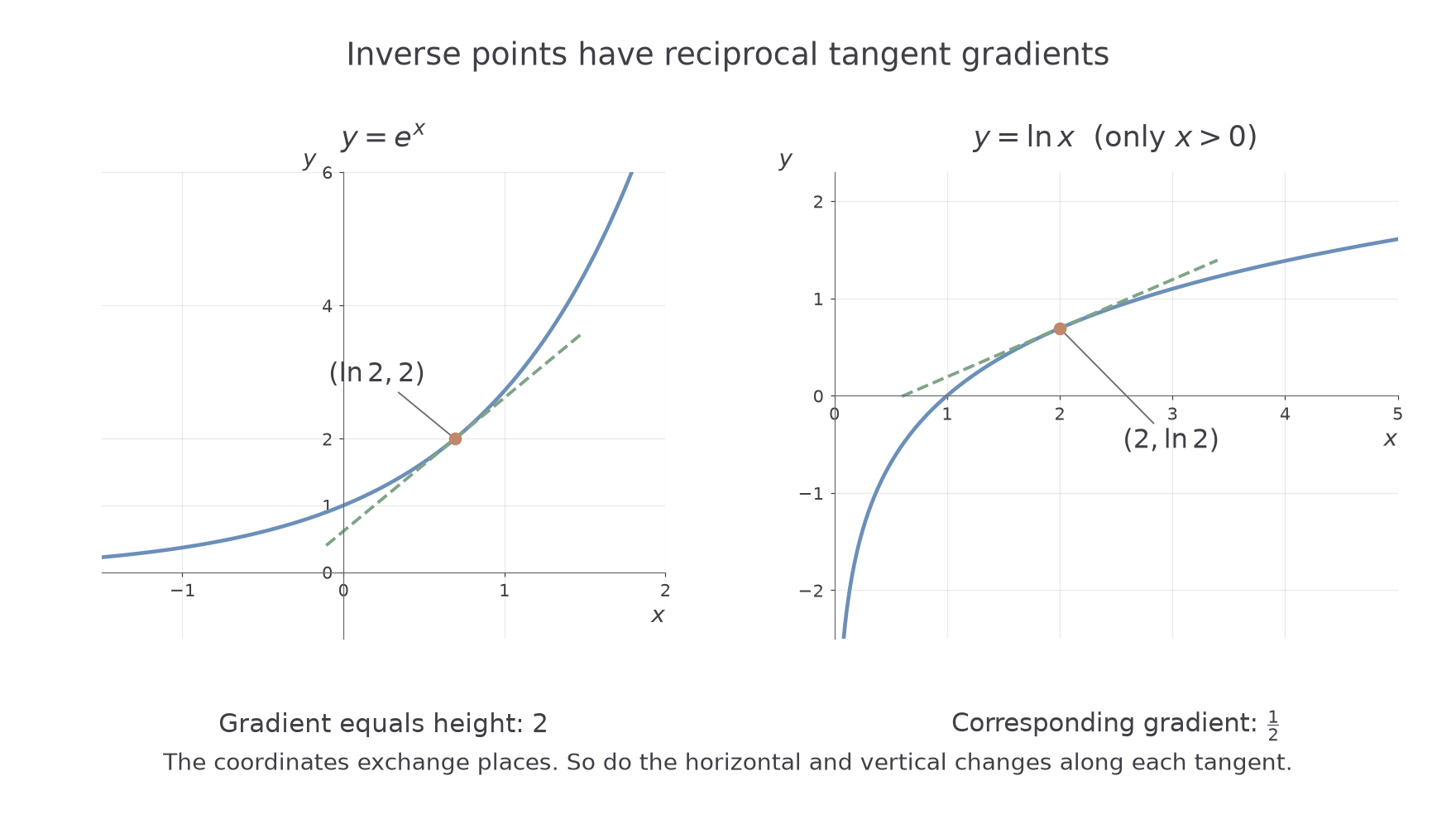
At , the exponential has gradient 2; at , the logarithm has gradient . The general version gives the standard derivative.
Natural logarithm derivative
For , on , so too.
Not in the formula sheet: learn it.
Although exists at negative inputs, does not have real values there. The derivative inherits the function's domain. It is positive on that domain and gets smaller as increases.
Continue this lesson.
You’re previewing NovaLearn without an account. Create a free account to read the rest.
Create free account