Mg10 - Circle equations, centres and radii
Connect the fixed-distance meaning of a circle to its algebraic equation. You will complete squares to determine centres and radii, construct circles from points or diameters, and draw their important features accurately.
A circle as a distance locus
Can describe a circle even though neither its centre nor its radius is obvious? Start with a clearer description: all points units from . A point directly to its right at is one of them.
You already know
For two coordinate points, squared distance is the sum of the squared horizontal and vertical changes. Completing the square rewrites as , without changing its value.
The centre stays fixed; the point on the circumference changes position.
Circle
A circle is the locus of points at a fixed positive distance from a fixed point , the centre. The distance is its radius. The centre is not itself on the circumference.
Distance gives . Squaring is reversible because the two sides are non-negative.
Circle equation
For real and ,
The centre is . At the origin, the form reduces to .
Not in the formula sheet: learn it.
An equation is also a test: substitute a point to find whether its squared distance equals the squared radius.
Worked example 1: verifying a point
Question. Write the circle equation for centre , radius , and verify that lies on it.
Plan. Substitute the centre and squared radius, then evaluate the point's squared distance.
Why is the second bracket ? The centre's vertical coordinate is , so you subtract .
Answer. ; the substitution verifies that lies on it.
Check. The point is units horizontally from the centre, agreeing with the radius.
Change only the radius from to , keeping the centre and test point unchanged.
Worked example 2: comparing a distance with a larger radius
Question. Write the equation for centre , radius , and determine the position of .
Plan. Compare the same squared distance with the new squared radius.
Why does the inequality establish the position? Distances are non-negative, so a smaller square means a smaller distance.
Answer. The equation is , and the point is inside.
Check. Its distance is , less than .
More generally, a squared distance smaller than puts a point inside, and a larger one puts it outside. Equality gives the circumference. These comparisons are consequences of the distance definition, rather than separate supplied formulas.
Watch out
Wrong: centre , radius , gives . Right: subtract the centre coordinates and put on the right.
Use a different centre and a point whose two coordinate changes are nonzero.
Recovering the centre by completing squares
Completing squares changes the appearance of an equation, rather than its points. Group the terms and terms separately; balance every constant you introduce.
Expanded circle equations
Completing the squares in gives
A circle requires a positive right side. Zero describes one point; a negative value describes no real points.
Not in the formula sheet: learn it.
The signs in the brackets reveal the centre. The whole right side is the squared radius, so take its positive square root.
Worked example 3: a hidden centre and radius
Question. Determine the centre and radius of .
Plan. Complete each square, then identify centre and positive radius.
Why is the centre ? Those coordinates make both squared brackets zero.
Answer. Centre , radius .
Check. Expanding the completed form gives , which returns the given equation.
Change only the equation's common scale by multiplying every term by . Its solution set remains unchanged.
Worked example 4: normalising the squared terms
Question. Determine the centre and radius of .
Plan. Divide all terms by before completing squares.
Why divide every term? Dividing only the squared terms would produce a different equation and a different circle.
Answer. Centre , radius , as before.
Check. Multiply the expanded circle equation by ; all five coefficients match the question.
For example, the different equation gives , centre , radius . Unequal coefficients on the two squares cannot be read directly as the circle form.
A small constant can make a big geometric difference. In , the squared radius is . Changing to leaves just ; changing it to leaves no real points. A sum of real squares cannot be negative. The same test gives no real circle for , whose completed right side is .
Watch out
Wrong: use as the centre of . Right: the centre is , the coordinates that make both brackets vanish.
Show the completed form so that both the signs and the radius can be checked.
Constructing and drawing a circle
A circle equation needs its centre and squared radius. A known centre and one circumference point provide them; a diameter provides both through its midpoint and length.
Worked example 5: a radius from coordinates
Question. Determine the circle with centre passing through .
Plan. Find the squared centre-to-point distance, then write the equation.
Why keep the squared distance? It is exactly the number needed on the right side.
Answer. .
Check. The displacement has length , so the result has the required radius.
Change only the form of the geometric information: give the opposite diameter endpoint in place of the centre.
Worked example 6: recovering the centre from a diameter
Question. Determine the circle with diameter endpoints and .
Plan. Use their midpoint as centre and measure from it to one endpoint.
Why use half the diameter? The two endpoints lie on opposite sides of the centre, each one radius away.
Answer. .
Check. The endpoint distance is , twice the radius .
Another diameter, from to , gives centre and equation . One circumference point alone would allow many different centres and circles.
[DIAGRAM: asset_name: A circle recovered from completed squares; caption: Equal axis scales show the centre and radius without distortion; asset_slug: h640-centre-radius; description: Equal-scale axes show the circle centred at minus 2 comma 3 with radius 5. Its four extreme points are minus 7 comma 3, 3 comma 3, minus 2 comma 8 and minus 2 comma minus 2. A horizontal radius and the centre are labelled.]
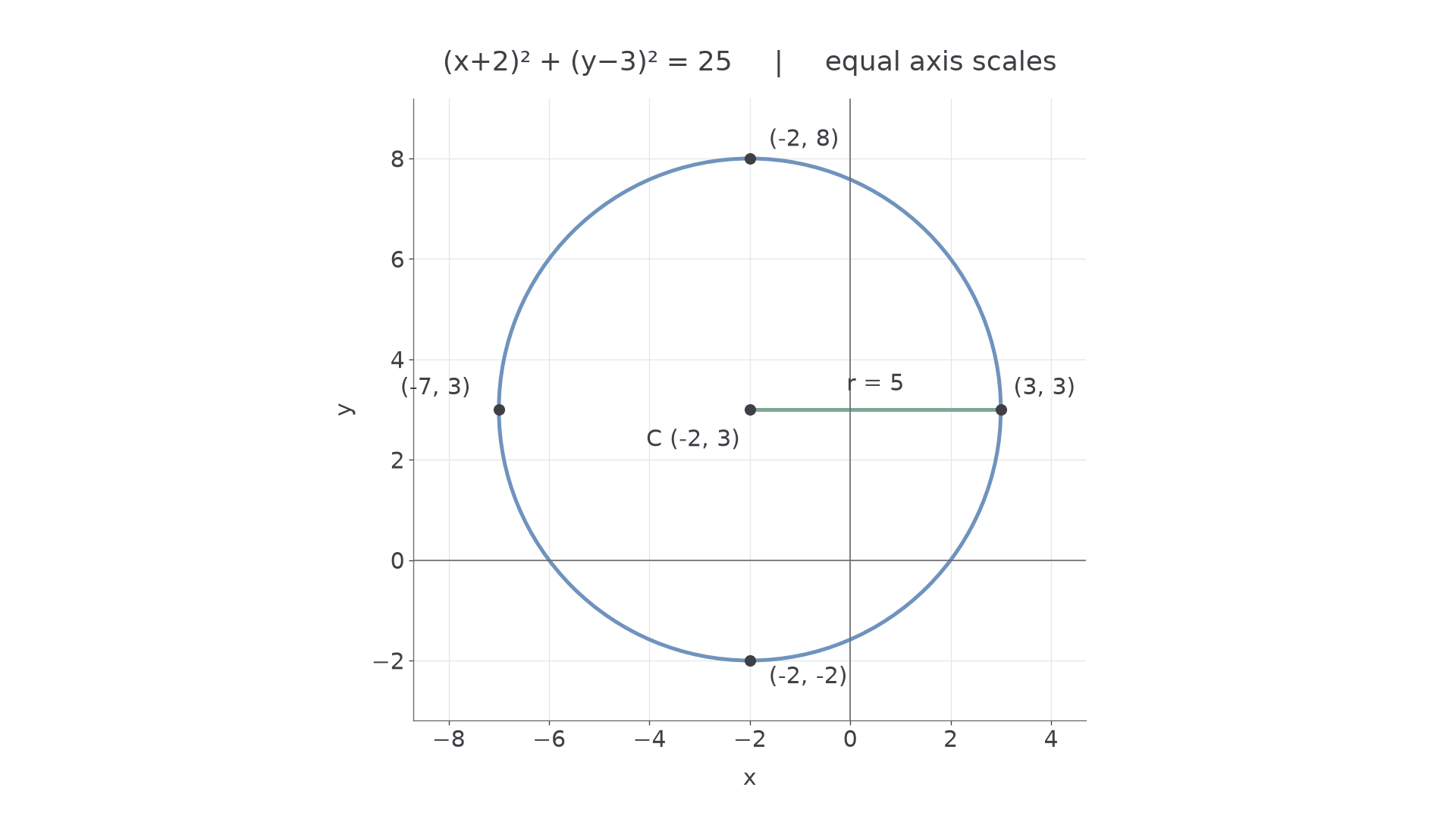
To draw the opening circle, first mark , then its four extremes , , , . Use the same physical scale on both axes and draw a smooth circumference; unequal scales would display an ellipse. Use a compass for an accurate drawing when possible.
Intersections with axes come from substitutions. Putting gives , so . Putting gives , so . A circle may miss an axis, so do not assume every sketch needs two intercepts on each. These construction and intercept methods follow from the equation and are not printed as formulas in the sheet.
Exam tip
When MEI asks you to determine a diameter-defined circle, show how you found the midpoint and radius. In a sketch, label the centre and essential features; for a drawing, choose a scale that preserves the circular shape.
Use a different diameter and finish with the full equation.
Quick Recap
- The circle equation fixes a positive distance from its centre; its right side is the squared radius.
- Complete both squares to recover the centre with the correct signs.
- A zero right side leaves one point; a negative one leaves no real points.
- Diameter endpoints give a midpoint centre and half-distance radius.
- Preserve equal axis scales and find intercepts by substitution.
The opening equation is , so it describes a circle with centre and radius .