Mg12–Mg14 - Parametric curves and cartesian equations
Use Mg12 to understand a shared parameter, Mg13 to convert between equation forms with the correct restrictions, and Mg14 to describe circles by an angle. You will also read an unfamiliar curve definition and reconstruct its Cartesian relation without losing an endpoint condition.
One parameter, two coordinates
Can a point go round a circle without ever reaching one particular point on it? A bounded picture need not have a bounded parameter. We will return to that puzzle after learning how a parameter chooses coordinates.
For a simple start, , gives at and at . Both coordinates use the same value of .
You already know
Substitution replaces a variable consistently. Solving simultaneous equations means finding values that satisfy both; a restriction is part of the mathematical information, not an optional extra.
The parameter can represent time, but it does not have to. It is also useful simply as an ordered label.
Parametric equations
Parametric equations specify coordinates through a shared parameter, for example , , with a stated domain for . A generated point uses the same parameter value in both equations.
Pairing coordinates from different parameter values generally invents a point outside the curve.
Worked example 1: a line segment
Question. Describe the path of , , .
Plan. Evaluate the parameter endpoints and follow the coordinate changes.
Why this step? Endpoints locate the segment; the signs of the changes locate its direction.
Answer. The segment is traced left and up from to , including both ends.
Check. At , the intermediate point is , halfway along the segment.
Change only the interval, allowing .
Worked example 2: shifted and open boundaries
Question. Describe the same equations for .
Plan. Find the new boundary points and carry over the strict endpoint condition.
Why this step? A finite endpoint can be calculated even when the parameter domain excludes it.
Answer. The segment runs left and up from , included, towards , excluded.
Check. still gives , between the boundaries.
With all real parameters, the same equations describe the whole straight line.
Watch out
Wrong: use and together as . Right: forces , so its matching coordinate is .
Keep the equations but choose another interval.
Elimination with the original restrictions
Elimination gives a relation between the coordinates. It must describe exactly the points the parameter permits, rather than a larger curve that happens to contain them.
The preceding line has , so . For , the full Cartesian description includes . This conversion method is not in the formula sheet: learn it.
Worked example 3: preserve a branch
Question. Eliminate from , , .
Plan. Recover from the linear equation and translate its domain.
Why this step? The squared equation permits negative too unless the branch restriction is stated.
Answer. , ; equivalently , .
Check. Every retained point gives , establishing the reverse direction.
Change only the domain to . It now includes points on both sides of the vertex.
Worked example 4: a vertex inside the interval
Question. Give the Cartesian description for the same equations with .
Plan. Retain the relation and translate both parameter boundaries using .
Why this step? An -interval cannot distinguish all the required and forbidden points on this sideways parabola.
Answer. , .
Check. The endpoints are , , with vertex at .
Division can cause the opposite problem: it can lose a point. Before cancelling , test in both given equations. In , , the origin is a valid point and must not disappear through cancellation.
Watch out
Wrong: with no restriction. Right: keep the translated interval; the whole parabola contains points requiring forbidden parameters.
Move the interval towards the lower branch.
Converting from Cartesian form
When MEI asks you to convert Cartesian equations to parametric form, guidance will be given on the choice of parameter. Use that guidance: another correct parametrisation may describe the curve but fail the specified task.
Worked example 5: a given scaling
Question. For , , use to give parametric equations and a domain.
Plan. Substitute the prescribed and divide the interval by .
Why this step? The square acts on the whole , so its coefficient becomes , not .
Answer. , , .
Check. gives , , the required endpoints.
Change only the guidance to . The curve remains the same while traversal reverses.
Worked example 6: a reversed scaling
Question. Give the parametrisation of the same curve using .
Plan. Substitute the new guidance and reverse the inequality when dividing by a negative number.
Why this step? The minus sign changes the parameter order but vanishes inside the square.
Answer. , , .
Check. Increasing starts at and ends at , reversing the first route.
A guided parameter can also be : for , putting gives . For a vertical line , use , . The conversion procedure is not in the formula sheet.
Watch out
Wrong: preserve by copying the -interval. Right: use the actual relation , obtaining .
Try a different reversed scale, keeping the Cartesian curve.
A circle described by an angle
The horizontal and vertical projections of a rotating radius give a parametric circle. For a unit radius at the origin, its endpoint has coordinates : a leftward projection is negative horizontally and a downward projection is negative vertically. Pythagoras therefore gives . Multiplying by the radius and adding the centre coordinates produces a shifted circle, with the signs still recording position and traversal.
Circle with an angular parameter
For centre , radius , and measured anticlockwise from the positive horizontal direction,
Then , using . The interval traces the circle once. Not in the formula sheet: learn it.
One turn is radians, or . Both endpoints together would repeat the start.
Worked example 7: a guided angular description
Question. Use the stated angular convention to parametrise . State the point at .
Plan. Read the centre and radius and use signed projections.
Why this step? The radius is , not ; the Cartesian equation contains its square.
Answer. These equations with trace the full circle once anticlockwise. At , the point is .
Check. .
Change only the parameter interval to . The equations stay fixed.
Worked example 8: identify the arc
Question. Describe the curve generated by the same equations for .
Plan. Find the endpoints and use the sign of sine to choose the semicircle.
Why this step? Endpoint coordinates alone would not tell you whether the upper or lower arc is traced.
Answer. The upper semicircle is traced anticlockwise from to , with both endpoints included.
Check. Its midpoint in parameter order, , gives the top point .
Replacing the sine term by instead reflects the path in the horizontal line through the centre and reverses the full-circle traversal.
Watch out
Wrong: includes every point exactly once. Right: and give the same point, so exclude one boundary for once-only tracing.
Keep the upper-half-turn interval and translate only the centre, to .
Sketching the path and its traversal
A parametric sketch should show the generated portion and increasing-parameter order, not merely a familiar unrestricted Cartesian curve.
[DIAGRAM: asset_name: Parametric path and traversal; caption: Parametric path and traversal; asset_slug: h640-parametric-paths; description: Equal-scale axes show x equals t squared minus 1 and y equals 2t for minus 2 to 2, with endpoint and vertex labels and traversal arrows, beside a centre 1 comma minus 2 radius 3 circle traced anticlockwise by an angle]
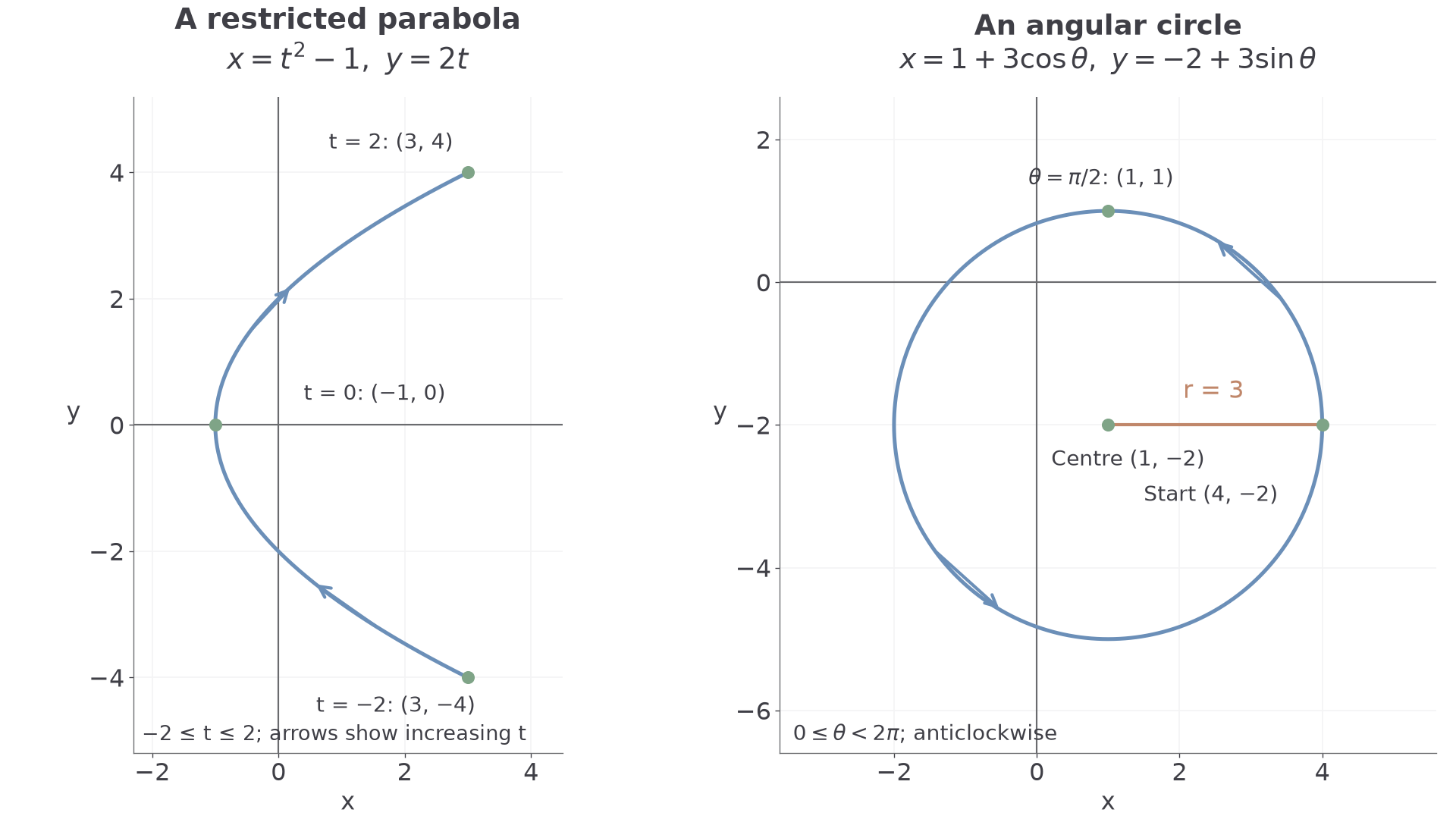
The parabola panel includes its vertex as well as its two endpoints. The circle panel shows a different centre from the preceding examples, , and radius ; its quarter-turn points check the general angular rule.
Worked example 9: a curve with a turn
Question. Describe the sketch and traversal of , , .
Plan. Eliminate the parameter and use endpoints plus the vertex.
Why this step? The parameter increases throughout, even while the horizontal coordinate changes its direction of motion.
Answer. The right-opening parabola segment is traversed up and left to , then up and right to .
Check. gives , , matching both branches.
Change only the sign of to . The point set stays fixed but its order reverses.
Worked example 10: reverse the traversal
Question. Describe , , .
Plan. Re-evaluate the ordered key points and compare the Cartesian relation.
Why this step? Squaring removes the sign, so the Cartesian equation alone cannot reveal the change of traversal.
Answer. The segment is traced down and left to the vertex, then down and right to the lower endpoint.
Check. At , the point is , reached after the vertex, as expected.
A plotting calculator needs the correct shared parameter range and a sufficiently fine step. Arrows show parameter order, not equal speed. These sketching rules are not in the formula sheet: learn the method.
Watch out
Wrong: join a few points by straight segments and call the zigzag a parabola. Right: use the eliminated equation to guide a smooth curve through the ordered features.
Keep the reversed equations and retain only the non-negative parameters.
A rational description of a circle
An unfamiliar definition can produce a familiar curve. Read the domain before eliminating: it can explain a missing point even when the resulting equation looks complete.
Consider this short mathematical passage:
> The denominator is always positive. The coordinates satisfy a circle equation, but not every point of that circle is generated. For a generated point, $1+x=2/(1+u^2)>0$ and $u=y/(1+x)$. Unlike the angular formula, this definition contains no sine or cosine. That is the surprising fact behind the opening puzzle: rational expressions alone can trace a semicircle while approaching an endpoint forever without reaching it. The supplied description is not a formula-sheet result and is not required recall; use it as given.For each real number , define a point by
Worked example 11: reconstruct the implicit relation
Question. For the passage's domain , determine the Cartesian curve and identify its missing endpoint.
Plan. Add the squared coordinates, then use positivity and the recovery formula to check which points occur.
Why this step? The identity proves containment in the circle; the restrictions and reverse formula establish the actual generated set.
Answer. The upper semicircle , , with excluded. The start is included. For any other upper-semicircle point, set . The circle identity gives , hence . Substituting these into both passage equations recovers and , proving that every retained point occurs.
Check. gives , gives , and gives . Setting would imply , so no finite reaches it.
Change only the domain, from to . The algebraic identity stays the same, while the retained arc changes.
Worked example 12: translate a new passage restriction
Question. Determine the curve produced by the passage equations when .
Plan. Retain the circle identity and use the sign of to locate the arc.
Why this step? The same circle equation can describe many arcs; the new parameter interval selects the first quadrant.
Answer. The first-quadrant quarter-circle, including both endpoints, from to .
Check. At , , lying on the retained arc. Conversely lies in on this arc because .
The recovery formula is doing real work: it prevents a one-way algebraic identity from being mistaken for an exact description of the point set. Such reading and reconstruction are useful when an unseen MEI passage introduces its own notation.
Watch out
Wrong: , so the full circle is generated. Right: retain the domain's sign and endpoint information, then test the reverse parameter recovery.
The next question supplies the full unfamiliar definition again and changes only its parameter interval.
Quick Recap
- Both coordinates use one shared parameter value.
- Eliminate and retain the domain; establish the reverse direction when an exact point set is required.
- Follow the given guidance when converting to parametric form.
- Circle projections give angular parametrisations, with signs and intervals controlling arcs and traversal.
- An unfamiliar definition can have a familiar implicit equation while omitting an endpoint.
Yes: the opening puzzle is answered by the rational circle passage. As grows, its points approach , but no finite allowed parameter reaches that point.