Physics 9.10 - Lubrication
Moving parts can become warm even when heating is not their purpose. The clue lies at the tiny contact points between surfaces that look smooth to the eye. This lesson explains how a layer of lubricant changes that contact and reduces unwanted energy transfer.
Friction and unwanted transfer
Picture a metal shaft turning inside a machine. Choose the system as the shaft, the surface around it and their surroundings. The shaft is meant to move, but its surface rubs against the neighbouring surface.
Friction is a contact force that opposes relative motion between surfaces. At each rubbing contact, friction opposes the local sliding. For a strip sliding right across a stationary surface, the friction on the strip acts left. A driving force must do work against this friction to keep the shaft moving.
Work against friction transfers energy mechanically to the internal energy stores of the rubbing surfaces and then to the surroundings. The parts become warmer. The energy has not disappeared: it has been conserved, but it has been dissipated into less useful stores instead of remaining available for the machine's intended movement.
In this context, movement is useful; the unwanted outcome is an increase in the internal energy of the parts, followed by energy transferred by heating to the cooler surroundings. A machine with greater friction needs a greater driving force for the same motion and transfers more energy to internal stores for the same movement.
How lubrication changes the contact
Even a polished solid surface has microscopic high points and hollows. The high points are sometimes called asperities. When two dry surfaces slide, some of these high points touch, catch and deform, producing resistance to motion.
Lubrication
Lubrication is the use of a suitable material, such as oil or grease, between moving surfaces to reduce friction.
A lubricant spreads into the interface and forms a layer between the surfaces. This layer fills some gaps and separates many of the solid high points. The sliding then involves less direct solid-solid contact and more movement within the lubricant, which usually offers less resistance than dry rubbing.
[DIAGRAM: asset_name: Physics 9.10 - Lubrication and reducing transfer - diagram 01; asset_slug: physics_9_10_lubrication_and_reducing_transfer__diagram_01; recommended_method: image_gen; description: A monochrome two-panel microscopic model of dry and lubricated rough surfaces. In both panels the upper surface moves right and friction on that surface points left; the dry panel has several direct contacts and a longer friction arrow, while the lubricated panel has a continuous labelled film, less direct contact and a shorter but nonzero friction arrow. The model excludes particles, wear debris, heat symbols, equations and any claim that friction is eliminated.]
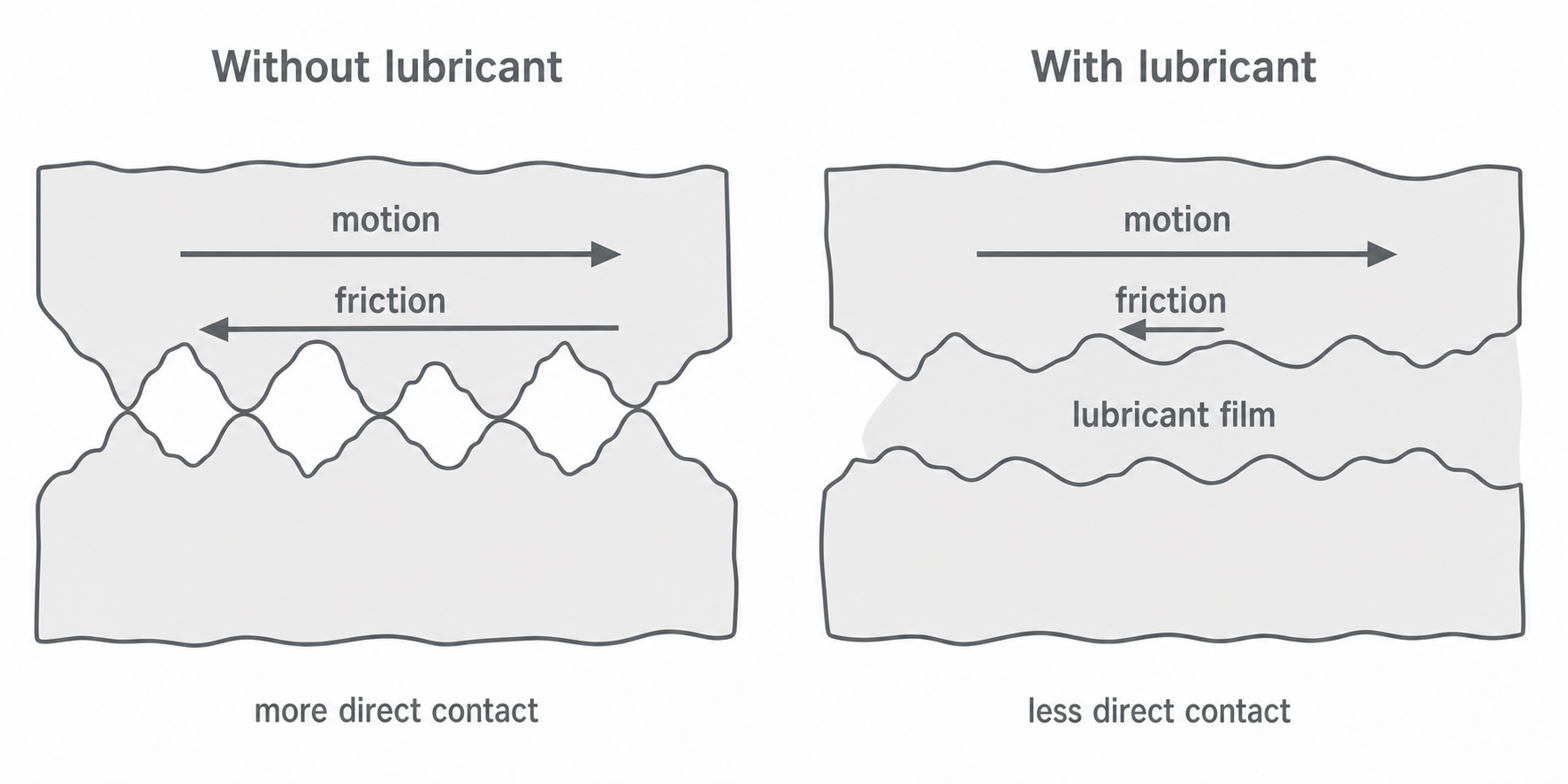
The roughness in the diagram is exaggerated so the contact can be seen. The friction arrows are also qualitative: the shorter arrow means a smaller force, not a measured value. Lubrication reduces friction; it does not normally make friction zero because the lubricant resists being sheared and some direct contact may remain.
From smaller friction to less heating
The explanation is a connected chain:
Continue this lesson.
You’re previewing NovaLearn without an account. Create a free account to read the rest.
Create free account