Physics 8.10 - 8.15 - Dissipation, power and efficiency
Real machines transfer energy at different rates and put different fractions of their input into useful work. Track the energy that becomes less useful, then use power and efficiency to compare performance quantitatively.
Energy dissipation
Pearson supplies an equation sheet for the 2025–2027 GCSE Combined Science Physics exams. Practise selecting equations, understanding their quantities, converting units and rearranging them. The independent calculations here include the equation support they need.
Dissipation means energy spreading into less useful stores, usually thermal stores of objects and their surroundings. An electric drill transfers energy electrically; as the bit starts to rotate, its kinetic store increases. Some supplied energy also warms the drill and air. Once the bit runs steadily, useful work on the material can continue without a further increase in the bit's kinetic store.
Dissipated energy has not vanished. Total energy is conserved, but energy spread through the surroundings is difficult to recover for the intended job. All real system changes involve some dissipation. What counts as useful depends on purpose: warming a room is useful for a heater, whereas warming a motor's casing is usually unwanted.
[DIAGRAM: asset_name: Physics 8.10-8.15 - Dissipation, power and efficiency - diagram 01; asset_slug: physics_8_10_8_15_dissipation_power_and_efficiency__diagram_01; recommended_method: image_gen; description: Landscape monochrome energy-flow model of an electric drill: one arrow labelled Electrical energy supplied enters the drill; one arrow labelled Useful kinetic energy leaves along the rotating bit; one branch labelled Energy dissipated by heating the drill and surroundings leaves down-right; a conservation statement appears underneath; no numerical proportions or extra pathways.]
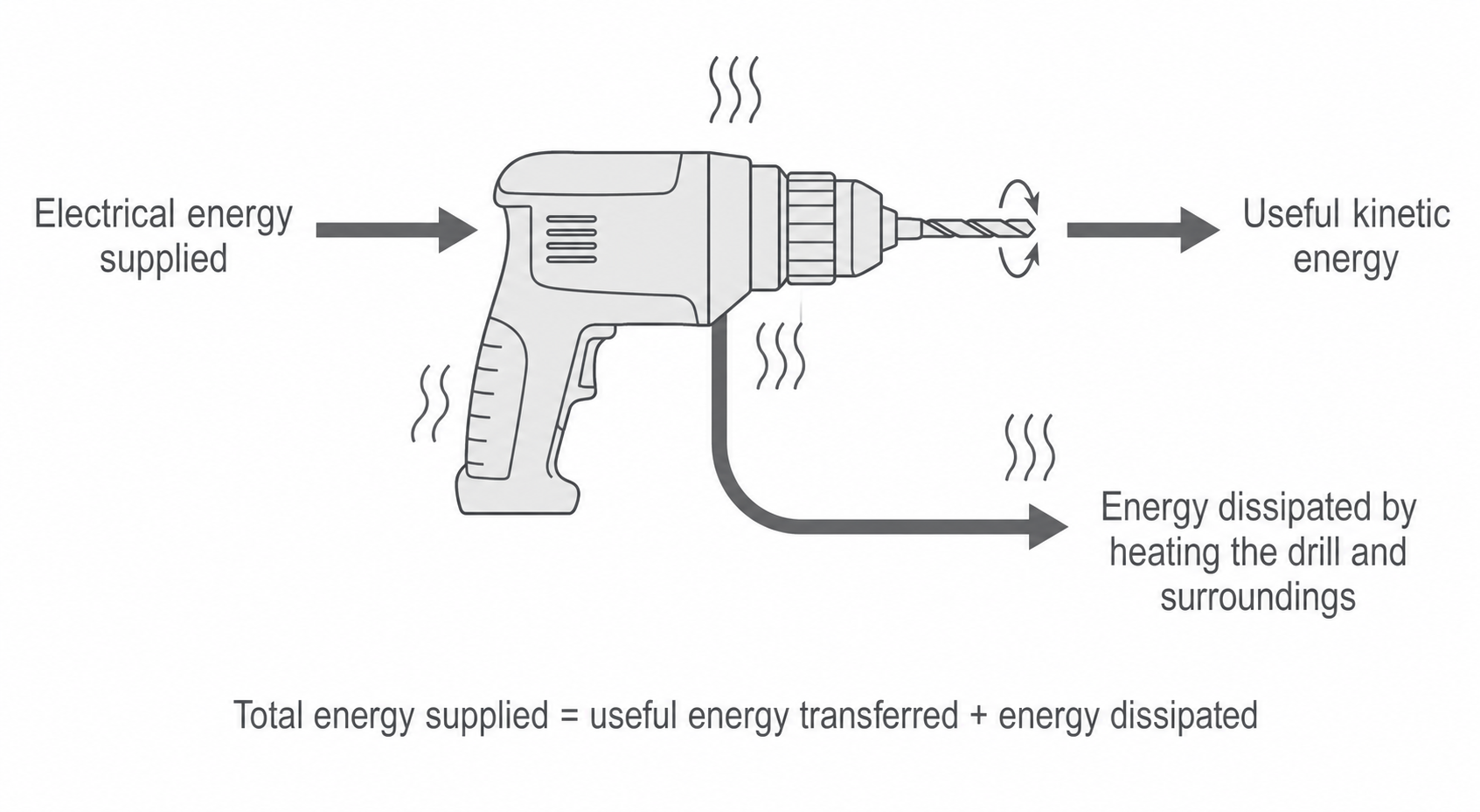
The arrows identify pathways, not numerical proportions. For the drill's starting interval, the useful increase can be kinetic energy; during steady drilling, the useful output is work on the material.
Wasteful mechanical processes
Moving parts rub against bearings, bend, or move through air. Work against friction increases the internal energy of the parts; their temperature rises, and energy is then transferred by heating to the cooler surroundings. A greater share dissipated this way leaves less of a fixed input available for the intended mechanical output.
Brakes transfer energy from the bicycle's kinetic store to internal energy stores of the pads and wheel. Stopping is useful, but the energy dispersed afterwards cannot easily be returned to propel the bicycle. In a motor bearing, the same warming is an unwanted consequence of maintaining rotation.
Power and the watt
Power is the rate at which energy is transferred: how much energy is transferred each second. It does not describe a store or the total amount of energy.
Power
Here is power in watts (W), is work done or energy transferred in joules (J), and is time in seconds (s).
Continue this lesson.
You’re previewing NovaLearn without an account. Create a free account to read the rest.
Create free account