Physics 14.11 - Water heating and melting practical
Measure the energy needed to warm water and record how temperature changes as ice melts. Use a joulemeter, mass and temperature readings to determine specific heat capacity, then use a Bunsen-heated water bath to obtain a melting graph.
Core practical: specific heat capacity of water
The purpose is to determine the specific heat capacity of water from the mass of water, the energy supplied and the resulting temperature rise.
[DIAGRAM: asset_name: Physics 14.5-14.11 - Heating, specific heat and latent heat - diagram 01; asset_slug: physics_14_5_14_11_heating_specific_heat_and_latent_heat__diagram_01; recommended_method: image_gen; description: Two-panel monochrome apparatus diagram. Left: thermometer in crushed ice heated indirectly in a beaker water bath over a Bunsen burner on a heatproof mat. Right: thermometer, stirrer and submerged immersion heater in an insulated container of water, with an above-water two-core connection order from low-voltage supply through joulemeter to heater. The tube is indirectly heated and all electrical connections are above water; no equations appear in the diagram.]
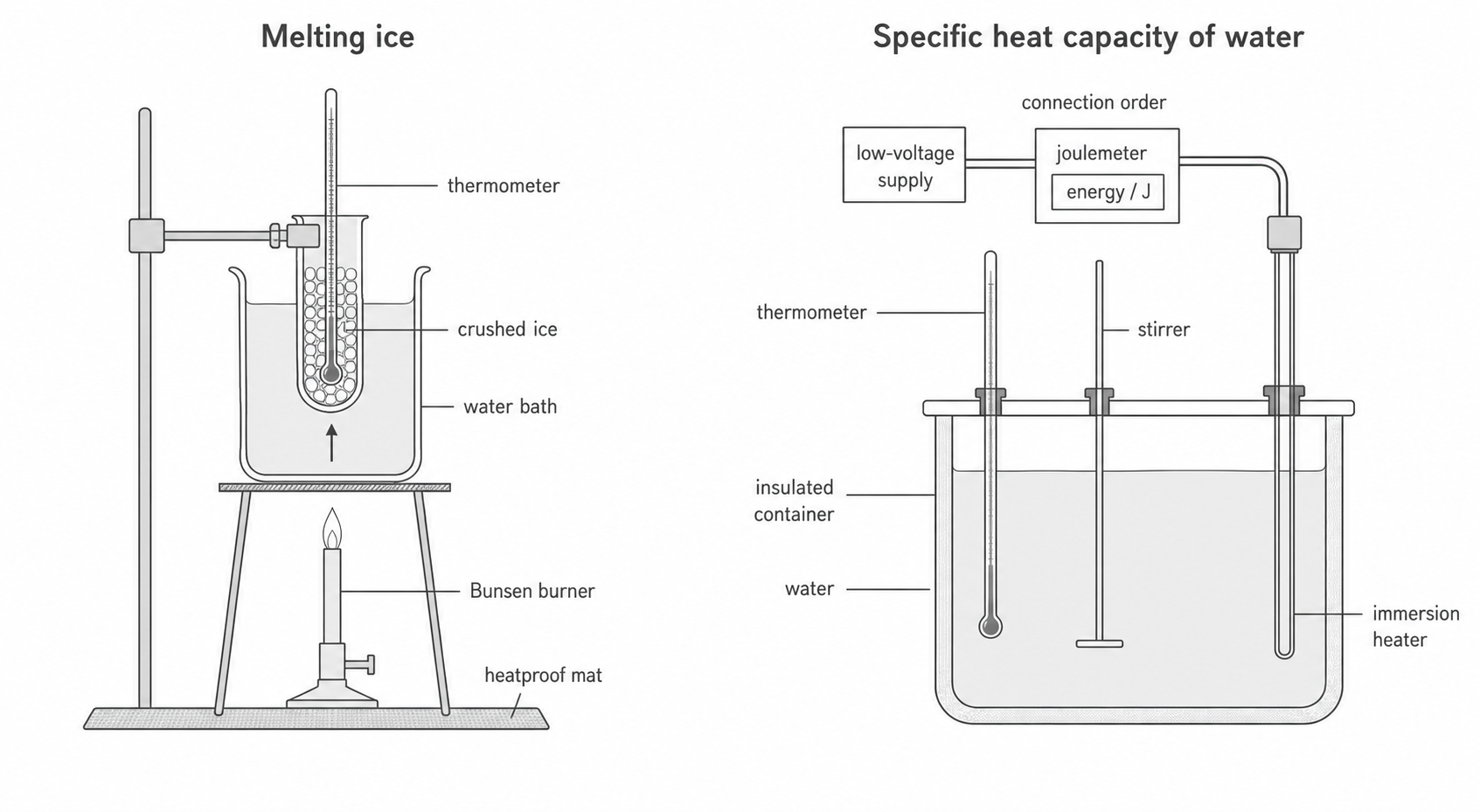
Apparatus and variables
Use a balance, insulated container with lid, water, thermometer or temperature probe, low-voltage immersion heater, low-voltage supply, joulemeter and stirrer. A stopwatch is useful for regular readings.
- Independent progression: energy transferred to the heater, or elapsed time while the heater runs steadily.
- Dependent variable: water temperature in .
- Measured quantity needed for the result: mass of water in .
- Controls across repeats: mass of water, heater depth, container and insulation, stirring method, starting-temperature range, heating duration and thermometer position.
Method
- Find the mass of the empty, dry container. Add water and find the new mass. Subtract to obtain the mass of water, then convert grams to kilograms if needed.
- Fit the lid, thermometer, stirrer and immersion heater. The heater must be submerged but must not touch the container base. The thermometer should not touch the heater or container.
- Connect the low-voltage supply to the heater through the joulemeter. Keep all connectors above the water and dry.
- Stir gently, record the initial temperature, and zero the joulemeter.
- Switch on the heater. Stir continuously and gently so the measured temperature represents the whole water sample.
- Record temperature and joulemeter energy at regular intervals, such as every , for a fixed duration. A useful run should produce a clear temperature rise without approaching boiling.
- Switch off the supply before removing or touching the heater. Record the final well-mixed temperature and its corresponding joulemeter reading and calculate the temperature rise as final minus initial.
- Repeat the complete determination with fresh water of the same mass and a similar starting temperature. Compare the results, investigate anomalies and take the mean of valid repeat values.
The three essential measurements are therefore energy supplied in joules, mass of water in kilograms, and temperature rise in degrees Celsius. They are the evidence used to determine specific heat capacity. All students use these readings to calculate specific heat capacity.
Calculating specific heat capacity
Specific heat capacity is the energy needed to raise the temperature of one kilogram by one degree Celsius. The water stays liquid, so use . For each run, calculate:
For example, suppose of water receives and its temperature rises from to .
- Convert energy: .
- Temperature rise: .
- Substitute: .
- Suitable presentation: .
For a series of readings, plot temperature rise against energy supplied. The gradient is , so . A line fitted across several readings reduces the influence of any one random reading error.
This is higher than the reference value of about . The calculation treats all joulemeter energy as though the water gained it, but some energy heats the container and heater or transfers to the surroundings. This tends to make the calculated value too high.
Safety and evaluation
- Water, the heater and the container can become hot. Use a modest temperature rise, place the apparatus securely, switch off before handling and allow it to cool.
- Use a purpose-made low-voltage immersion heater. Keep plugs and connections dry; never use an improvised mains connection.
- A lid and insulation reduce energy transfer to the surroundings. A low-heat-capacity container reduces the energy diverted into the container itself.
- Stirring reduces temperature gradients. Positioning the thermometer away from the heater prevents a local hot spot from giving an unrepresentative reading.
- More closely spaced paired temperature and energy readings reveal instability. If the reading continues rising after switch-off because the heater is still hot, record the highest well-mixed temperature with the final energy supplied and note the thermal lag. Repeats test reliability; they do not remove a systematic energy-loss error.
Continue this lesson.
You’re previewing NovaLearn without an account. Create a free account to read the rest.
Create free account