Chemistry 3.21 - Preparing an insoluble salt
Prepare a pure, dry precipitate by mixing suitable solutions, filtering, washing and drying. Distinguish a high measured mass from good purity and recovery.
Preparing a pure, dry insoluble salt
The purpose is to make a pure, dry sample of magnesium carbonate. This is a suggested preparation that teaches Chemistry 3.21; it is not one of the qualification's mandatory core practicals.
Selecting substances and apparatus
Choose magnesium sulfate solution as a soluble source of ions and sodium carbonate solution as a soluble source of ions. Magnesium sulfate is soluble because magnesium is not a sulfate exception; sodium carbonate is soluble because all sodium salts are soluble.
Use the two solutions, a measuring cylinder or pipette, a beaker, a glass stirring rod, a filter funnel and filter paper, a conical flask, a wash bottle of distilled or deionised water, a spatula, dry filter paper or a watch glass, and eye protection.
Reproducible method
- Measure suitable volumes of magnesium sulfate solution and sodium carbonate solution into a beaker. Equal volumes of solutions with equal concentrations in moles per unit volume supply equal amounts of and , matching their 1:1 ratio in the formula .
- Stir thoroughly so that the ions mix. A suspension of solid magnesium carbonate forms.
- Place folded filter paper in a filter funnel over a conical flask. Pour the mixture through it, keeping the liquid below the top edge of the paper.
- The magnesium carbonate precipitate is the residue on the paper. The liquid passing through is the filtrate and contains soluble sodium and sulfate ions, plus any excess soluble reactant.
- Rinse the beaker with a small amount of distilled or deionised water to transfer remaining solid to the filter. Wash the residue with several small portions of the same water, allowing each portion to drain through.
- Leave the final washings to drain. Transfer the residue carefully to a clean watch glass and dry it in a warm place, or press it between dry filter papers. If mass is being measured, dry, cool and reweigh until two successive masses are the same: constant mass is evidence that water is no longer changing the result.
Washing improves purity because soluble sodium sulfate and excess soluble reactant dissolve in the wash water and pass through the filter. Drying removes water; it does not remove dissolved contamination, which is why washing must come first. Evaporating the filtrate would recover soluble substances, not the wanted insoluble precipitate.
[DIAGRAM: asset_name: Chemistry 3.21 - Preparing an insoluble salt; asset_slug: che_d_precipitation_method; recommended_method: image_gen; description: The diagram shows a second valid preparation: calcium nitrate solution and sodium carbonate solution form insoluble calcium carbonate. The same filter–wash–dry sequence applies to magnesium carbonate. The filtrate is water containing dissolved soluble salts; the wanted solid remains as the residue.]
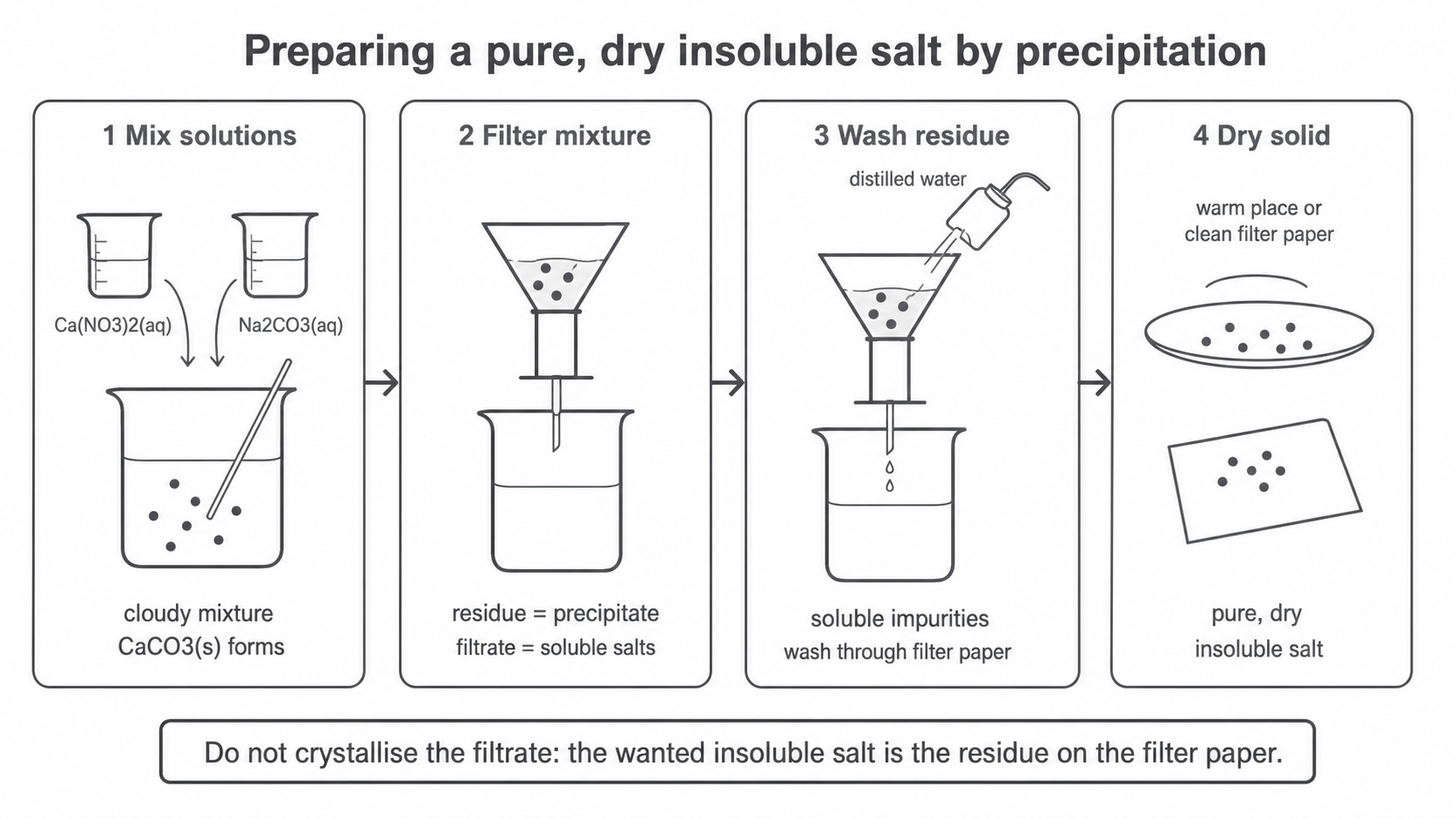
The diagram shows a second valid preparation: calcium nitrate solution and sodium carbonate solution form insoluble calcium carbonate. The same filter–wash–dry sequence applies to magnesium carbonate. The filtrate is water containing dissolved soluble salts; the wanted solid remains as the residue.
Practical quality and evaluation
Variables, repeats and processing
This procedure is a preparation, not automatically a fair-test investigation, so it has no inherent independent and dependent variables. If it is turned into an investigation of how magnesium sulfate concentration affects product mass, use:
Continue this lesson.
You’re previewing NovaLearn without an account. Create a free account to read the rest.
Create free account