Chemistry 6.14-6.16 - Noble gases
Full outer electron shells explain why noble gases react so little. Link their properties to balloons, lamps and protective atmospheres, then use boiling-point and density data to make justified predictions.
Full outer shells and chemical inertness
Group 0 is the far-right column of the periodic table. Its elements include helium, neon, argon, krypton, xenon and radon. They are called the noble gases.
Chemically inert
A chemically inert substance is very unlikely to take part in chemical reactions under ordinary conditions. For noble gases, inert means much less reactive than most other elements; it does not mean that a reaction is impossible in every imaginable condition.
Chemical reactions usually involve the electrons in an atom's outer occupied shell. Atoms with incomplete outer shells may react by losing, gaining or sharing electrons. Noble-gas atoms already have full outer shells, so they have little tendency to lose, gain or share electrons and are therefore chemically inert compared with other elements.
| Element | Electronic configuration | Why the outer shell is full |
|---|---|---|
| Helium | 2 | The first shell is full with 2 electrons |
| Neon | The second shell is full with 8 electrons | |
| Argon | The third shell is full with 8 electrons |
Helium is the important exception to the careless rule that every noble gas has eight outer electrons. It has only one occupied shell, and that first shell is complete with two electrons. A full shell is what matters.
[DIAGRAM: asset_name: Chemistry 6.14-6.16 - Noble gases and inertness - diagram 01; asset_slug: chemistry_6_14_6_16_noble_gases_and_inertness__diagram_01; recommended_method: image_gen; description: A clean monochrome three-panel electron-shell model headed exactly Helium 2, Neon 2.8 and Argon 2.8.8. Show a small labelled nucleus and respectively one, two and three concentric occupied-shell rings. Place exactly 2 filled electron dots on helium's first and outer shell; exactly 2 dots on neon's first shell and 8 on its second and outer shell; exactly 2 dots on argon's first shell, 8 on its second shell and 8 on its third and outer shell. Make each outermost ring slightly heavier and place the exact caption full outer shell beneath each panel. Use #6A6B6E linework, labels and electron dots on white. Exclude bonds, ions, arrows, orbital notation, extra or decorative dots, colour-dependent meaning, gradients and frames.]
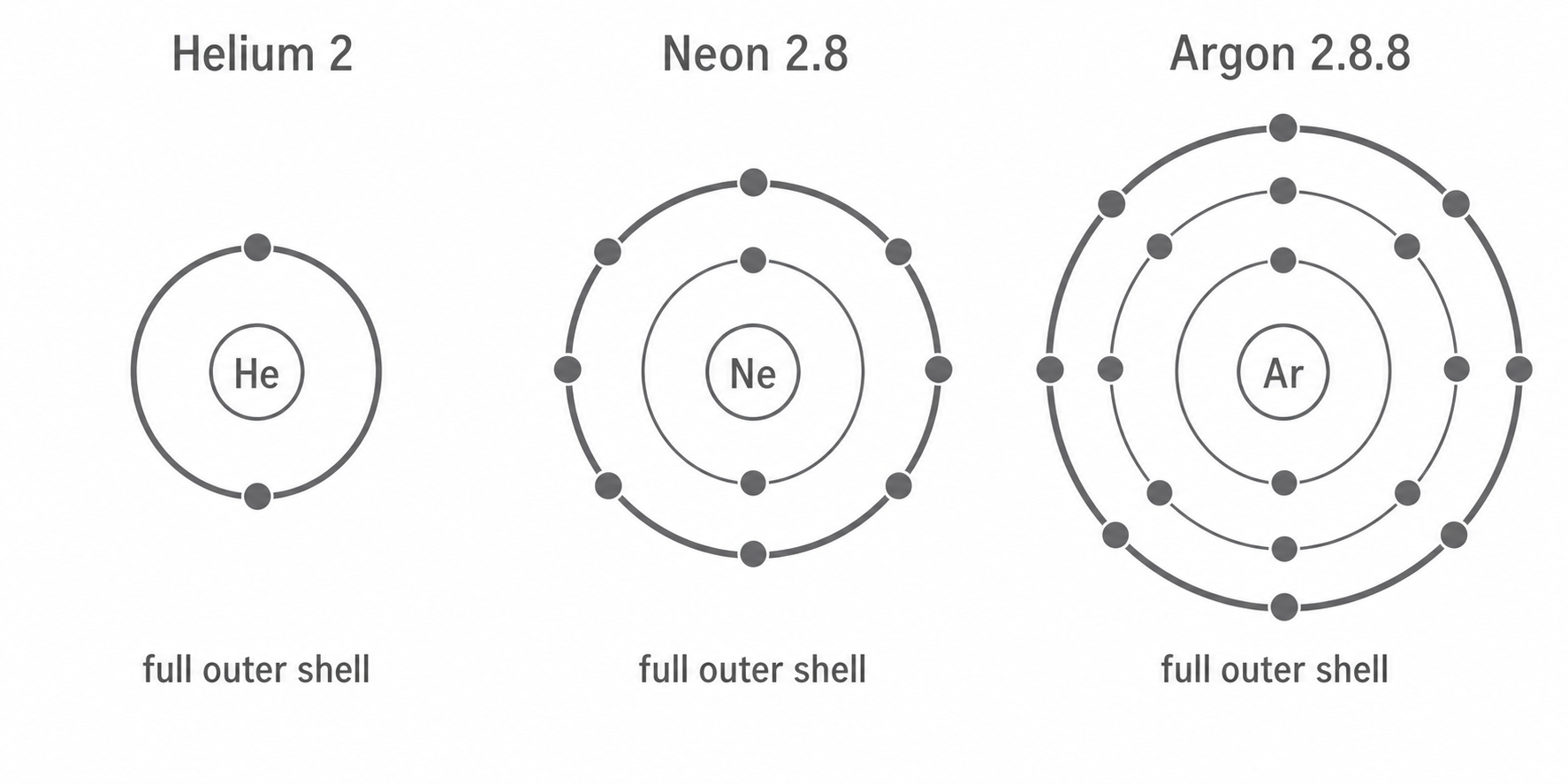
At the macroscopic level, a noble gas shows little or no visible chemical change when many other substances would react. At the particle level, each atom keeps its already complete outer shell rather than readily transferring or sharing electrons. The configurations 2, and are the symbolic evidence used by the GCSE model.
This lesson has no Higher-only content: Chemistry 6.14-6.16 is common to both Foundation and Higher tier on Combined Science Chemistry 2 (1SC0/2CF or 1SC0/2CH).
Properties select the use
A useful explanation does more than name a gas and a job. It links a property of the gas to what that job requires:
property → useful consequence → use
| Noble gas and use | Relevant property | Why the property matters |
|---|---|---|
| Helium in weather balloons and airships | Low density | Helium is less dense than air, so a sufficiently light helium-filled balloon has a lower average density than the surrounding air and can rise |
| Helium in balloons and airships | Non-flammable | Helium does not burn in oxygen, reducing the fire risk compared with a flammable lifting gas |
| Argon around a hot lamp filament | Chemical inertness | Argon does not readily react with the hot filament, so the filament is protected from oxygen and lasts longer |
| Argon shielding a weld | Chemical inertness | Argon forms a protective atmosphere that keeps oxygen away from the hot metal, reducing oxidation |
Chemical inertness and non-flammability are related but not identical. Inertness describes very low chemical reactivity in general; non-flammability specifically means that the substance does not burn in oxygen. Low density is a separate physical property and does not mean that helium has no mass.
Neon in a sealed discharge tube provides another useful distinction. Neon remains stable because it is inert, but the reddish-orange light is produced when an electrical discharge excites the gas. Inertness is not itself the cause of the glow.
Continue this lesson.
You’re previewing NovaLearn without an account. Create a free account to read the rest.
Create free account