Physics 14.12-14.15 - Gas pressure and absolute zero
A gas pushes on its container through particle collisions. Explain why a fixed mass of gas changes pressure when warmed or cooled at constant volume, then use absolute zero to convert between Celsius and kelvin.
How moving particles produce pressure
A gas contains a very large number of particles. The particles are widely spaced and move continuously in random directions. Between collisions they travel through the container; when they reach a wall, they collide with it and change direction.
The system to picture is the gas inside its container. At a wall collision, the wall changes the particle's motion by exerting a force on it. The particle exerts a force back on the wall. One collision has a tiny effect, but an enormous number of collisions take place every second across the walls.
Gas pressure
Gas pressure is the total force exerted by gas particles on each unit area of a surface. It is produced by many particle collisions with that surface.
Pressure is therefore a large-scale property of the gas, not something stored inside one particle. Collisions between gas particles can redirect them, but it is their collisions with the container wall that exert the force on that wall.
All the content in this lesson is common to Foundation and Higher tier. The temperature-pressure relationship is required qualitatively: the particle explanation matters, but no gas-law pressure calculation belongs in this lesson.
How temperature changes pressure
To isolate the effect of temperature, two conditions must stay fixed:
- A fixed mass of gas means no gas enters or leaves, so the number of particles stays the same.
- Constant volume means the container is rigid, so its size and wall area stay the same.
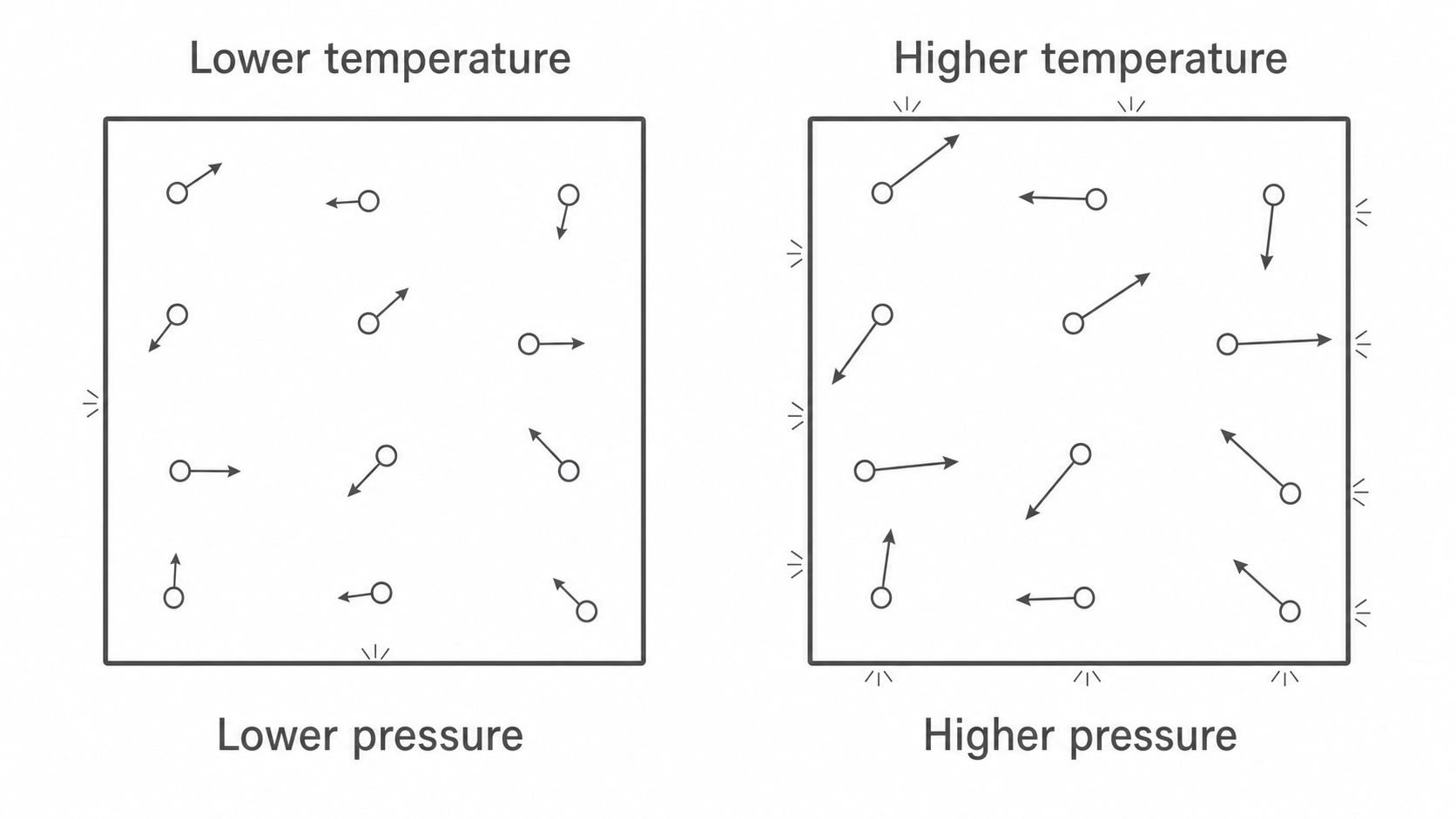
When energy is transferred to the gas by heating, its temperature rises. The particles gain kinetic energy, so their typical speed increases. In the specification this is described as an increase in the magnitude of their velocity.
Faster particles affect the walls in two linked ways. They travel from wall to wall in less time, so collisions with the walls happen more often. Each faster particle also has a greater change in momentum when it bounces, so each collision has a greater effect on the wall. The total force on the unchanged wall area increases, so the gas pressure increases.
Cooling reverses the chain: the particles move more slowly, wall collisions are less frequent and have less effect, the total force on the walls decreases, and the pressure decreases.
[DIAGRAM: asset_name: Physics 14.12-14.15 - Gas pressure and absolute zero - diagram 01; asset_slug: physics_14_12_14_15_gas_pressure_and_absolute_zero__diagram_01; recommended_method: image_gen; description: A monochrome two-panel particle-model comparison of the same fixed mass of gas in two identical rigid containers. Left panel labelled Lower temperature and lower pressure; right panel labelled Higher temperature and higher pressure. Both boxes contain exactly 12 identical small particles at the same positions and size. Short motion arrows in varied random directions appear beside particles on the left; visibly longer arrows in varied random directions appear beside corresponding particles on the right. Include small wall-impact indicators to show collisions, but no graph, formula, piston, changed volume, added particles, enlarged particles, colour coding or pressure-volume content.]
Continue this lesson.
You’re previewing NovaLearn without an account. Create a free account to read the rest.
Create free account