Physics 6.7 - 6.9 - Electron changes
An electron can change its allowed energy level or leave an atom altogether. Follow the energy transfer and count the remaining electrons to distinguish these changes.
Set electron orbits and radiation
In the model required here, electrons orbit the nucleus at different set distances. These allowed orbits correspond to set energy levels. An electron is not modelled as resting at any arbitrary distance between them, and the drawn rings are not solid shells.
Electromagnetic radiation connects the allowed orbits:
- When an electron absorbs electromagnetic radiation of a suitable energy, it moves from an inner orbit to an allowed orbit farther from the nucleus.
- When an electron moves from an outer orbit to an allowed orbit closer to the nucleus, it emits electromagnetic radiation.
Absorption therefore goes with an outward change in this model; emission goes with an inward change. The nucleus and the number of electrons do not change during either transition.
[DIAGRAM: asset_name: Physics 6.1-6.9 - Atomic and nuclear structure - diagram 01; asset_slug: physics_6_1_6_9_atomic_and_nuclear_structure__diagram_01; recommended_method: image_gen; description: Landscape monochrome two-row before-and-after model on white. Top row titled Absorption: the before atom has one small central nucleus, two concentric set-orbit rings and exactly one electron on the inner orbit; a right-pointing sequence arrow labelled electron moves out leads to an otherwise identical after atom with that one electron on the outer orbit, while a separate incoming right-pointing wavy arrow is labelled electromagnetic radiation absorbed. Bottom row titled Emission reverses the states: the before atom has exactly one electron on the outer orbit; a right-pointing sequence arrow labelled electron moves in leads to the after atom with that one electron on the inner orbit, followed by an outgoing right-pointing wavy arrow labelled electromagnetic radiation emitted. Directly label nucleus, inner orbit, outer orbit and electron once with short uncrossed leaders, and include the note one electron shown before and after. Use only white, #6A6B6E linework, labels and arrows, with visible arrowheads and generous whitespace. Exclude extra electrons, shell capacities, orbitals, photon-energy values, colour, gradients, decorative frames, radioactive emissions, electron paths between allowed orbits, changes to the nucleus and any inward absorption or outward emission transition.]
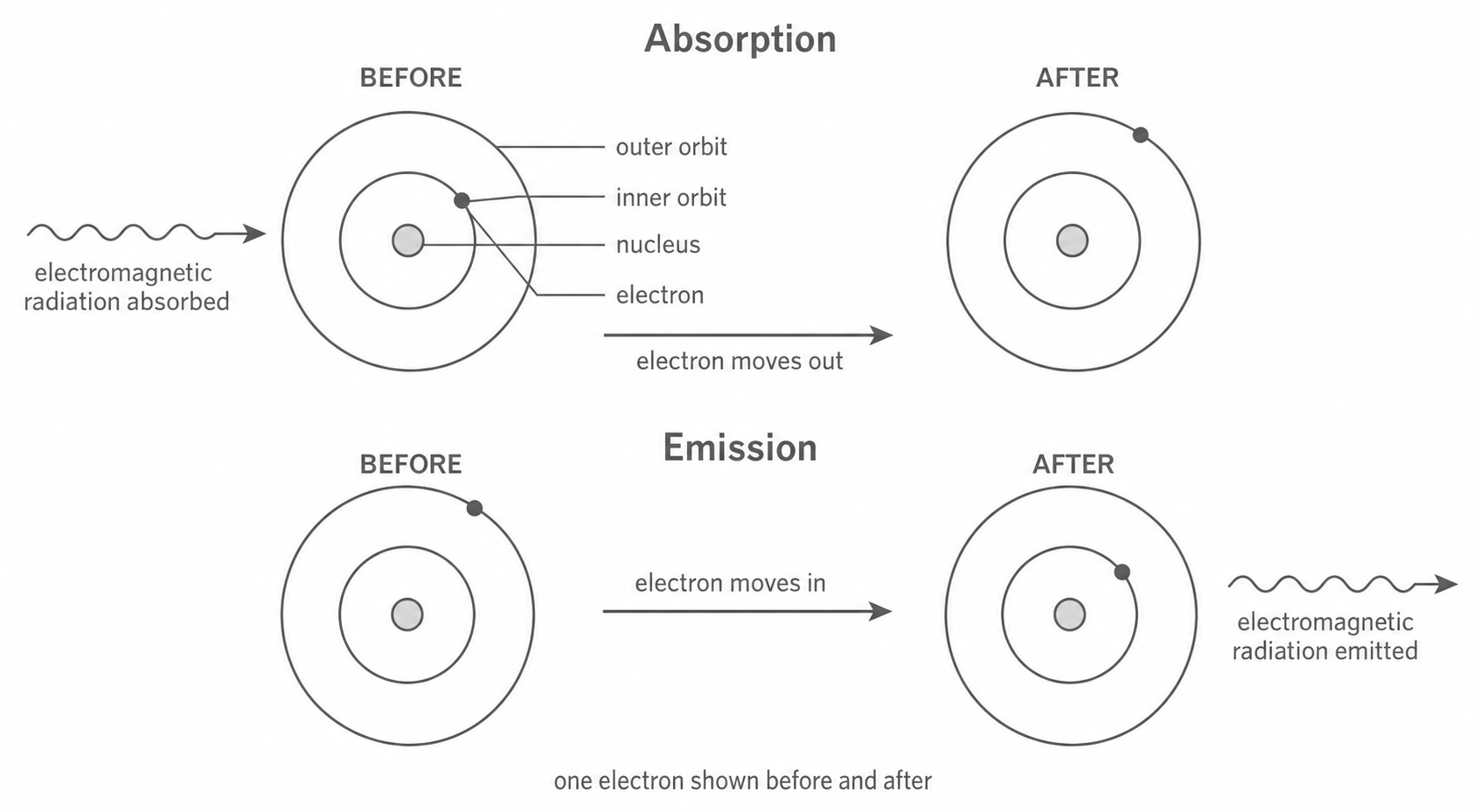
The diagram shows two times for one electron, not two electrons in one atom. Its sequence arrows indicate before and after; they do not claim that the electron travels along the drawn arrow as a visible object.
Continue this lesson.
You’re previewing NovaLearn without an account. Create a free account to read the rest.
Create free account