Chemistry 3.6 - Investigating pH change
Investigate how measured additions of calcium hydroxide or calcium oxide change the pH of a fixed volume of dilute hydrochloric acid. Plan repeatable measurements and use them to locate the neutral region.
Core practical: tracking pH
The purpose is to investigate how the pH changes as increasing measured masses of powdered calcium hydroxide or calcium oxide are added to a fixed volume of dilute hydrochloric acid. Use one named solid throughout a run; the method below uses calcium hydroxide.
Apparatus and arrangement
Use dilute hydrochloric acid, powdered calcium hydroxide, a beaker, measuring cylinder, balance, weighing boat, spatula, glass stirring rod, thermometer or temperature probe, and a calibrated pH probe connected to a meter. Use a water bath when needed to maintain the chosen mixture temperature. Universal indicator paper, a white tile and a pH colour chart offer a lower-resolution alternative to the probe.
The beaker leaves room to stir and immerse the probe without spilling. A balance measures the solid actually added; a spatula transfers powder but is not itself a mass-measuring instrument. The acid volume is measured so it can be held constant between runs.
[DIAGRAM: asset_name: Chemistry 3.1-3.8 - Acids, alkalis, pH and neutralisation practical - diagram 01; asset_slug: chemistry_3_1_3_8_acids_alkalis_ph_and_neutralisation_practical__diagram_01; recommended_method: image_gen; description: Monochrome practical sequence showing a balance measuring powdered calcium hydroxide in a weighing boat, an arrow into a beaker containing a fixed volume of dilute hydrochloric acid, a glass rod stirring the mixture, and a correctly immersed pH probe connected to a numerical meter; labels must distinguish cumulative mass added from pH measured and exclude equations, colour coding, flames, and titration apparatus.]
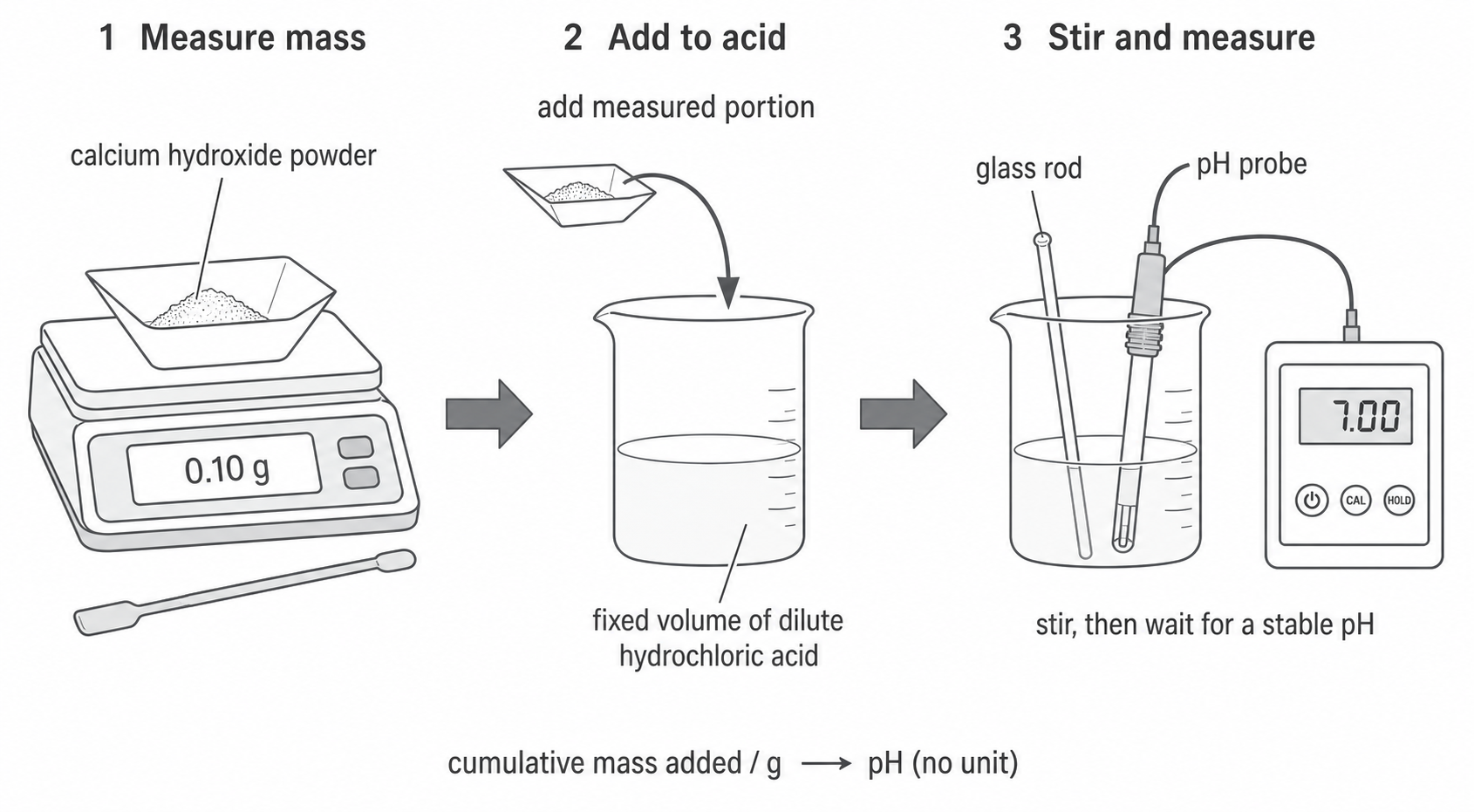
Variables
- Independent variable: cumulative mass of calcium hydroxide added, in grams ().
- Dependent variable: pH of the mixture, which has no unit.
| Controlled variable | How it is held constant |
|---|---|
| volume of hydrochloric acid | measure for every run using the same measuring cylinder |
| concentration of hydrochloric acid | take every portion from the same stock solution |
| solid identity and particle size | use calcium hydroxide from the same powdered stock throughout |
| mixing and reading endpoint | stir for 30 seconds after every addition, then wait for a stable reading |
| temperature | start runs at the same measured temperature; monitor the mixture and use a water bath if needed to return it to the chosen temperature before each pH reading |
| pH instrument | use the same probe, calibrated before the runs |
Equal target mass intervals make the pattern easier to sample, but the actual measured cumulative mass belongs in the results table.
Reproducible method
- Put on splash-resistant eye protection. Measure of dilute hydrochloric acid into the beaker. Record the initial pH at a cumulative solid mass of .
- Tare the balance with an empty weighing boat, then measure a small teacher-specified portion of calcium hydroxide. Record the actual mass delivered, using the difference between the boat mass before and after transfer if powder remains. Transfer carefully without raising dust. Choose smaller portions near the rapid pH change so the neutral point is not skipped.
- Stir gently for the same time on every occasion, such as 30 seconds. Neutralisation can warm the mixture, so check its temperature with a thermometer or temperature probe. If temperature is being held constant, allow the mixture to return to the chosen temperature in a water bath before taking a stable pH reading. Being in the same room alone does not guarantee a constant mixture temperature.
- Add another measured portion. Add its actual mass to the running total, mix in the same way and record pH again.
- Continue through pH 7 until several readings are above 7 and further additions produce little pH change. This gives a range from acidic, through neutral, to alkaline conditions.
- Repeat the whole investigation at least twice more using fresh portions of the same hydrochloric acid and the same target cumulative masses. Do not call several readings from one changing mixture "repeats"; they are different values of the independent variable.
If universal indicator paper is used, place separate small pieces on a white tile. After each addition and mixing step, use a glass rod to transfer one small drop to a fresh piece, then compare its colour with the supplied pH chart. Never dip indicator paper into the reaction beaker because indicator could contaminate the mixture.
Continue this lesson.
You’re previewing NovaLearn without an account. Create a free account to read the rest.
Create free account