Physics 10.4 - 10.6 - Potential difference and energy
A voltage reading tells you the energy transferred by each coulomb of charge. Learn where to connect a voltmeter and use energy, charge and potential difference to calculate the missing quantity.
Measuring potential difference
Pearson supplies an equation sheet for the 2025–2027 GCSE Combined Science Physics exams. Practise selecting equations, understanding their quantities, converting units and rearranging them. The independent calculations here include the equation support they need.
Potential difference, often called voltage, is measured between two points. A voltmeter therefore needs one connection on each side of the component being measured.
The voltmeter is connected in parallel with the component. In the right-hand panel of the diagram, the voltmeter's separate branch begins on one side of the lamp and rejoins the circuit on the other side.
[DIAGRAM: asset_name: Physics 10.1-10.6 - Charge, circuit diagrams and potential difference - diagram 02; asset_slug: physics_10_1_10_6_charge_circuit_diagrams_and_potential_difference__diagram_02; recommended_method: image_gen; description: Three-panel NovaLearn monochrome circuit comparison on white. Panel A labelled Series: one cell and two lamp symbols in one complete unbranched loop, with no junctions. Panel B labelled Parallel: one cell and two lamp symbols on separate branches between the same two filled junctions. Panel C labelled Voltmeter across a lamp: one cell and one lamp in the main loop, with a voltmeter symbol V on a separate branch connected exactly to the two sides of that lamp. Preserve every wire connection and junction; no ammeter, current arrows, numerical readings, resistance rules or decorative marks.]
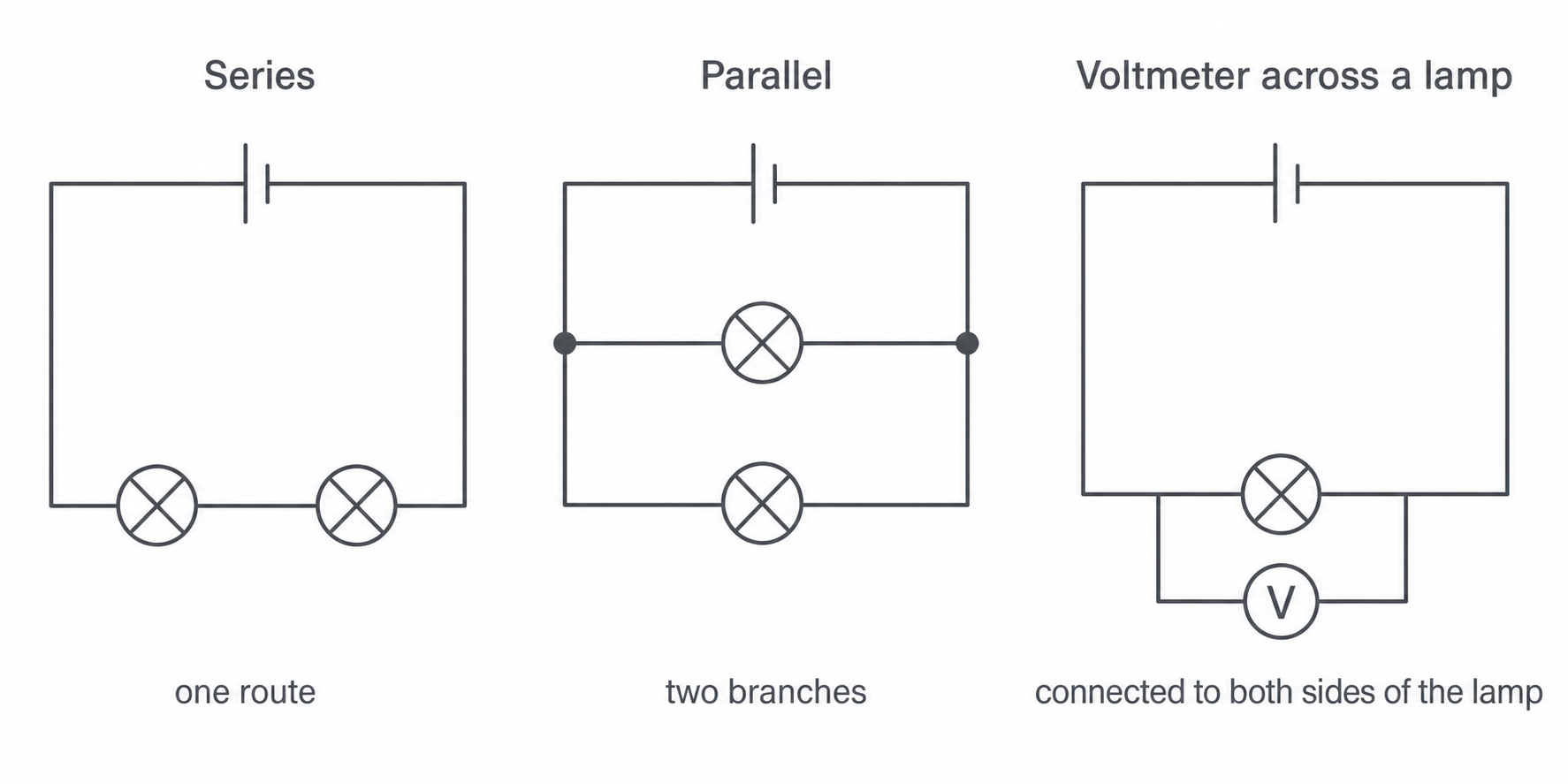
Putting the voltmeter into the single main route instead would not be the required connection.
The unit of potential difference is the volt, symbol . A statement such as “the potential difference across the lamp is ” names the component, the measured quantity and its unit.
Potential difference and energy
Potential difference tells us how much energy is transferred for each unit of charge that passes. Charge is measured in coulombs (C). Potential difference belongs across a chosen component or source, so the energy, charge and potential difference in a calculation must all refer to that same part of the circuit.
Continue this lesson.
You’re previewing NovaLearn without an account. Create a free account to read the rest.
Create free account