Physics 2.1 - 2.5 - Scalars, vectors and velocity
Distinguish quantities that need only a magnitude from those that also need a direction. Compare distance with displacement and speed with velocity, then classify the named physical quantities.
What makes a physical description complete?
A physical quantity describes something that can be measured or determined, such as mass, energy or velocity. Its magnitude is its size. For a quantity with a unit, the magnitude is communicated by a numerical value and that unit: , and are examples.
Some quantities are completely described by magnitude. Others are not complete until a specific direction is added.
Scalar quantity
A scalar quantity has magnitude (size) but no specific direction.
Vector quantity
A vector quantity has both magnitude (size) and a specific direction.
The difference is about whether direction is part of the quantity itself. A car's mass does not become a vector because the car happens to be travelling north. The mass is still completely described by a value such as . By contrast, does not completely specify a velocity: and are different velocities.
A vector can be represented by an arrow. This arrow is a model, not the object's path or a physical trail:
- the arrow's length can represent the vector's magnitude when a consistent scale is used;
- the arrowhead shows the vector's direction;
- the arrow should be associated with the object or change being described.
Distance and displacement describe different journeys
Distance is the total length of the path travelled. It has magnitude but no required direction, so distance is a scalar.
Displacement describes the straight-line change in position from the starting point to the finishing point, including the direction from start to finish. It has magnitude and direction, so displacement is a vector. Displacement is not the route taken.
Worked comparison
A trolley moves and then .
- Distance: include every section of the path: .
- Displacement: compare only the final position with the starting position. The trolley finishes of its start, so its displacement is .
- Sense-check: the distance records all movement, whereas the displacement records the overall change in position. The displacement magnitude is sensibly no greater than the path length in this journey.
If an object returns to its starting point, its displacement is zero even though it may have travelled a non-zero distance. This does not make displacement a scalar; zero displacement is a special vector value for no overall change in position.
Velocity is speed in a stated direction
Speed tells us how fast an object is moving. It is a scalar because direction is not part of a speed. A statement such as can therefore be a complete speed.
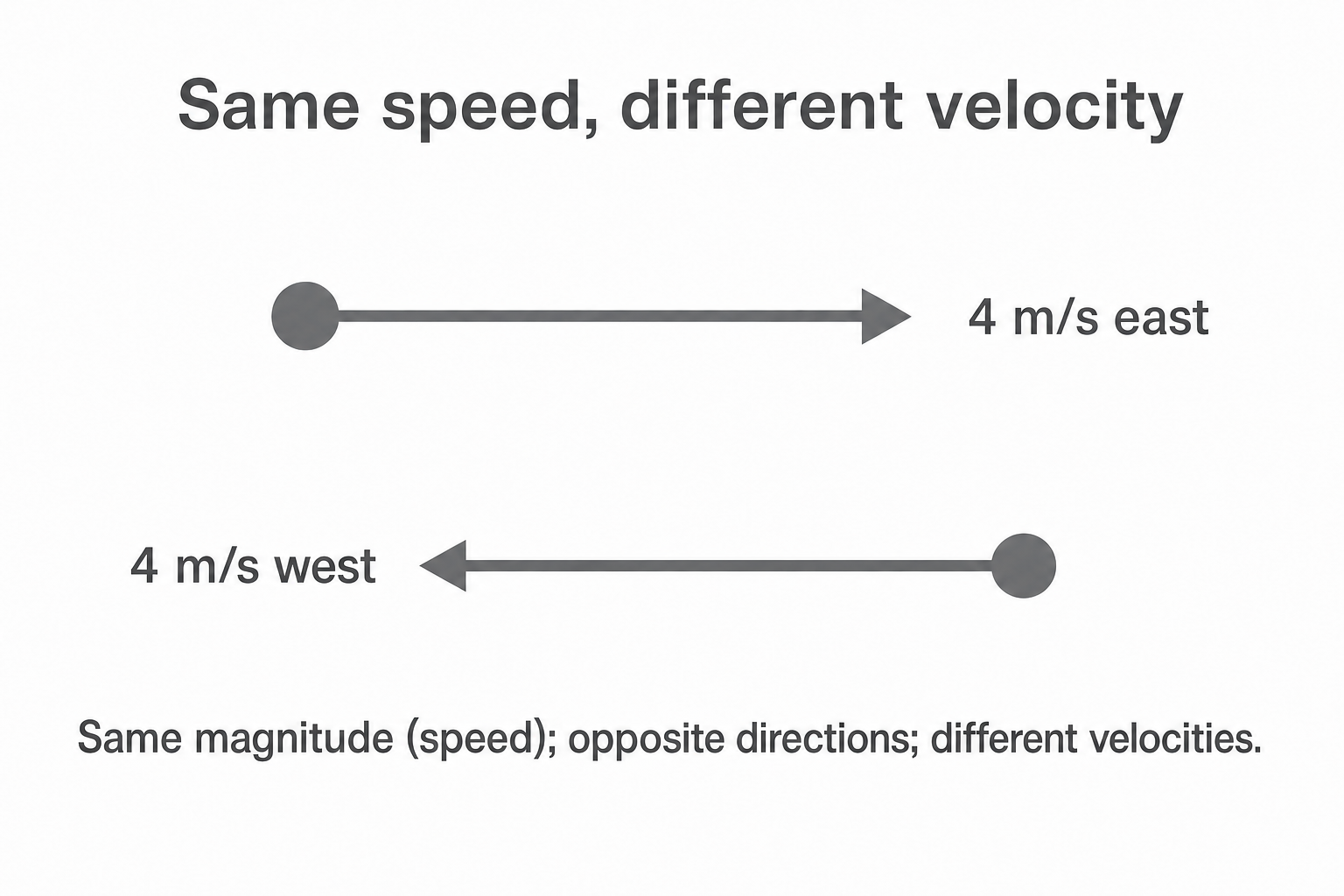
Velocity is speed in a stated direction. It is a vector, so alone is an incomplete velocity. Examples of complete velocities are , or .
[DIAGRAM: asset_name: Physics 2.1-2.5 - Scalars, vectors and velocity - diagram 01; asset_slug: physics_2_1_2_5_scalars_vectors_and_velocity__diagram_01; recommended_method: image_gen; description: A white and #6A6B6E monochrome two-row vector model titled 'Same speed, different velocity': exactly two equal-length horizontal arrows begin at identical object markers; the upper arrow points right and is labelled ' east', the lower arrow points left and is labelled ' west'; a caption states that equal magnitude means the same speed but opposite directions mean different velocities. No axes, compass, resultant, vector addition, path, graph or speed equation.]
Continue this lesson.
You’re previewing NovaLearn without an account. Create a free account to read the rest.
Create free account